









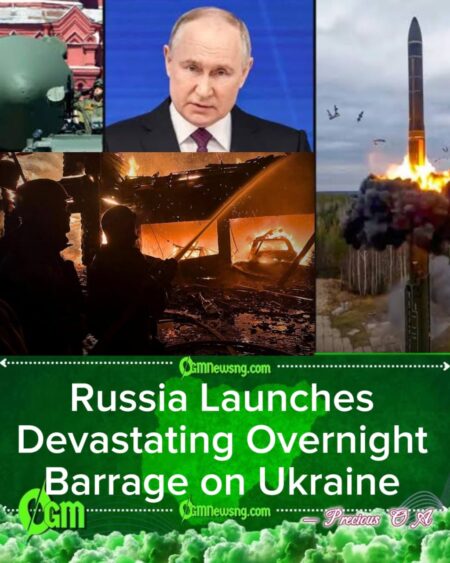
Russia launched a new and extensive barrage of missile and drone strikes across multiple regions of Ukraine, unleashing a coordinated overnight assault that plunged numerous cities into darkness and heightened fears of an escalating winter offensive. The scale, timing, and synchrony of these strikes underscored a meticulously constructed and deliberately sustained strategy designed to degrade national resilience, overwhelm emergency responses, and test the limits of Ukraine’s already strained energy grid. As waves of explosions rippled across the country, officials described the assault as one of the most methodically layered attacks seen in recent months.
Russia continued its bombardment with a sweeping mix of ballistic missiles, cruise weapons, and loitering munitions deployed in successive formations, each calibrated to exploit vulnerabilities in air-defense cycles and strain intercept capabilities stretched thin across dispersed fronts. The intensity of the onslaught created significant pressure on local authorities who struggled to keep critical infrastructure functioning under relentless aerial threats. Rescue teams raced between impact sites as fires broke out near transformer stations, sending plumes of smoke across dense urban skylines.
Russia targeted substations, transmission hubs, and thermal power plants with striking precision, demonstrating both technological adaptation and strategic intent to disrupt essential civilian services during winter months when electricity and heat become indispensable for survival and social stability. Engineers working overnight described the damage as “layered and deliberate,” making immediate restoration extraordinarily difficult.
IMPACT ON CIVILIAN INFRASTRUCTURE
Russia triggered widespread blackouts that left millions without power, forcing communities to rely on backup generators, improvised heating sources, and emergency shelters during freezing temperatures that continued to plunge as night progressed. Residents across affected regions described sudden darkness engulfing entire neighborhoods, followed by hours of uncertainty as local technicians attempted to assess damage under dangerous conditions littered with unexploded remnants.
Russia inflicted severe damage on several industrial zones and energy corridors, compounding the challenges faced by Ukrainian engineers who have spent months reinforcing vulnerable infrastructure against repeated bombardment. These strikes eroded key redundancies that had previously enabled quicker restoration of services after earlier attacks, leaving repair crews with an increasingly fragile system that struggles to absorb repeated high-impact shocks.
Russia’s strikes also disrupted water pumping stations, hospitals, and transportation networks, requiring rapid deployment of mobile medical units and crisis-management teams. Despite attempts to reroute power where possible, authorities warned that rolling blackouts could persist for days due to the extent of the damage and the limited availability of replacement equipment for heavily damaged nodes.
MILITARY RESPONSES AND AIR DEFENSE
Russia launched its offensive using complex flight paths and decoy drones intended to saturate Ukrainian radar systems and force defenders to expend valuable interceptors. The layered nature of the assault required Ukrainian forces to prioritize immediate threats while simultaneously tracking additional waves approaching from multiple directions, creating an extraordinarily demanding tactical environment.
Ukraine’s air-defense units responded with extensive aerial interception efforts, firing a mix of domestically produced systems and Western-supplied platforms to blunt the impact of the attack. The defense command reported numerous successful shoot-downs but acknowledged that no air-defense network can guarantee full protection against such high-volume barrages, particularly when executed in coordinated waves designed to exhaust ammunition stockpiles.
Military analysts observed that the Russian strikes appeared timed to probe Ukraine’s ammunition reserves, assess response times, and identify weaknesses that could be exploited in future large-scale offensives. Ukrainian officials reiterated the urgent need for sustained international support to maintain operational readiness, noting that repeated mass-strike nights are consuming defensive resources at a rapid pace.
HUMANITARIAN CONSEQUENCES
Emergency workers, humanitarian agencies, and volunteer groups mobilized rapidly to assist families displaced by outages, delivering blankets, power banks, portable heaters, and essential food supplies to communities cut off from basic services. Shelters across major cities reported surges in overnight occupancy as temperatures continued to fall and electricity remained unavailable for extended periods.
Local hospitals operated on backup generators, rationing fuel and redirecting non-critical patients in order to preserve power for life-support systems, emergency surgeries, and neonatal units. Medical teams emphasized that prolonged outages could jeopardize already fragile healthcare networks that have endured months of strain, particularly in frontline regions where resources are continuously stretched.
Parents sought safe locations for children, with many schools suspending in-person classes and transitioning temporarily to remote learning despite connectivity challenges caused by weakened networks. Aid groups warned that repeated outages may exacerbate mental-health stressors, particularly among elderly populations and families with young children struggling to maintain warmth and communication.
INTERNATIONAL REACTIONS
Foreign governments condemned the renewed wave of strikes, characterizing them as deliberate attempts to inflict civilian suffering and undermine Ukraine’s infrastructure during the harshest period of the year. Diplomatic channels buzzed with calls for urgent consultations on strengthening defensive cooperation and accelerating delivery of pledged support systems.
Security alliances reaffirmed commitments to bolster air defenses, increase energy-infrastructure assistance, and coordinate intelligence sharing aimed at mitigating the impact of future large-scale attacks. Discussions intensified around long-term strategies for grid resilience, decentralization, and the creation of rapid-repair brigades capable of responding to wide-area damage patterns.
International observers emphasized that recurring strikes on energy networks represent not only tactical actions but also a broader geopolitical strategy intended to weaken resolve, destabilize governance, and pressure Ukraine’s international partners into negotiation fatigue. Several analysts noted that sustained energy-targeting assaults risk spilling humanitarian and economic consequences beyond Ukraine’s borders.
STRATEGIC IMPLICATIONS FOR THE REGION
Russia’s escalating campaign signaled an intent to maintain pressure through the winter season, leveraging environmental hardship to shape battlefield and diplomatic outcomes. Analysts noted that the timing aligns with seasonal constraints that complicate ground operations and increase dependence on secure energy supplies, making electrical infrastructure an increasingly attractive strategic target.
The ongoing strikes further complicated diplomatic pathways, as regional partners weighed the risks of broader instability spilling into neighboring countries with interconnected power systems and critical transit routes. The cumulative effects of repeated infrastructure attacks raised significant concerns about long-term regional energy security, especially for states reliant on shared grids.
Russia’s latest offensive demonstrated a willingness to pursue prolonged attrition tactics, combining military strikes with psychological pressure designed to erode economic stability and public morale. Officials warned that future operations could become even more aggressive if international support for Ukraine shows signs of wavering, making upcoming months pivotal for both strategic endurance and wartime diplomacy.
Table of Contents
Discover more from OGM News NG
Subscribe to get the latest posts sent to your email.