







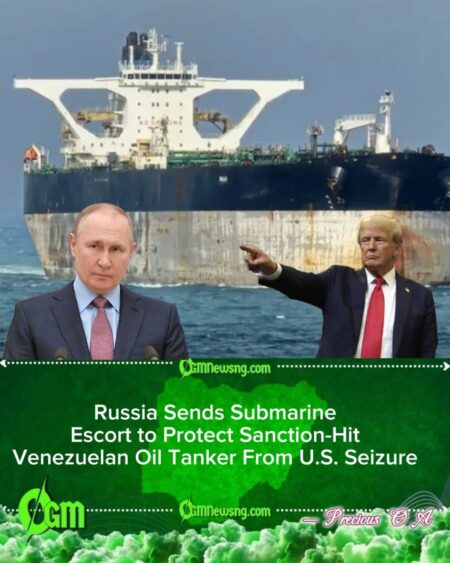
Russia moved first, quietly but decisively, when intelligence confirmed that U.S. authorities were preparing to seize an oil tanker that had recently departed Venezuelan waters under heavy scrutiny. The tanker, suspected of violating American sanctions against Caracas, became the focal point of a growing geopolitical standoff as Moscow signaled that it would not allow what it views as unlawful interference with allied commercial shipping.
American officials had been tracking the vessel for several days, citing concerns that its cargo and ownership structure could be linked to sanction-evasion networks tied to the Maduro government. U.S. enforcement agencies reportedly began legal coordination with partner states in the Caribbean to prepare for a potential boarding operation.
Within hours of those plans becoming known, the dynamic shifted dramatically. Russian military movements in the region suggested a far more assertive posture than Washington had anticipated, escalating what had been an administrative sanctions enforcement case into a full-blown international confrontation.
Russia Escalates Its Maritime Posture
Russia deployed a submarine and several naval surface assets into the tanker’s projected transit corridor, establishing a visible escort formation around the vessel. The move was interpreted by defense analysts as a direct warning to any foreign authority considering interference.
The Russian Ministry of Defense did not publicly disclose the class of submarine involved, but satellite imagery and open-source maritime trackers quickly confirmed heightened underwater activity along the tanker’s route. The escort formation included at least one guided-missile frigate and auxiliary support ships.
Russia framed the deployment as a defensive measure designed to ensure the “safe passage of legitimate commerce,” while also signaling that it views the tanker as being under Russian legal and political protection. The decision marked one of the most assertive Russian naval gestures in the Western Hemisphere in recent years.
U.S. Enforcement Faces New Barriers
American officials now find themselves in unfamiliar territory. What had been a sanctions enforcement effort has suddenly taken on the characteristics of a military confrontation, complicating legal and operational planning.
The presence of Russian naval units significantly raises the risk calculus for any attempted interdiction. Boarding or redirecting a tanker under armed escort could be interpreted as a hostile act, escalating tensions beyond economic enforcement into the realm of military conflict.
Russia has privately communicated through diplomatic channels that any interference with the tanker would be considered an “unfriendly act,” a phrase historically associated with potential retaliatory measures.
Venezuela’s Role in the Dispute
Venezuela, long under U.S. sanctions for alleged corruption, human rights abuses, and electoral irregularities, has relied heavily on foreign partners to keep its energy sector functioning. The tanker in question is believed to be transporting crude oil intended for overseas markets.
Caracas has repeatedly accused Washington of conducting “economic warfare” designed to destabilize its government. The Maduro administration has praised Russia for what it describes as “solidarity in the face of illegal coercive measures.”
Russia has maintained extensive economic and military ties with Venezuela, making the tanker escort not only a defensive maneuver but also a symbolic reaffirmation of their strategic alliance.
Russia Signals a New Hemisphere Strategy
Russia appears to be testing how far it can extend its naval presence into areas traditionally dominated by U.S. influence. By projecting force in the Caribbean, Moscow is sending a message that it can operate globally and challenge American enforcement actions far from Eastern Europe.
Defense analysts note that this move mirrors patterns seen in the Mediterranean and Arctic, where Russian naval escorts have increasingly accompanied energy shipments facing sanctions pressure.
Russia has also emphasized that its actions are fully compliant with international maritime law, framing the U.S. sanctions regime as unilateral and lacking universal legal legitimacy.
A Flashpoint with Global Implications
The confrontation has raised alarm among U.S. allies, particularly those with shipping interests in the region. Insurance providers have already begun reassessing risk premiums for vessels operating near the tanker’s route.
Diplomatic sources suggest emergency consultations are underway within NATO and among key Western partners to evaluate potential responses that would avoid military escalation while preserving the credibility of sanctions enforcement.
Russia has made it clear that it views this case as a precedent-setting moment, one that could redefine how sanctions are enforced in contested geopolitical spaces.
What Comes Next
The immediate future of the tanker remains uncertain, but the broader implications are already taking shape. Washington must now weigh whether enforcing sanctions is worth the risk of a direct standoff with Russian naval forces.
International maritime law experts argue that the outcome of this case could influence how future sanctions are structured and enforced, particularly when major powers choose to physically protect disputed shipments.
Russi has effectively transformed a single tanker dispute into a test of geopolitical will, forcing the United States and its allies to reconsider how economic pressure tools operate in an increasingly multipolar world.
Table of Contents
Discover more from OGM News NG
Subscribe to get the latest posts sent to your email.