





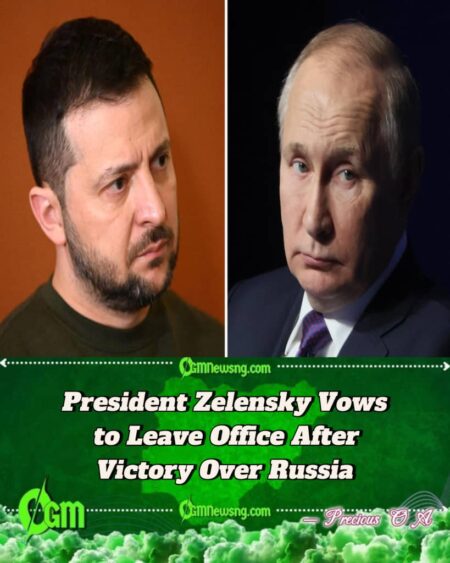
Ukrainian President Volodymyr Zelensky has declared that he is “ready” to step down from office once the war with Russia concludes, signaling a potential turning point in both his political career and Ukraine’s postwar trajectory. Speaking during a press briefing in Kyiv, he emphasized that his focus remains squarely on securing victory for Ukraine and ensuring the country’s long-term stability, rather than clinging to power.
Zelensky remarks come at a critical juncture in the ongoing conflict, which has now stretched beyond two years, testing Ukraine’s resilience and the international community’s commitment to supporting Kyiv. Once a comedian and political outsider, he has become the face of resistance against Russian aggression. Yet, in his latest comments, he hinted at the burdens of leadership in wartime and the necessity for new leadership to rebuild the nation when peace finally arrives.
Observers note that his willingness to step aside underscores his self-perception as a servant of the people rather than a career politician. This candid declaration, however, also raises pressing questions about succession, national unity, and the political landscape that will emerge in a postwar Ukraine.
Zelensky has repeatedly said that his only mission is to safeguard Ukraine’s sovereignty and future. By making clear that his tenure is not indefinite, he is attempting to reassure Ukrainians that the presidency will not become a position of personal ambition but rather a temporary responsibility carried in the nation’s time of greatest need.
Reactions at Home and Abroad
Zelensky’s announcement has triggered a wave of reactions across Ukraine, where many view him as the symbol of national resistance. While some citizens expressed concern about potential instability following his departure, others praised his honesty and selflessness, seeing his decision as evidence of true democratic values. Lawmakers remain divided, with opposition figures calling for clarity on the country’s succession plan, while allies in his party maintain that discussions of leadership should only come after victory is secured.
Internationally, the statement has been closely watched by Ukraine’s Western partners, including the United States and European Union. Washington has reiterated its unwavering support for Kyiv, with officials stressing that his leadership has been instrumental in uniting the free world against Russian aggression. President Trump, who has frequently commented on the conflict, is expected to weigh in on the implications of the remarks for ongoing military and diplomatic strategies.
Zelensky has also drawn attention from European leaders, who voiced cautious optimism. Some suggested that his eventual exit could pave the way for fresh political energy during the country’s reconstruction phase, while others warned that premature speculation about leadership changes risks undermining morale at the front lines. Analysts agree that continuity of governance will be key, regardless of who holds the presidency after the war.
Zelensky’s leadership style, often marked by direct communication and emotional appeals to both domestic and foreign audiences, has been central to rallying support. His ability to maintain morale in a time of crisis has become one of Ukraine’s strongest weapons, and many argue that this will be difficult to replicate under new leadership. Still, his promise to eventually step aside reflects an understanding that no single individual can embody a nation’s future indefinitely.
What Lies Ahead for Ukraine
Zelensky’s statement adds a new dimension to Ukraine’s uncertain future. While the outcome of the war remains undecided, the postwar challenges of reconstruction, healing national wounds, and integrating with Western institutions loom large. A transition in leadership could complicate these efforts but might also inject renewed vigor into the political system.
Zelensky may choose to leave office at a historic high point, remembered as the leader who steered his nation through its darkest hours. However, others caution that political rivalries could intensify in his absence, potentially fracturing the unity so desperately needed in rebuilding. Questions about who might succeed him are already surfacing, though many argue it is too soon to discuss replacements when the war remains unresolved.
For ordinary Ukrainians, the prospect of his departure is both sobering and symbolic. It marks the recognition that wartime leadership requires sacrifices—not only from the people but also from the leaders themselves. His words suggest that he envisions a democratic Ukraine where power transitions peacefully, even after moments of existential crisis.
Zelensky’s readiness to step aside also highlights the broader democratic principles Ukraine has sought to uphold, even under bombardment. By signaling that leadership is temporary and accountable, he distinguishes the nation’s system from the authoritarian model that defines its adversary. This symbolic contrast is not lost on international observers, who point to his statement as further evidence of Ukraine’s determination to remain a functioning democracy despite war.
As the war grinds on with no immediate end in sight, his declaration serves as both a reminder of the stakes and a promise that the future of Ukraine lies in the hands of its people, beyond the tenure of any single individual. His eventual departure, if realized, will mark not just the end of a presidency but the beginning of a new chapter in Ukraine’s national journey.
Table of Contents
Discover more from OGM News NG
Subscribe to get the latest posts sent to your email.