






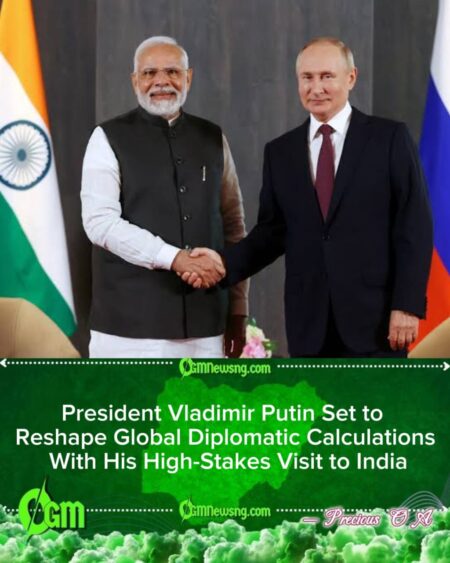
Russian president Putin is scheduled to arrive in India on December 4–5 for a series of wide-ranging diplomatic engagements that are expected to draw substantial global attention due to the deep historical significance of Indo-Russian relations. His upcoming presence marks an important moment in the current geopolitical landscape, particularly as both nations navigate shifting international alliances and emerging global economic pressures. The visit, arranged after extensive diplomatic coordination, is being closely watched for the tone it will set in reinforcing longstanding strategic commitments between the two countries.
president Putin is expected to meet senior Indian officials to address a diverse range of issues that span defense cooperation, energy security, trade innovation, and collaborative strategic planning. Discussions are anticipated to be highly detailed, with both sides seeking to refine their existing frameworks in ways that reflect contemporary geopolitical realities. With global supply chains constantly evolving and new economic constraints emerging, the visit presents an opportunity to strengthen mechanisms that ensure stable, long-term cooperation.
president Putin will also participate in delegation-level discussions intended to broaden the depth of bilateral engagement. These discussions will likely explore regional stability, evolving security considerations, technological cooperation, and industrial development. Diplomatic observers believe these conversations will help shape the next phase of Indo-Russian partnership, which remains one of the most durable bilateral relationships in Eurasia.
Strategic Significance for India–Russia Relations
president Putin arrives at a time when India continues to face a complex diplomatic environment requiring careful balancing of relationships with Western powers, neighboring Asian partners, and enduring allies like Russia. His visit reinforces Russia’s intention to preserve and strengthen its long-standing ties with India, especially in a world marked by increasing geopolitical competition and strategic realignment. Many analysts believe the visit will reaffirm the mutual trust that has characterized the relationship for decades.
India is preparing to leverage the visit to expand sectors of collaboration beyond traditional areas such as defense. Officials are expected to highlight the need for enhanced cooperation in industrial production, advanced research, defense co-development, and technological exchange. With Russia remaining a significant partner in numerous strategic sectors, India views this visit as a key moment in its larger foreign-policy effort to maintain diversified partnerships.
Regional observers note that India may use the visit to strengthen cooperation in energy diversification, alternative payment systems, finance, and emerging technologies. Both nations continue to adapt to global sanctions regimes, supply-chain shifts, and the growing complexity of international economic networks. This moment offers both sides an opportunity to consolidate their cooperation while preparing for long-term challenges.
Defense and Security Discussions
president Putin is expected to hold extensive discussions with Indian defense leadership on ongoing contracts, joint-production programs, and future procurement pathways that remain central to India’s defense modernization strategy. Russia continues to play a major role in India’s defense ecosystem, and the visit underscores the importance both nations place on the sustainability of military-technical cooperation.
Indian defense officials anticipate that negotiations may include updated maintenance agreements, revised timelines on key contracts, technology-transfer commitments, and framework adjustments for next-generation defense systems. India’s defense diversification strategy means it must simultaneously preserve its historical defense partnership with Russia while engaging a broader set of global suppliers, making this visit important in maintaining balance.
Security experts believe the visit may include enhanced discussions on counterterrorism collaboration, expert-level intelligence coordination, and shared regional security objectives. Conversations are likely to address evolving challenges across Eurasia, West Asia, and the Indo-Pacific, areas where the strategic interests of both nations frequently intersect.
Energy, Trade, and Economic Cooperation
president Putin will meet with Indian economic and energy officials to review the rapidly expanding trade relationship, with a particular focus on the energy sector, where Russia has become one of India’s primary suppliers. This shift has reconfigured bilateral trade patterns and prompted new logistical, financial, and infrastructural mechanisms to support sustained cooperation.
India is expected to pursue negotiations on energy logistics, including improved shipping arrangements, refined processing strategies, and expanded investment partnerships in hydrocarbons and critical minerals. The goal is to stabilize long-term supply routes and reduce vulnerability to international price fluctuations and geopolitical constraints. These discussions may also explore deeper cooperation in nuclear energy and other large-scale infrastructural initiatives.
Trade analysts believe both nations may review alternative payment structures, currency arrangements, and specialized financial channels designed to bypass existing international restrictions. These mechanisms are important for maintaining consistency in bilateral trade flows amid global economic uncertainty and shifting sanctions regimes.
Geopolitical Considerations and Global Reactions
president Putin arrives in India at a moment when Russia remains at the center of global geopolitical attention, particularly regarding military strategy, economic sanctions, and regional alliances. His decision to visit India underscores Moscow’s intention to strengthen key partnerships in Asia, especially those rooted in long-term diplomacy rather than short-term political changes.
Global actors will closely study India’s diplomatic messaging during the visit, as several Western nations maintain active strategic interest in India’s international positioning. India has consistently emphasized its foreign-policy independence, insisting on choosing partners based on national interest rather than external pressure. The visit is expected to highlight this approach once again.
International reactions are anticipated to vary considerably. Some nations may view the engagement as a reinforcement of multipolar diplomacy, while others may interpret it through the lens of global competition, energy dependencies, and shifting strategic alignments in Asia and beyond.
Future Outlook for Bilateral Engagement
president Putin is likely to use the visit to articulate Russia’s long-term strategic vision for engagement with India and the broader South Asian region. With global power structures undergoing transformation, Moscow seeks to deepen ties with nations that maintain independent diplomatic pathways. The visit is therefore being seen as an investment in long-term regional stability and collaboration.
Diplomats expect announcements regarding expanded cooperation in space technology, pharmaceuticals, higher education, nuclear science, and joint innovation initiatives. These are sectors where India and Russia have historic records of collaboration and where both nations see significant potential for future expansion.
Analysts believe the outcomes of the visit will shape the direction of India–Russia relations for years to come, influencing not just bilateral projects but also wider regional dynamics. As both countries navigate a world increasingly defined by strategic rivalry, evolving technology, and complex global pressures, this visit may mark a foundational moment for the next stage of their partnership.
Table of Contents
Discover more from OGM News NG
Subscribe to get the latest posts sent to your email.