






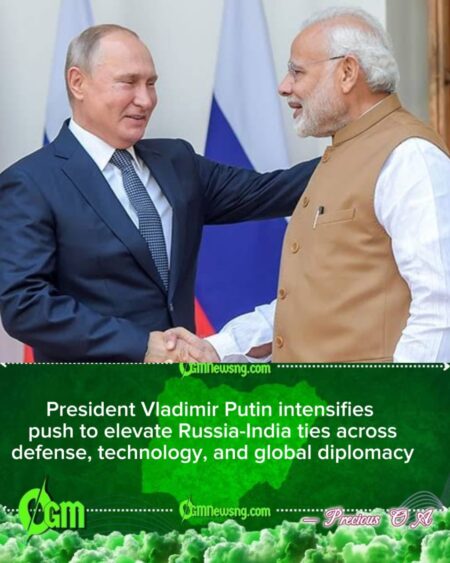
President Vladimir Putin reaffirmed his commitment to expanding Russia’s strategic partnership with India, emphasizing with notable deliberateness that the long-standing relationship between the two nations remains central to Moscow’s global diplomatic vision, particularly at a time when the international environment is marked by shifting alliances, economic uncertainty, and heightened geopolitical competition. He described the partnership as one rooted not merely in transactional necessity but in the shared historical goodwill and pragmatic collaboration that have consistently defined Russia–India ties across multiple decades of global change.
Putin reiterated that Russia views India not merely as an ally of convenience but as a foundational partner capable of shaping regional balance, technological cooperation, and long-term developmental collaboration, arguing that the durability of this partnership has repeatedly demonstrated its ability to weather political transitions, economic disruptions, and fluctuations in global strategic priorities. He stressed that Moscow’s continued engagement with New Delhi reflects a judgment grounded in strategic depth rather than short-term interests.
Putin underscored that Russia’s foreign-policy strategy is built around reliable partners like India, noting that mutual respect, economic complementarity, and shared geopolitical interests form the backbone of continued cooperation, especially as both nations navigate a world increasingly defined by polarized blocs, contested supply chains, and the rising importance of multipolar diplomacy. He emphasized that this partnership is not static but evolving toward deeper resilience and broader scope.
Expanding Economic Cooperation
Putin detailed Russia’s intention to broaden joint energy ventures, highlighting opportunities in nuclear technology, oil and gas supply routes, and renewable-energy frameworks designed to increase India’s long-term energy security while simultaneously expanding Russia’s presence in one of the world’s most dynamic energy markets. He noted that these collaborative ventures extend beyond mere resource exchange and are intended to establish integrated systems of production and technological support.
A renewed focus on trade diversification was presented as a major priority, with emphasis on expanding bilateral settlements in local currencies, developing new logistics corridors, and removing structural barriers that have slowed commercial growth, thereby enabling both nations to reduce exposure to external financial disruptions and build a more autonomous economic architecture capable of supporting bilateral ambitions.
Putin emphasized that Russia is prepared to support India’s industrial ambitions by offering advanced machinery, critical raw materials, and expanded export channels that reinforce long-term economic stability, insisting that strengthening these economic linkages will create a mutually reinforcing cycle of growth that supports broader strategic cooperation.
Deepening Defense and Security Ties
Russia’s leadership stressed the enduring relevance of defense cooperation, noting that decades of trust have allowed both countries to collaborate on missile systems, aircraft platforms, and joint-training initiatives that enhance regional stability and provide both militaries with operational experience rooted in shared strategic objectives rather than external pressure.
Putin stated that Russia remains committed to timely delivery of equipment, co-development of next-generation technologies, and preservation of strategic autonomy in defense decision-making free from external pressure, asserting that the military dimension of the partnership remains one of its strongest and most resilient pillars even as global defense dynamics grow increasingly complex.
Putin highlighted the importance of intelligence coordination, counterterrorism efforts, and cybersecurity exchanges, describing them as essential pillars of a partnership designed to withstand modern global threats, including digital warfare, organized extremist networks, and transnational destabilization efforts affecting multiple regions.
Advancing Technological and Space Collaboration
Putin pointed to emerging frontiers such as AI research, quantum computing, and high-precision engineering as areas where Russia intends to deepen long-term cooperation with India, arguing that the technological landscape of the future demands integrated innovation ecosystems built on trusted partnerships.
Collaborative space exploration was framed as a symbolic and practical bridge between both nations, with Russia reiterating its willingness to assist with launch capabilities, astronaut training, and high-orbit mission planning, ensuring that India’s rapidly expanding space ambitions continue to benefit from decades of Russian expertise.
Putin asserted that scientific partnerships between the two nations will drive innovation, improve technical sovereignty, and strengthen the global competitiveness of both countries in advanced knowledge sectors, noting that these collaborations extend far beyond immediate scientific gains and feed into broader national objectives.
Cultural and Educational Exchange Commitments
Russia reaffirmed the cultural warmth that underpins political cooperation, stressing that academic exchanges, language programs, and shared historical ties continue to foster public goodwill between the two societies, thereby reinforcing a foundation of mutual understanding that transcends policy cycles.
Putin emphasized Russia’s readiness to expand university scholarships, medical placements, research fellowships, and long-term educational linkages that reinforce stable societal engagement, allowing future generations to inherit a partnership enriched by personal and academic connections.
Putin explained that broader cultural visibility, film cooperation, tourism initiatives, and heritage preservation programs will further solidify the deep-rooted connection between Russia and India, ensuring that cultural diplomacy remains a vibrant component of bilateral engagement.
Geopolitical Alignment and Future Outlook
Growing global polarization has pushed Russia and India to strengthen strategic autonomy, ensuring that both nations can pursue independent foreign-policy decisions without undue influence or coercion, especially as international institutions face new pressures and regional rivalries intensify.
Putin maintained that the Russia-India partnership will serve as a stabilizing force in Eurasia, providing a counterweight to escalating tensions and supporting diplomatic avenues that prioritize dialogue over confrontation, thereby contributing to an environment conducive to sustainable engagement.
Putin concluded that Russia’s long-term vision is anchored in a resilient partnership with India, one that he intends to protect, reinforce, and elevate across every sector of cooperation, emphasizing that this bilateral relationship remains a cornerstone of Moscow’s strategic outlook well into the future.
Table of Contents
Discover more from OGM News NG
Subscribe to get the latest posts sent to your email.