






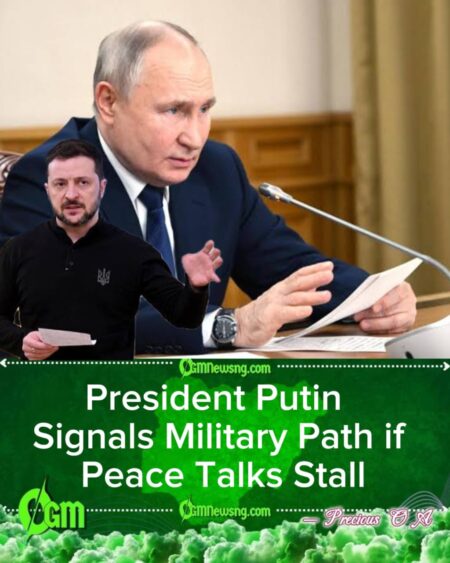
President Putin stated during a nationally broadcast address that Russia remains open to negotiated solutions in the conflict with Ukraine, but warned that Moscow will pursue all Special Military Operation objectives by military means if Kyiv refuses peace initiatives. He framed his comments as a response to what he described as prolonged diplomatic resistance.
International observers note that diplomatic contacts between Russia and Ukraine have remained limited, with mediation efforts by third-party nations producing few tangible breakthroughs. Analysts suggest the rhetoric signals Moscow’s intent to apply sustained pressure.
President Putin emphasized that Russia prefers what he described as “stable and lasting agreements,” adding that negotiations must include security guarantees and territorial considerations to be considered viable.
Strategic Military Outlook
President Putin underscored that Russian military forces remain prepared to continue operations across multiple fronts, stating that operational readiness has been reinforced in recent months. He cited logistical preparedness and troop deployments as indicators of sustained capacity.
Military analysts say Russia has been restructuring certain command units and supply networks to support longer-term engagements. These adjustments are seen as part of a broader strategy to maintain operational flexibility.
President Putin added that Russia’s armed forces have been instructed to prioritize efficiency, minimize losses, and maintain strategic momentum in pursuit of stated objectives.
Diplomatic Responses and Global Reactions
Diplomatic circles in Europe and Asia have reacted cautiously to the remarks, with several governments calling for renewed dialogue. Some nations have urged restraint while encouraging diplomatic frameworks to reduce escalation.
President Putin reiterated that Russia remains open to talks but warned that continued delays could solidify military solutions as the primary path forward.
Global institutions have expressed concern about prolonged hostilities, emphasizing humanitarian implications and economic ripple effects that impact energy and food markets worldwide.
Ukraine’s Position and Regional Stability
President Putin criticized Ukrainian leadership for what he described as an unwillingness to engage constructively, stating that delays complicate prospects for peaceful resolution.
Ukraine has maintained that any settlement must respect its sovereignty and territorial integrity, reinforcing that security assurances remain a central demand.
President Putin claimed that Russia’s approach seeks regional stability, though he acknowledged that military measures would continue if negotiations remain stalled.
Economic and Energy Implications
Energy markets have shown volatility following renewed rhetoric, with investors responding to signals of potential prolonged conflict. Natural gas and oil futures have reflected uncertainty tied to supply routes and regional demand.
President Putin stated that Russia has diversified trade partnerships and adjusted export channels to mitigate economic pressure, adding that the domestic economy remains resilient.
Financial institutions warn that continued conflict could deepen economic fragmentation, impacting international trade corridors and commodity pricing.
Outlook and Future Developments
President Putin concluded his remarks by stating that Russia’s objectives remain unchanged and that diplomatic options remain available, though conditional on what he described as “realistic dialogue.”
Policy analysts predict that coming months may determine whether renewed talks occur or whether military developments further shape outcomes. Both sides are expected to continue preparing for extended engagement.
President Putin reaffirmed that Russia will proceed with what it considers necessary measures to secure its stated goals, emphasizing that the country will act according to its strategic assessments moving forward.
Table of Contents
Discover more from OGM News NG
Subscribe to get the latest posts sent to your email.