








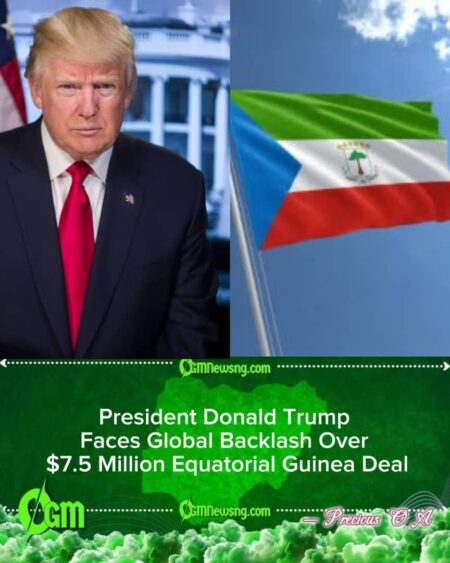
President Donald Trump has come under intense scrutiny following revelations that his administration authorized a $7.5 million payment to the government of Equatorial Guinea. The payment, reportedly drawn from the U.S. State Department’s Migration and Refugee Assistance emergency fund, was made in exchange for the small West African nation’s agreement to accept non-citizens deported from the United States. The move, now at the center of a growing political storm, has been condemned by lawmakers, human-rights advocates, and policy experts as a misuse of taxpayer funds and a troubling expansion of deportation practices that could have long-term consequences for U.S. immigration policy.
Officials within the administration have defended the decision as part of a broader effort to strengthen border security and reduce illegal immigration. They have characterized the deal as a “strategic migration partnership,” claiming it would relieve pressure on U.S. detention facilities, lower deportation costs, and deter unlawful entry. However, critics argue that the program’s secrecy, the lack of congressional consultation, and the unusual use of humanitarian funds suggest a “migrant-dumping” scheme that sidesteps both U.S. law and international norms designed to protect asylum seekers and migrants in vulnerable circumstances.
This move has been compared to similar arrangements with other countries during Trump’s previous term, but analysts note that this particular deal stands out for its scale, opacity, and the sensitive geopolitical context in which it was executed. Senator Jeanne Shaheen, a senior member of the Senate Foreign Relations Committee, disclosed that the $7.5 million transfer far exceeded the total U.S. foreign aid sent to Equatorial Guinea over the past eight years combined. Her letter to Secretary of State Marco Rubio demanded a thorough explanation of how funds meant for humanitarian assistance were redirected for deportation purposes, describing the action as “a gross violation of congressional intent.”
Donald Trump’s decision has thus ignited a heated debate in Washington over whether the administration bypassed congressional oversight and misused emergency humanitarian funds for political objectives. Lawmakers across party lines are now calling for a full investigation into the origins, purpose, and approval process of the payment, with some suggesting that the deal might violate statutory limits on foreign assistance spending. The controversy has also reopened broader questions about the administration’s approach to immigration enforcement and foreign policy ethics.
Allies of the President, meanwhile, have portrayed the criticism as partisan obstruction, insisting that he is simply “putting America first” and addressing a broken immigration system ignored by previous administrations. Supporters of the policy argue that the deal is an innovative step toward solving chronic migration challenges and represents a necessary evolution in border management strategy. To them, the criticism is less about legality and more about political resistance to Trump’s firm stance on immigration.
Governance, Human-Rights Concerns, and Equatorial Guinea’s Role
President Donald Trump’s choice of Equatorial Guinea as a deportation partner has raised alarm because of the country’s notorious record on governance, corruption, and human rights. The oil-rich Central African state, led for more than four decades by President Teodoro Obiang Nguema Mbasogo and his son Vice President Teodoro Nguema Obiang Mangue, has long been accused of embezzlement, authoritarian rule, and suppression of dissent. Human-rights organizations have consistently ranked the nation among the least free in the world, with severe restrictions on political expression, media freedom, and judicial independence.
Human-rights organizations warn that sending migrants there could expose them to significant risks, given the nation’s history of arbitrary arrests, limited due process, and lack of refugee protection frameworks. Senator Shaheen’s letter described the arrangement as “deeply troubling,” questioning why U.S. taxpayer money was transferred to a regime widely criticized for corruption and abuse. Advocacy groups such as Amnesty International and Human Rights Watch have emphasized that migrants deported to Equatorial Guinea might face detention, mistreatment, or forced labor, making the United States complicit in potential human-rights violations.
Donald Trump’s administration, however, argues that the payment was strictly transactional and tied to logistical cooperation rather than political endorsement. White House officials insist that Equatorial Guinea’s role is limited to processing individuals who have no legal right to remain in the U.S., and that adequate measures will be taken to ensure their safety and fair treatment. The administration maintains that this partnership reflects “a pragmatic approach” to immigration control rather than an endorsement of any regime’s internal policies.
This approach fits within a broader strategy of leveraging economic incentives to secure migration-control deals in Africa and Latin America. This model, often described as “outsourcing border enforcement,” allows the U.S. to reduce domestic detention costs while shifting deportation responsibilities abroad. Supporters of the administration say such agreements can help the U.S. maintain sovereignty over immigration decisions while also addressing international migration pressures more efficiently.
Opponents of the policy counter that such deals undermine international asylum obligations and risk turning impoverished or authoritarian nations into holding grounds for displaced migrants. They argue that the deal undermines America’s global leadership on human rights and humanitarian protection, setting a precedent where financial power is used to export migration challenges rather than resolve them responsibly. For many critics, the agreement symbolizes a dangerous shift away from compassion and transparency in U.S. foreign and immigration policy.
Global Reaction and Policy Implications
President Donald Trump’s deal has triggered sharp reactions both domestically and internationally. Human-rights organizations such as Amnesty International and Human Rights Watch have condemned the payment, calling it a “cash-for-deportees” arrangement that devalues human dignity and weakens global refugee protections. Diplomats from the European Union and the United Nations have also expressed concern that the U.S. is normalizing the use of financial inducements to manage migration, a practice more commonly associated with authoritarian states. Within the U.S., civil-rights lawyers have already begun exploring potential legal challenges to the deal.
Supporters of the policy, however, praise the decision as pragmatic and effective. They argue that traditional asylum systems are overwhelmed and that third-country partnerships represent an innovative way to deter irregular migration while reducing strain on American immigration courts and border facilities. Conservative commentators have also emphasized that the U.S. retains sovereign authority to determine where and how deportees are relocated, noting that similar models have been used by European nations such as the United Kingdom and Denmark.
Donald Trump’s actions, though controversial, highlight a broader geopolitical shift in U.S. foreign policy. By blending migration control with financial diplomacy, Washington may be setting a precedent for future deals that link immigration enforcement to economic aid. Analysts warn that this could erode transparency, encourage transactional diplomacy, and blur the boundaries between humanitarian assistance and political bargaining. The deal could thus serve as a blueprint—or a cautionary tale—for future administrations seeking to externalize border control.
This payment to Equatorial Guinea thus represents more than a budgetary controversy—it is a test case for how far the United States is willing to go in externalizing its immigration challenges. Whether it becomes a one-time experiment or a new diplomatic pattern will depend on congressional oversight, public scrutiny, and the administration’s willingness to disclose full details of the agreement. Lawmakers have already called for hearings to determine whether the State Department followed legal and ethical protocols in approving the transfer.
Donald Trump’s administration now faces mounting pressure to justify the deal not just in terms of cost and legality, but also in moral, humanitarian, and strategic terms—questions that could define the legacy of his second term’s immigration agenda. As scrutiny intensifies, the world watches closely to see whether the U.S. will uphold its values or continue down a path of transactional migration diplomacy. With the debate growing louder each day, the $7.5 million deal may ultimately reshape both America’s global reputation and the trajectory of its immigration policy for years to come.
Table of Contents
Discover more from OGM News NG
Subscribe to get the latest posts sent to your email.