








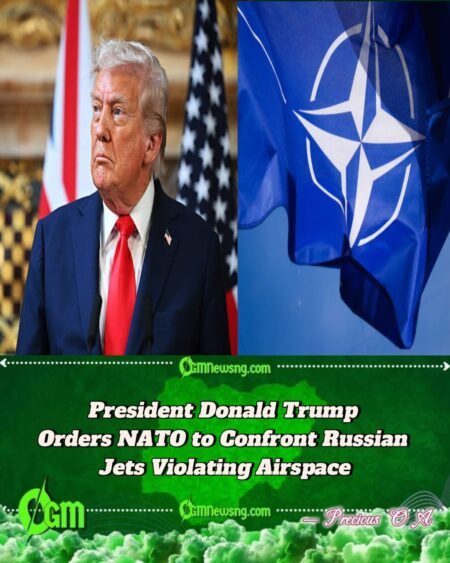
US President Donald Trump has issued a sharp directive to NATO allies, calling on them to respond decisively against Russian aircraft that illegally enter their airspace. He stated that NATO countries must be prepared to shoot down any Russian military jets that violate international boundaries, describing it as an essential step to maintain sovereignty and prevent further escalation.
Donald Trump emphasized that the United States stands firmly behind its allies and will not tolerate repeated violations of sovereign airspace. His remarks come amid rising tensions in Eastern Europe, where NATO officials report that Russian planes have repeatedly flown near alliance borders, raising concerns about deliberate provocations.
The directive marks a more aggressive stance compared to previous warnings issued by NATO leaders. While NATO forces have frequently intercepted Russian jets, the president’s call to authorize shoot-downs signals a new level of confrontation. Military analysts say this policy is intended to deter Moscow but carries significant risk of escalation.
His order follows weeks of reported Russian maneuvers near NATO territories, including Poland, Lithuania, and Romania. NATO air command has warned that these flights increase the chances of accidents or miscalculations that could lead to conflict. Many in the alliance view the move as an attempt by Moscow to probe NATO’s readiness and test its political will.
Moscow, meanwhile, has rejected accusations of wrongdoing. Russian officials continue to deny that their aircraft have violated international airspace, instead accusing NATO of heightening tensions through military exercises close to Russia’s borders. The Kremlin has often described NATO’s presence in Eastern Europe as a direct threat, claiming that its military flights are defensive in nature.
NATO Allies React to Trump’s Directive
Donald Trump’s remarks drew mixed reactions across Europe. Leaders in Poland, Estonia, and Latvia welcomed the move, arguing that it sends a strong message that NATO will defend its territories. These countries, situated on the alliance’s eastern flank, have long warned of Russian aggression and see the directive as overdue reinforcement of NATO’s credibility.
The president has insisted that strength is the only language Russia understands. He argued that repeated violations cannot be ignored, and NATO must act decisively to prevent further testing of its defenses. Supporters of his stance believe that the firm order will discourage Moscow from engaging in further risky maneuvers near allied borders.
His directive has also stirred debate within NATO’s leadership. Secretary General Jens Stoltenberg acknowledged the importance of deterrence but stressed the need for balance, warning that unintended escalation could have grave consequences. Consultations are now underway among NATO members to determine how strictly to apply the order and whether guidelines should be set to prevent accidental confrontations.
The position has drawn sharp responses from Moscow. Though no formal statement has been released, Russian officials previously warned that hostile action against their aircraft would be met with “serious consequences.” Analysts fear that any downing of a Russian plane could ignite a broader conflict in Europe, potentially forcing NATO into a military confrontation it has sought to avoid.
European public opinion also reflects the divide. In frontline states such as Lithuania and Poland, many citizens view Donald Trump’s directive as necessary to ensure national security. In Western Europe, however, skepticism runs deeper, with critics warning that shooting down a Russian aircraft could trigger a crisis worse than the Cold War standoffs.
Implications for Global Security and Diplomacy
Donald Trump’s directive has also caught the attention of the United Nations. Diplomats warn that such a move, while grounded in the right of self-defense, could fuel global instability if not carefully managed. Some nations view the president’s order as necessary to protect sovereignty, while others fear it could undermine ongoing diplomatic negotiations aimed at de-escalating tensions.
His approach highlights a broader strategy of confronting Russia directly rather than relying solely on dialogue. While it may strengthen NATO’s deterrence, experts caution that the world now faces a heightened risk of military miscalculation. With tensions already high in Ukraine, Syria, and beyond, the order has the potential to reshape the balance of power in Europe and widen existing geopolitical divides.
Donald Trump’s call for decisive military action underscores his belief that deterrence must be backed by readiness to act. This signals a shift toward a more confrontational NATO posture, which could redefine alliance policies for years to come. Defense planners suggest that the directive may accelerate investment in air defense systems and joint exercises designed to prepare member states for potential encounters with Russian aircraft.
The policy direction has drawn both praise and criticism from defense analysts. Supporters say it closes loopholes that Russia has exploited, pointing to years of aggressive flights that tested NATO responses without consequence. Critics, however, warn that it risks pushing the alliance into a military clash that diplomacy might otherwise have prevented. They argue that while deterrence is essential, so too is maintaining avenues for negotiation.
Donald Trump’s order has also intensified debate in Washington. Congressional leaders are split, with some Republicans backing the president’s call for toughness against Russia, while Democrats caution that the risks of escalation are too high. Defense officials briefed lawmakers on the potential consequences of the directive, stressing the importance of clear communication channels with Moscow to prevent accidental escalation.
Table of Contents
Discover more from OGM News NG
Subscribe to get the latest posts sent to your email.