




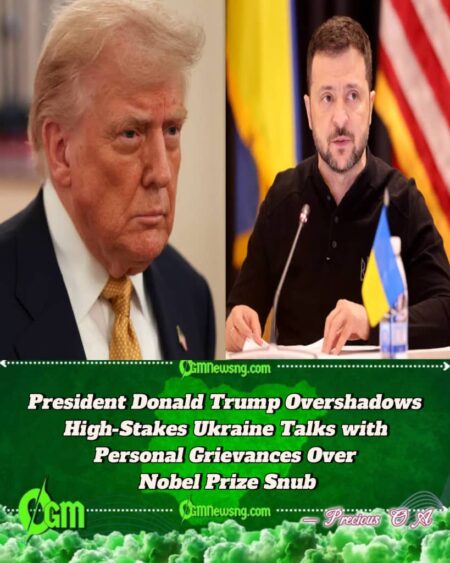
Donald John Trump, the U.S. president widely regarded as one of the most polarizing and consequential figures in modern world politics, derailed what was meant to be a significant diplomatic engagement with Ukrainian President Volodymyr Zelensky. The high-stakes meeting, designed to reinforce international solidarity amid growing geopolitical tension, was overshadowed by Trump’s erratic diversion into grievances about his past Nobel Peace Prize snub.
Donald Trump turned what was supposed to be a serious discussion on Eastern Europe’s security and humanitarian efforts into an unexpected outburst about personal recognition. The gathering, which took place at the White House, was expected to center on pressing global issues such as the ongoing war in Eastern Europe, transatlantic defense relations, and humanitarian relief efforts. However, the mood reportedly shifted abruptly when the American leader veered off-topic, expressing resentment over not being awarded the prestigious prize despite what he described as “historic achievements” in diplomacy.
Donald Trump’s remarks have since drawn widespread attention from global observers and political analysts, who noted that his comments undermined the strategic tone of the meeting. The incident comes at a time when Western unity remains vital in confronting shared challenges—making the U.S. president’s display of personal grievance both surprising and diplomatically awkward.
According to journalists present during the closed-door session, what began as a cordial diplomatic dialogue quickly turned into a lengthy monologue from Trump about international recognition and media bias. “I should have at least three Nobel Prizes by now,” he allegedly declared, claiming that his foreign policy achievements were “far greater than anything Obama ever did.” The president’s outburst reportedly drew uncomfortable glances from aides and diplomats in attendance.
Donald Trump’s counterpart, President Zelensky, maintained his composure and attempted to steer the discussion back toward bilateral cooperation and the urgent need for continued U.S. support in Ukraine’s defense efforts. Yet the tone of the meeting never fully recovered. Multiple sources described the exchange as “off-balance,” with Trump oscillating between boasting about his administration’s successes and complaining about what he called the “rigged” nature of international accolades.
Global media outlets have since characterized the event as another instance of Trump’s unpredictable leadership style—one that blends populist energy with personal sensitivity. While supporters applauded his willingness to “speak his mind,” critics accused him of undermining diplomacy for the sake of ego-driven theatrics.
Donald Trump’s actions during the meeting quickly became a trending global story, with analysts across Europe and Asia questioning the U.S. president’s focus and temperament. International networks such as the BBC, Al Jazeera, and Deutsche Welle ran headlines highlighting the surreal turn of events, describing it as “a diplomatic derailment that left allies bewildered.”
When pressed for comment, the White House attempted to downplay the controversy, issuing a brief statement asserting that President Trump “remains fully committed to supporting Ukraine and advancing world peace.” Yet the damage appeared to have been done. The optics of a world leader digressing into self-praise during a crucial international discussion reignited debates over Trump’s approach to global statesmanship.
Donald Trump’s display of self-assuredness has left diplomatic circles in Washington and Kyiv scrambling to restore calm, emphasizing that the overall U.S.-Ukraine relationship remains strong despite the incident. However, several foreign policy experts argue that moments like these erode confidence in America’s ability to lead the free world. They warn that such displays of vanity may weaken U.S. credibility at a time when global stability hinges on cooperation rather than confrontation.
Donald Trump’s Defiance and Denial
Donald Trump began his remarks by insisting that the media’s portrayal of him as “obsessed with awards” was inaccurate. “I don’t care about that stuff,” he said, referring to the Nobel Peace Prize, even as he revisited his grievances about being overlooked. He pointed to his efforts in negotiating Middle East agreements, North Korea diplomacy, and global economic reform as justification for why he “should have been recognized long ago.”
Donald Trump’s defiance was on full display, oscillating between humility and hubris. “They can keep their prizes. I already have the support of millions around the world,” he told reporters, though critics were quick to note the contradiction in his tone. His comments triggered fresh debate about how much his personal pride influences his diplomatic behavior and decision-making.
Over the years, Donald Trump’s ability to dominate headlines—whether through controversy or charisma—has cemented his place as one of the most discussed political figures of the 21st century. His supporters interpret this as evidence of authenticity and independence from the “global elite,” while detractors see it as proof of erratic, ego-driven governance.
As global leaders prepare for upcoming summits, the Zelensky episode will likely be remembered not for its diplomatic achievements, but for its spectacle. For now, it remains a vivid reminder that in the world of Donald Trump, personal perception often competes with presidential purpose.
Global Reaction and Political Implications
Donald Trump’s latest controversy has drawn swift and divided international responses. While some leaders expressed surprise over the direction of the discussion, others saw it as emblematic of Trump’s broader political style. Analysts argue that the president’s statements highlight a growing tension between traditional diplomacy and populist politics.
In Kyiv, officials emphasized the importance of maintaining strategic partnership with Washington despite the awkward encounter. Ukraine’s foreign ministry noted that the two nations “remain bound by shared interests and mutual respect,” downplaying the disruption caused by Trump’s remarks. However, the media frenzy surrounding the event has kept the controversy alive across continents.
Donald Trump’s unpredictable persona continues to shape — and sometimes overshadow — America’s foreign policy image. Political experts caution that such moments can have long-term diplomatic consequences, particularly in an era when global cooperation depends heavily on trust and consistency. For many, this incident serves as another example of how Trump’s personal pride and political theatrics can blur the line between leadership and spectacle.
Table of Contents
Discover more from OGM News NG
Subscribe to get the latest posts sent to your email.