







U.S. President Donald Trump, the 45th president of the United States and now serving his second term, has solidified his position as a key architect of America’s modern economic and national security strategy. Known for his assertive foreign policy and focus on economic independence, Trump has consistently sought to reduce America’s reliance on foreign powers—particularly China—for essential materials and manufacturing.
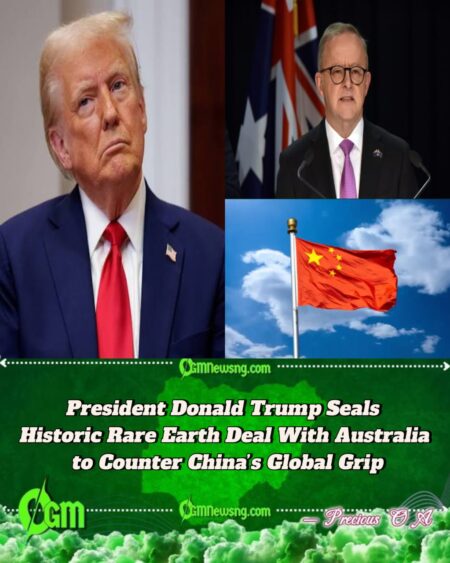
In his latest move, he signed a groundbreaking trade agreement with Australia aimed at securing critical minerals and rare earth supplies vital to U.S. technology, defense, and renewable energy production. This agreement represents one of the most ambitious efforts by his administration to strengthen America’s industrial base and secure the resources that drive its advanced manufacturing and defense capabilities.
Donald Trump described the deal as “a decisive step toward safeguarding America’s future.” The agreement, signed at the White House alongside Australian Prime Minister Anthony Albanese, focuses on strengthening mining partnerships, refining processes, and developing long-term reserves of materials such as lithium, cobalt, and rare earth elements. These materials are indispensable to modern life, powering everything from smartphones and electric vehicles to fighter jets, satellites, and missile systems. The accord also sets new benchmarks for transparency and environmental responsibility within the mining sector, reinforcing both nations’ commitment to ethical resource management.
He emphasized that the partnership was not merely an economic collaboration but a strategic defense measure designed to protect U.S. industries from potential geopolitical blackmail. “We will no longer allow our energy and technology future to depend on nations that do not share our values,” he declared during the signing ceremony. “This is about freedom, strength, and securing the next generation of American innovation.” Trump’s words reflected his administration’s broader goal of reshaping global trade networks to favor democracies and reduce vulnerabilities that adversarial nations could exploit in times of crisis.
Donald Trump also praised Australia for being “a trusted and dependable ally,” highlighting decades of cooperation between the two nations. In response, Prime Minister Albanese reaffirmed that Australia stands ready to expand mining operations and invest heavily in cleaner, more efficient refining technologies that align with global environmental goals. The two leaders pledged ongoing collaboration in research, logistics, and policy alignment to ensure that both countries benefit equally from this strategic partnership.
Reducing Dependence on China’s Rare Earth Monopoly
Donald Trump has long warned about the dangers of depending on China for critical resources. For decades, Beijing has controlled nearly 70% of the world’s rare earth mining and more than 80% of refining operations, giving it substantial leverage over industries that shape the global economy. The new deal, according to Trump, is a “game changer” that will help “restore balance” by creating secure supply lines through democratic nations like Australia. Trump’s administration views this as not only an economic safeguard but a defense imperative—ensuring that the U.S. military and technology sectors remain immune to sudden foreign supply disruptions.
The Trump administration has identified China’s rare earth dominance as both an economic and national security threat. In 2020, China’s brief restriction of rare earth exports served as a wake-up call for Western economies. Since then, Trump has pushed for greater investment in alternative sources, viewing this partnership as the culmination of years of strategic planning. The deal includes billions of dollars in joint exploration, technology sharing, and sustainable mining initiatives across Western Australia and the Northern Territory. American experts will work alongside Australian engineers to improve extraction efficiency and reduce environmental impacts, setting a global standard for responsible mining.
Donald Trump’s energy advisors confirmed that the U.S. Department of Energy and Australia’s Department of Industry will jointly fund new research into eco-friendly extraction and refining methods. These innovations are expected to reduce environmental damage while ensuring consistent supply for critical American industries. The initiative also supports Trump’s broader “Made in America” policy, which aims to strengthen domestic production, create high-quality jobs, and reduce the trade deficit. By expanding cooperation with democratic allies, the administration seeks to build a global framework for sustainable industrial growth rooted in shared values.
Donald Trump’s move has been praised by economists and defense analysts alike. Dr. Evan Clarke, an international trade expert, noted that “the United States has taken a major step toward economic sovereignty.” He explained that the agreement not only diversifies supply chains but also reaffirms the West’s commitment to free trade built on transparency and shared democratic principles. Other analysts have also pointed out that the deal could help stabilize global prices for critical minerals, reducing volatility in sectors such as clean energy, aerospace, and defense manufacturing.
Global Reactions and Future Implications
Donald Trump’s bold move has drawn swift international attention. Allied nations, including Japan, Canada, and the United Kingdom, have welcomed the agreement as a critical step in stabilizing global supply chains. However, China’s Ministry of Commerce issued a sharp response, labeling the deal “an unnecessary provocation” and warning that it could “distort market dynamics.” Trump, known for his direct diplomacy, responded firmly that the United States “will always act in its own best interest” and will “stand with nations that believe in fair trade and freedom.” His remarks underscored a growing divide between democratic and authoritarian economies competing for control of the world’s most valuable natural resources.
He also underscored the domestic benefits of the agreement, noting that it will generate thousands of jobs in mining, transport, and advanced manufacturing sectors across both countries. Infrastructure projects are already being planned to improve mineral transport routes, upgrade port facilities, and expand processing plants in the U.S. and Australia. Trump described the agreement as “a win for workers, a win for security, and a win for the future of free nations,” emphasizing that the long-term economic impact would be felt across multiple industries.
Donald Trump’s administration plans to use the deal as a blueprint for future partnerships with other democratic allies. Talks are already underway with Canada, India, and Japan to join a wider alliance focused on critical minerals and clean energy collaboration. Analysts believe this could mark the beginning of a long-term geopolitical shift, positioning the United States and its allies as key players in the emerging global energy economy. Such alliances could redefine trade dynamics and strengthen Western influence over the next wave of industrial innovation.
Donald Trump concluded his address by framing the deal as part of his larger vision to ensure “America’s independence in every critical field—energy, defense, and technology.” His message to Americans was clear: “We’re building a future that is secure, self-reliant, and unstoppable.” As the global race for resources intensifies, Trump’s deal with Australia stands as a defining moment in the new era of economic and strategic resilience—cementing his legacy as a leader determined to make America stronger, safer, and more self-sufficient in an increasingly competitive world.
Table of Contents
Discover more from OGM News NG
Subscribe to get the latest posts sent to your email.