







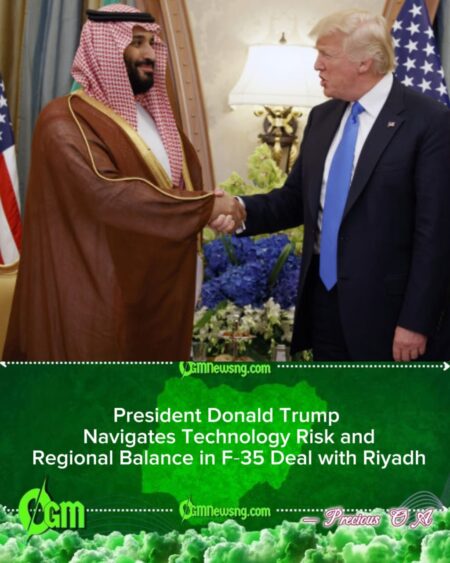
President Donald Trump has moved to advance Saudi Arabia’s long-standing ambition to acquire the F‑35, the U.S.’s most advanced stealth fighter, as part of its comprehensive plan to modernize its air force and strengthen its strategic deterrent, which has become increasingly important in light of evolving regional tensions and the complex security landscape of the Middle East.
Donald Trump is overseeing a proposed agreement that would mark a major step in U.S.–Saudi defense relations, with officials emphasizing that the acquisition could significantly enhance Riyadh’s capabilities while signaling deeper strategic alignment with Washington. According to Bloomberg News, the deal is expected to be signed during Saudi Crown Prince Mohammed bin Salman’s upcoming visit to Washington, highlighting the symbolic and practical importance of the timing.
Saudi officials note that each F‑35, manufactured by Lockheed Martin, costs roughly US$100 million, with Riyadh signaling intent to enhance regional air-power parity. Observers suggest that acquiring these jets would represent a substantial technological leap for Saudi Arabia’s air force, which has historically relied on older aircraft models that may not match the capabilities of neighboring countries’ modern fleets.
U.S. Motivations and Strategic Aims
President Donald Trump has indicated that the sale serves multiple objectives: bolstering U.S. defense exports, deepening Gulf alliances, and promoting Saudi Arabia’s role in regional initiatives such as the Abraham Accords, which aim to foster cooperation and stability among Gulf and Arab nations while also encouraging diplomatic ties with Israel.
Donald Trump’s move extends his administration’s engagement with Riyadh, building on prior large-scale arms agreements, while reinforcing U.S. strategic influence and defense industry interests in the Middle East, where competition for influence remains intense and multifaceted. Analysts point out that such agreements also provide economic benefits for the American defense sector, including job creation and revenue for manufacturers like Lockheed Martin and their extensive supply chains.
Analysts argue that equipping Saudi Arabia with the F‑35 enhances regional deterrence, strengthens interoperability with U.S. forces, and supports collective security goals consistent with an America-first yet globally engaged defense posture. The jets’ advanced stealth and sensor capabilities could allow Saudi Arabia to conduct precision operations more effectively while improving coordination with U.S. military forces in joint exercises or potential regional contingencies.
Concerns over Technology Leakage and Israel’s Military Edge
President Donald Trump is facing scrutiny from intelligence and defense officials over potential technology leakage, with reports warning that China could access F‑35 systems due to Saudi Arabia’s existing defense partnerships and sophisticated espionage capabilities, which have long been a concern for U.S. policymakers seeking to protect sensitive military technology.
Defense sources caution that the sale also raises concerns about the regional military balance. Israel, as the sole F‑35 operator in the region, maintains a “qualitative military edge,” a status traditionally guaranteed by the United States to ensure stability and prevent escalation. Introducing the F‑35 into Saudi Arabia’s arsenal could trigger debates in both Washington and Tel Aviv over how to maintain this edge without alienating U.S. partners.
Donald Trump’s administration must navigate congressional oversight, as lawmakers are poised to review safeguards, export controls, and the risk-benefit implications of providing such advanced technology to the Kingdom. This includes considering whether Saudi Arabia can maintain strict security protocols and prevent sensitive information from being inadvertently shared with other actors or adversarial nations.
Diplomatic Implications for the Middle East
President Donald Trump’s timing coincides with Saudi Arabia’s increasing regional involvement, including its engagement with Israel, Gaza, the Gulf, and broader normalization efforts with Arab states, signaling Riyadh’s desire for a more prominent strategic role and a willingness to assert its position in key security and diplomatic issues.
Donald Trump’s sale could serve as leverage for encouraging Saudi Arabia into normalization agreements, providing incentives to align its policies with broader U.S. interests, and reinforces the notion of Gulf states as key security partners beyond energy cooperation. This includes cooperation on intelligence, missile defense, and counterterrorism initiatives, which have become increasingly critical in the face of persistent regional threats.
Regional analysts note that Iran, China, and Russia may perceive the deal as enhancing U.S. influence and Saudi air-power, potentially shifting calculations across the Persian Gulf and Levant. The sale may also influence how other Gulf states consider future defense procurements, potentially setting a precedent for advanced aircraft acquisitions and altering regional military dynamics in subtle but significant ways.
Economic and Industrial Dimensions
President Donald Trump emphasizes that the sale represents a significant win for the U.S. defense-industrial base, generating substantial revenue for Lockheed Martin and its supply chain, while supporting high-skilled jobs and providing a boost to domestic manufacturing in an era where economic growth and defense capabilities are closely linked.
Donald Trump’s administration notes that Saudi Arabia’s acquisition may include offset requirements, domestic industrial participation, and growing demands for training, maintenance, and support services, which could drive long-term economic cooperation between the two nations. These measures not only foster economic benefits but also strengthen strategic ties through integrated industrial and technical partnerships.
Economic experts highlight that the F‑35 sale is part of broader U.S.–Saudi economic agreements, including LNG imports, AI-chip access, and other technology initiatives negotiated alongside the defense package. These interconnected arrangements signal a holistic approach to diplomacy, combining defense, technology, and economic engagement into a comprehensive bilateral strategy.
Outlook and Next Steps
President Donald Trump is preparing for Crown Prince Mohammed bin Salman’s White House visit, where final negotiations will address jet quantities, timeline, technology transfer limits, training, support, and offset arrangements. The visit is expected to be closely watched by policymakers, defense analysts, and regional observers alike.
Donald Trump will oversee export-licensing reviews, congressional notifications, and Department of Defense safeguard assessments, with potential delays or objections from lawmakers or defense officials possible, particularly in light of ongoing debates about maintaining Israel’s qualitative military edge.
Military analysts predict that how Saudi Arabia integrates F‑35s into its air-defense system and broader strategy will have implications for future advanced weapons sales to allies with complex geopolitical and technological considerations. This integration process, combined with rigorous U.S. oversight, will likely serve as a benchmark for subsequent international sales of advanced fighter technology.
Table of Contents
Discover more from OGM News NG
Subscribe to get the latest posts sent to your email.