







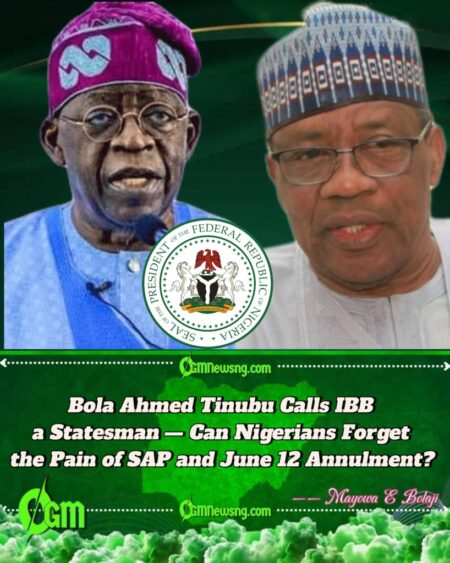
Bola Ahmed Tinubu began his congratulatory message to former military president Gen. Ibrahim Babangida on his 84th birthday by extolling his “unwavering service to the Nigerian nation.” He emphasized Babangida’s influence on Nigeria’s socio-economic and political development, noting that his reign left behind structures still shaping modern governance. According to Tinubu, IBB’s leadership during a turbulent period “strengthened the country’s unity” and built the foundation for reforms that continue to resonate today.
Bola Ahmed Tinubu described Babangida as a “statesman of rare vision” whose contributions to Nigeria remain indelible in the nation’s history. However, this glowing tribute raises eyebrows among critics who argue that the IBB era was marked more by regression than progress. The 1985–1993 military regime, though credited with some structural reforms, also attracted heavy criticism for authoritarian practices and controversial policies.
Remembering the June 12 Annulment
Bola Ahmed Tinubu’s warm words for Babangida will not erase the bitter memory of the annulled June 12, 1993, election. Nigerians still recall how Babangida nullified what many observers described as the freest and fairest election in the country’s history—an act that derailed democratic momentum and plunged Nigeria into political chaos.
Bola Ahmed Tinubu’s praise now seems to clash with his long-standing image as a democracy activist who resisted military dictatorship. Political analysts argue that Tinubu, once a staunch defender of the June 12 mandate, now walks a delicate line by celebrating the man responsible for its annulment. This irony fuels debates about whether Tinubu’s tribute is an act of reconciliation or a revision of history.
IBB’s Economic Policies: Reform or Ruin?
Bola Ahmed Tinubu highlighted IBB’s “courageous economic reforms” that attempted to open Nigeria’s markets to global competition. Under Babangida’s regime, the Structural Adjustment Programme (SAP) was introduced, which shifted the economy toward liberalization and deregulation. Supporters of the policy recall that it created opportunities for investment and private-sector growth, while attempting to curb Nigeria’s dependence on oil revenues.
Bola Ahmed Tinubu’s emphasis on these reforms, however, overlooks the deep scars SAP left on millions of Nigerians. The program led to widespread inflation, job losses, and the collapse of local industries. Critics argue that IBB’s economic experiment worsened poverty and created the foundation for today’s economic inequalities. By celebrating Babangida’s economic record, Tinubu risks reopening debates about whether SAP was an economic rebirth or a national betrayal.
Human Rights Record Under Scrutiny
Bola Ahmed Tinubu lauded Babangida as a “patriotic soldier” whose rule was guided by national interest. Yet, civil society organizations remember his years in power for repression, intimidation, and clampdowns on dissent. The regime’s record on human rights—marked by imprisonment of activists, curtailment of press freedom, and silencing of opposition voices—remains one of its darkest legacies.
Bola Ahmed Tinubu’s glowing tribute appears to sidestep these troubling chapters. Critics insist that celebrating Babangida without acknowledging the authoritarian shadows of his reign amounts to rewriting history. For victims of his regime, including journalists and pro-democracy activists, the birthday praise reopens wounds of a past yet to be reconciled.
Tinubu’s Political Calculations
Bola Ahmed Tinubu’s birthday message may carry more than mere goodwill. Analysts suggest it is a strategic gesture aimed at consolidating political alliances among Nigeria’s northern elite. IBB, despite being retired from active politics, still wields influence in the corridors of power, particularly in the North-Central region. Aligning himself with such figures may strengthen Tinubu’s legitimacy as he navigates governance challenges and rising opposition.
Bola Ahmed Tinubu’s political maneuvering, however, risks alienating the democratic base that propelled him into prominence. Many Nigerians who trusted his democratic credentials during the pro-June 12 struggle may see this gesture as a betrayal. The political cost of praising Babangida may outweigh the benefits if it deepens public mistrust in Tinubu’s commitment to democratic ideals.
Nigerians React: Celebration or Controversy?
Bola Ahmed Tinubu’s tribute has sparked heated debates across social media and political circles. While some Nigerians see the message as a mature act of reconciliation, others interpret it as hypocrisy and political opportunism. The polarizing nature of IBB’s legacy ensures that any praise directed at him will remain contentious.
Bola Ahmed Tinubu’s challenge now lies in balancing statesmanship with historical accountability. Celebrating Babangida’s birthday without acknowledging his controversial past risks undermining the credibility of Tinubu’s democratic struggle. For many Nigerians, this moment is less about honoring an elder statesman and more about questioning the selective memory of their current president.
Table of Contents
Discover more from OGM News NG
Subscribe to get the latest posts sent to your email.