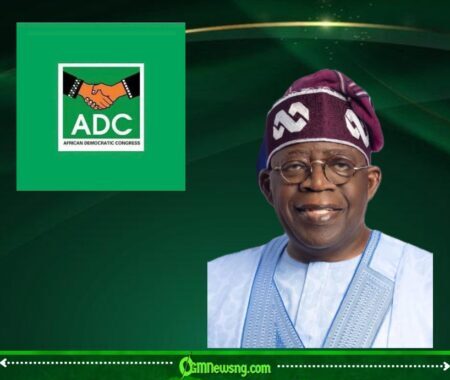





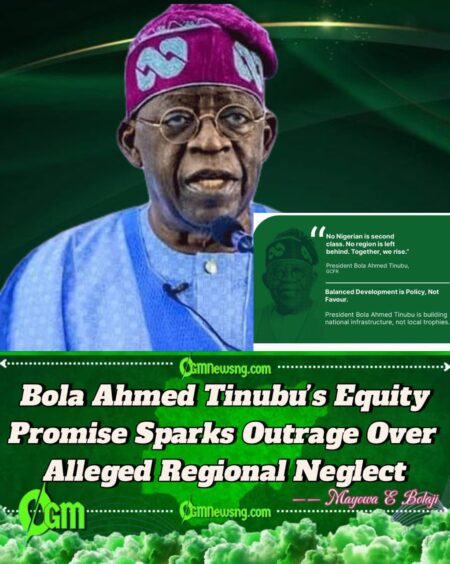
Bola Ahmed Tinubu began his remarks with a solemn declaration: “No Nigerian is second class, no region is left behind. Together we will rise as one nation, one people, and one destiny.” According to him, this principle is not merely a political slogan but the anchor of his presidency. His words reignited debates across the country about fairness, inclusivity, and justice in governance.
Bola Ahmed Tinubu emphasized that his oath of office compels him to prioritize all regions equally, challenging accusations of lopsided development. He framed his administration as one committed to rewriting the narrative of favoritism in Nigerian politics, positioning himself as a leader for all tribes, religions, and socio-economic classes.
Equity Promises vs. Ground Realities
Bola Ahmed Tinubu insists that his equity-driven agenda translates into real-time development projects across northern, eastern, and southern regions alike. He cited infrastructure expansion, healthcare renewal, and educational reforms as proof that his leadership is deliberately inclusive.
Bola Ahmed Tinubu, however, faces fierce criticism from citizens who argue that promises of equity remain rhetoric while poverty, insecurity, and unemployment continue to dominate their lives. Critics claim his statements are at odds with the lived experiences of many Nigerians struggling with uneven access to resources and opportunities.
Regional Politics and the Burden of Suspicion
Bola Ahmed Tinubu argues that Nigeria’s history of sectional politics is being dismantled under his leadership. He maintains that his appointments, policies, and projects are guided by merit and national interest rather than ethnic loyalty.
Bola Ahmed Tinubu has nonetheless become a target of skepticism, with opposition voices claiming that certain regions receive preferential treatment in federal projects and political appointments. The ongoing suspicion reveals how deep the scars of regional distrust run in Nigeria’s democracy.
Economic Justice as a Pillar of Unity
Bola Ahmed Tinubu stresses that economic inclusion is the most powerful driver of national unity. By fostering small businesses, enhancing credit access, and expanding digital opportunities, he pledges to ensure that every Nigerian, regardless of region, can benefit from the nation’s wealth.
Bola Ahmed Tinubu highlights reforms in fuel subsidy removal, power sector investment, and youth entrepreneurship as examples of his government’s determination to uplift marginalized groups. Still, analysts argue that rising inflation, joblessness, and naira instability undermine these lofty goals, making Nigerians question whether equity is achievable without economic balance.
Security Challenges Threatening the Unity Agenda
Bola Ahmed Tinubu acknowledges that insecurity—from terrorism in the Northeast to banditry in the Northwest and separatist agitations in the Southeast—threatens to derail his unity mission. He insists that no region will be abandoned in the fight against violence and instability.
Bola Ahmed Tinubu believes a strong national security architecture is essential for true equity, as no citizen can thrive under fear. Yet, security failures continue to fuel anger, with citizens in conflict-prone areas accusing the government of negligence and selective intervention.
The Destiny of One Nigeria: Vision or Illusion?
Bola Ahmed Tinubu paints a vision of Nigeria as a single family, undivided by tribe, religion, or political affiliation. He insists that unity is not an abstract idea but a lived reality that must be reflected in governance, resource allocation, and justice delivery.
Bola Ahmed Tinubu faces the ultimate test: transforming soaring rhetoric into practical results. While his words inspire hope, the growing dissatisfaction across the country threatens to cast his promise of “no Nigerian is second class” as political poetry rather than national policy.
Table of Contents
Discover more from OGM News NG
Subscribe to get the latest posts sent to your email.