






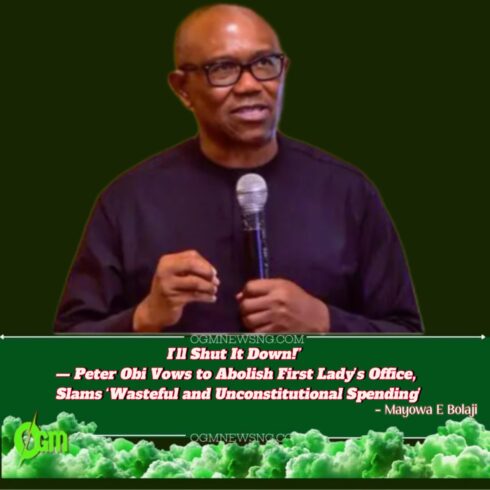
Peter Obi, the Labour Party presidential candidate, has ignited political turbulence by vowing to dismantle the Office of the First Lady if elected President. His declaration, made during a high-level policy forum in Abuja, condemned the allocation of significant public funds to an unelected and unofficial office, stating bluntly, “Nobody voted for her. It’s me they voted for, and I’ll shut it down.”
In a nation grappling with bloated governance costs and widespread corruption, Obi’s remarks have struck a nerve—polarizing the public and political elite alike. Here’s an in-depth look into the layers of controversy his statement has triggered.
Peter Obi began his controversial remarks by expressing disbelief at the scale of public funds funneled into the Office of the First Lady. “It is unacceptable that the wife of a president, who holds no constitutional office, receives more budgetary allocation than some federal ministries,” he said firmly. Obi maintained that this office has morphed into an extravagant institution, surviving on state funds without democratic legitimacy.
Peter Obi insisted that such expenditures reflect a distortion of priorities in governance. He noted that while ministries tasked with development and innovation often struggle for funding, a symbolic office with no legal standing thrives unchecked. “That is why Nigeria is not working,” Obi said. “We must plug the holes.” Peter Obi pledged to take immediate action against what he called “executive waste.” He stated unequivocally: “On the first day I assume office, I will shut down the Office of the First Lady. Not because I have anything personal against any woman, but because we must end institutional excess and respect the constitution.”
Peter Obi emphasized that leadership must be accountable and streamlined. “You cannot be talking about cutting costs and still allow parallel offices that serve no constitutional purpose,” he declared. His statement signaled not only fiscal discipline but a challenge to entrenched political norms that, in his view, enable systemic abuse.
Peter Obi Garners Support from Reformists and Civil Groups
Peter Obi’s statement has been met with applause from civil society organizations and budget transparency advocates who have long criticized the ambiguous nature of the First Lady’s spending. “What I said is not anti-women; it’s pro-governance,” Obi clarified. He explained that institutionalizing unofficial roles only invites corruption and reduces efficiency.
Peter Obi added that a constitutional democracy must be based on merit, transparency, and the rule of law. “You cannot continue to empower an office that is invisible in the constitution while expecting reforms to succeed,” he said. Reform-minded citizens and watchdog groups are now rallying behind his vision, hailing it as a step toward lean, efficient government.
Peter Obi Faces Backlash from Political Establishment
Peter Obi’s comments, however, triggered swift backlash from prominent figures in both the All Progressives Congress (APC) and the Peoples Democratic Party (PDP). “They are attacking me because I am disrupting the tradition of entitlement,” Obi responded. “But the truth remains that this office is an illegitimate burden on the public purse.”
Obi dismissed claims that his stance is sexist or politically naive. “It is not about gender; it is about governance,” he argued. He emphasized that his wife, should he become president, would not assume any taxpayer-funded role or office. “This is how public trust is built,” he asserted, “by doing away with excess and focusing on service.”
Peter Obi Challenges Constitutionality of the Office
Peter Obi questioned the legality of the Office of the First Lady, saying, “Tell me where in the Nigerian Constitution that office exists. You won’t find it. Yet, we allocate billions to it.” He argued that Nigeria’s democracy must adhere to constitutional definitions and not indulge in inherited military-era traditions.
Peter Obi noted that formalizing such offices without legislative approval sets a dangerous precedent. “You don’t strengthen democracy by expanding unofficial power centers,” he said. Legal experts, including those aligned with Obi’s campaign, have cited his argument as constitutionally sound, igniting a wider debate on the need to reform Nigeria’s executive architecture.
Peter Obi Signals 2027 Reform Agenda—But Will It Backfire?
Peter Obi portrayed his anti-First Lady stance as part of a broader 2027 governance reform agenda. “We are building a new Nigeria,” he said. “A Nigeria where public funds serve the public—not ceremonial positions.” He suggested that true leadership must prioritize impact over optics, no matter how controversial.
Peter Obi acknowledged the political risks of his bold pronouncement but remained undeterred. “Leadership is not popularity—it is responsibility,” he declared. As conversations swell around his statement, analysts believe this move could either boost his reformist image or alienate crucial voter demographics, especially women and traditionalists.
Peter Obi’s vow to scrap the Office of the First Lady has sparked one of the most contentious debates in Nigeria’s recent political discourse. While many hail his stance as a necessary blow against waste and unconstitutionality, others see it as a risky gamble. Whether it elevates his 2027 presidential ambition or damages his appeal remains to be seen—but it has undoubtedly reshaped the national conversation on what true governance should look like.
Table of Contents
Discover more from OGM News NG
Subscribe to get the latest posts sent to your email.