





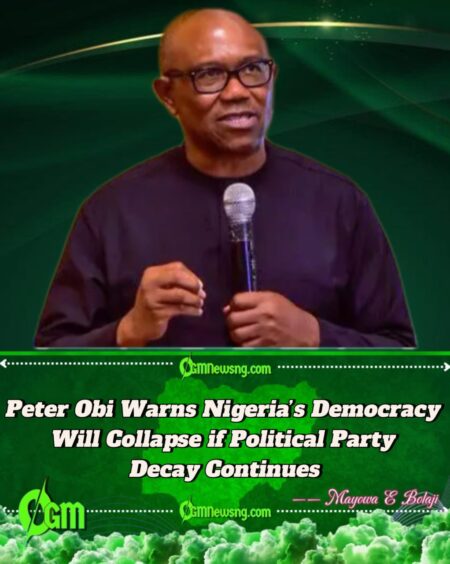
Peter Obi has accused top government officials of deliberately undermining Nigeria’s political party system, alleging that personal greed and unchecked corruption have replaced ideology and national interest. Speaking during a policy dialogue in Lagos, the former Anambra State governor declared that political parties in Nigeria have been reduced to mere vehicles for capturing power, not platforms for advancing the nation’s development.
Peter Obi stressed that the erosion of political party integrity is not accidental but the result of calculated sabotage by individuals in positions of authority. He argued that instead of strengthening democratic institutions, many in government are exploiting party structures to entrench themselves and secure financial benefits, leaving the nation’s democracy weaker and vulnerable.
Failure of Internal Democracy
Peter Obi warned that the absence of internal democracy in most political parties is a ticking time bomb that threatens Nigeria’s political stability. He pointed out that candidate selection has been hijacked by a small clique of political elites who manipulate primaries to impose their loyalists, sidelining competent and visionary leaders.
Peter Obi condemned the growing practice of “godfatherism” and “cash-and-carry” politics, insisting that these anti-democratic habits have turned political parties into business enterprises. According to him, unless internal reforms are urgently implemented, parties will continue to produce leaders who lack the capacity and moral compass to deliver real progress.
Erosion of Ideological Foundations
Peter Obi lamented that most political parties in Nigeria have abandoned any form of ideological foundation, making it difficult for citizens to differentiate between them. He argued that the absence of clear policy direction has left the electorate disillusioned, as parties now change their principles depending on which personalities hold sway.
Peter Obi asserted that ideology is the lifeblood of a credible political party and without it, parties become empty shells driven solely by the ambition of their leaders. He called for a return to value-based politics where party manifestos are not mere campaign documents but binding contracts with the people.
Impact on National Development
Peter Obi argued that the collapse of genuine party politics directly hampers Nigeria’s socio-economic growth. He noted that when parties lose their vision and discipline, governance becomes inconsistent, reactive, and short-term, with each administration abandoning the policies of its predecessor.
Peter Obi further explained that the instability within political parties leads to frequent defections, policy reversals, and leadership crises, all of which create uncertainty for investors and weaken public trust in government institutions. He maintained that the cost of this political recklessness is ultimately borne by ordinary Nigerians.
Call for Grassroots Mobilization
Peter Obi emphasized that the rescue of Nigeria’s political system must begin from the grassroots. He urged citizens to reclaim political parties from corrupt power brokers by participating actively in ward meetings, primaries, and decision-making processes.
Peter Obi challenged young Nigerians in particular to organize themselves, join political parties, and demand transparency in party administration. According to him, the only way to end the stranglehold of corrupt officials is for the masses to take ownership of political structures and enforce accountability.
Reform or Collapse Warning
Peter Obi issued a stern warning that unless urgent reforms are undertaken, Nigeria’s political parties risk total collapse. He recommended transparent funding mechanisms, stricter enforcement of electoral laws, and the establishment of internal dispute resolution systems to reduce rancour and litigation.
Peter Obi concluded by stating that the survival of Nigeria’s democracy depends on the ability of its political parties to evolve beyond personal ambition. He urged all stakeholders — including civil society, the media, and the electorate — to pressure parties into reforms that will restore credibility and public trust.
Table of Contents
Discover more from OGM News NG
Subscribe to get the latest posts sent to your email.