

The G5, once a powerful faction within the Peoples Democratic Party (PDP), was formed in defiance of what its members viewed as injustice in the party’s power-sharing structure. Led by Nyesom Wike, then-Governor of Rivers State, and including Seyi Makinde of Oyo, Samuel Ortom of Benue, Okezie Ikpeazu of Abia, and Ifeanyi Ugwuanyi of Enugu, the group demanded the resignation of National Chairman Iyorchia Ayu to achieve regional balance following Atiku Abubakar’s emergence as the PDP’s presidential candidate in 2023.
Initially, the G5 projected strength and solidarity, presenting a formidable challenge to the PDP’s leadership. However, this unity began to unravel after Wike shockingly supported APC candidate Bola Tinubu in the 2023 presidential elections. His subsequent appointment as Minister of the Federal Capital Territory (FCT) under the APC was viewed as a betrayal by many in the PDP, ultimately shattering the G5 alliance. The bloc that once gave the PDP conditional hope soon became a symbol of its deepest fractures.
A Fragmented Opposition: The Cost of Disunity
Beyond the G5, the PDP’s internal strife has had a ripple effect on the broader opposition movement in Nigeria. As plans to form a coalition against the ruling APC ahead of the 2027 elections falter, it is becoming evident that the PDP’s instability is a significant roadblock. Strategy meetings have been delayed, and negotiations with other opposition parties have stalled due to the party’s inability to speak with one voice.
Instead of uniting to form a credible alternative, the opposition is riddled with confusion, suspicion, and overlapping ambitions. With no clear direction, Nigerians are left watching a once-mighty political force consume itself from within. The PDP’s continued infighting not only weakens its position but also undermines democracy by reducing the effectiveness of checks and balances in the system.
Crisis Deepens Despite Reconciliation Efforts
Efforts to mend fences within the PDP have yielded fleeting moments of hope followed by dramatic setbacks. A notable breakthrough occurred during a meeting in Lagos, where the G5 governors agreed to reconcile and recommit to the party’s unity. Optimism grew after a follow-up meeting at Bukola Saraki’s Abuja guest house, where an agreement was reached to recognise Senator Samuel Anyanwu as the party’s National Secretary and to withdraw all related lawsuits.
But this fragile peace was short-lived. During preparations for a zonal congress in Jos, a technical violation shattered the agreement. The invitation letter was signed not by Anyanwu but by Deputy National Secretary Architect Setonji Koshoedo, breaching the terms of the Abuja consensus. The Independent National Electoral Commission (INEC) boycotted the event in response, deepening the crisis.
What should have been a step toward unity became another public embarrassment for the PDP. The incident not only highlighted the party’s disregard for its own internal agreements but also exposed its inability to enforce discipline and structure among its ranks.
Fallout and Fury: The Makinde–Wike Breakdown
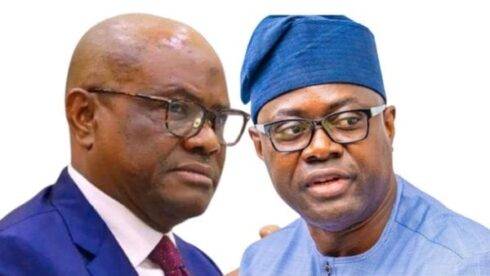
The fallout from the Jos congress quickly escalated into a personal and political confrontation between Wike and Makinde. In a scathing statement titled “PDP Crisis: My Position,” Wike accused Makinde of breaching their agreement and attempting to undermine Senator Anyanwu by promoting Ude Okoye as the National Secretary. He also alleged that Makinde rejected a gubernatorial communication signed by Anyanwu—an action Wike saw as direct sabotage.
This marked the complete breakdown of what was once a powerful political alliance between the two. Their relationship, once built on shared strategy and common goals, has now devolved into open hostility. The G5, which they once co-led, has become a casualty of this bitter feud, now characterized by deep mistrust and political brinkmanship.
The consequences are dire. Wike has since withdrawn from all reconciliation efforts, leaving a gaping hole in the party’s efforts to stabilize. The rift between these two influential leaders has not only weakened the PDP further but has also set a precedent for personal ambition superseding party loyalty.
Division on Display: PDP Under Siege
The public manifestation of the PDP’s internal crisis reached new heights at its 99th National Executive Committee (NEC) meeting, held at Legacy House in Abuja. The party’s National Secretariat had earlier been sealed by the FCT Administration—an act many interpreted as Wike’s influence at play, now wielded from his position in the APC-led federal government.
Prominent figures such as Atiku Abubakar, Wike, Samuel Anyanwu, Sule Lamido, and David Mark were conspicuously absent, casting further doubts on the party’s stability. Though Atiku’s camp claimed a scheduling conflict, the absence of key stakeholders sent a message of disunity at the highest level.
Although the NEC meeting approved the formation of convention planning and zoning committees, it failed to address the fundamental dispute over the National Secretary position. Once again, the PDP held a major meeting that produced more questions than answers—a pattern that has become emblematic of its descent into dysfunction.
A Party in Peril
From its days of national dominance between 1999 and 2015, the PDP has now become a shadow of itself, mired in leadership battles, strategic missteps, and bitter personal rivalries. The breakdown of the Makinde-Wike alliance is only the latest chapter in a saga of self-inflicted wounds.
As Nigerians look ahead to 2027, the central question remains: Can the PDP heal itself in time to mount a credible challenge to the APC? Or will it continue to spiral into political irrelevance, offering fewer choices to the electorate and weakening the nation’s democratic framework?
For now, the signs are troubling. The PDP is not just divided; it is under siege—from within and without.
Table of Contents
Discover more from OGM News NG
Subscribe to get the latest posts sent to your email.