






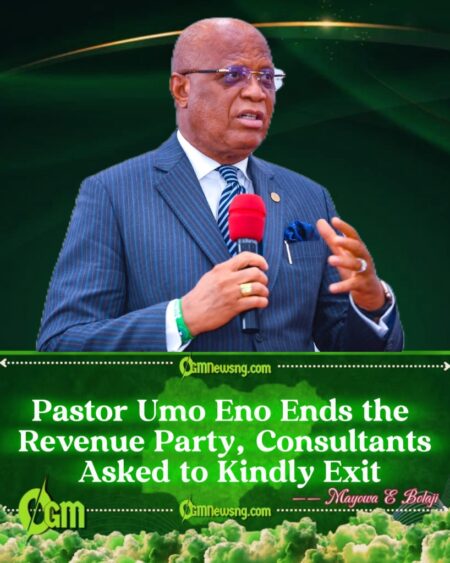
Pastor Umo Eno has ordered the immediate termination of all contractors and consultants engaged by the Akwa Ibom State Government in revenue-related activities, marking a decisive policy shift in the administration of public finances. The governor’s declaration covers every sector where private individuals or firms interface with government revenue, including transportation services, motor parks, and other income-generating operations across the state.
Pastor Umo Eno made it clear that the directive is comprehensive and non-selective, leaving no category of revenue consultant or contractor exempted. By emphasizing that all such engagements are terminated, the governor signaled an end to fragmented reforms and opted instead for a sweeping reset of the state’s revenue architecture.
Pastor Umo Eno’s move is widely interpreted as a firm statement of intent to strengthen government control, reduce revenue leakages, and enforce accountability. The decision suggests that the administration is prepared to overhaul existing systems entirely rather than attempt incremental adjustments that may leave underlying problems unresolved.
Curtain Falls on Private Revenue Collection Arrangements
Pastor Umo Eno has effectively brought to a close an era in which private consultants and contractors played dominant roles in revenue collection and management in Akwa Ibom State. Over the years, such arrangements were introduced to improve efficiency and boost internally generated revenue, but they often generated controversy and public skepticism.
Pastor Umo Eno’s directive responds to long-standing concerns over transparency, contract integrity, and the proportion of public funds retained by intermediaries. Critics of the old system have repeatedly argued that outsourcing revenue collection weakened government oversight and created opportunities for abuse.
Pastor Umo Eno appears undeterred by the potential pushback from affected contractors and vested interests, choosing instead to prioritize institutional reform. The abrupt nature of the termination underscores the administration’s determination to assert authority and redefine how public revenue is handled in the state.
Governance Impact and the Road Ahead
Pastor Umo Eno now places the responsibility for revenue collection squarely on government agencies, a move that carries both opportunity and risk. In the short term, the state must ensure that the exit of contractors does not disrupt revenue inflow, especially in high-traffic sectors such as transport and motor park administration.
Pastor Umo Eno is expected to back the decision with structural reforms, including improved internal controls, deployment of technology, and capacity building within the civil service. If these measures are effectively implemented, the state could see increased revenue retention and a more transparent financial system.
Pastor Umo Eno’s action goes beyond fiscal policy and speaks directly to governance philosophy. By dismantling private revenue arrangements, the governor projects an image of firmness and reform-minded leadership, a stance that could strengthen public trust and redefine the relationship between the Akwa Ibom State Government and its revenue sources.
Table of Contents
Discover more from OGM News NG
Subscribe to get the latest posts sent to your email.