




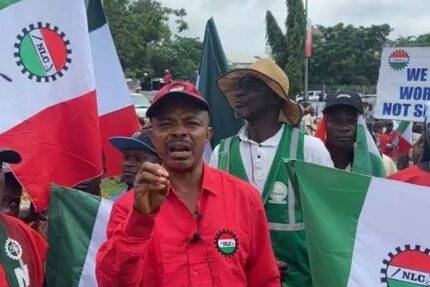
The Organized Labour both Nigeria Labour Congress (NLC) and Trade Union Congress (TUC) presented a comprehensive 20-point demand to the Federal Government during the 2025 May Day celebrations at Eagles Square, Abuja. Central to these demands was a call for economic justice in the face of mounting inflation and deteriorating living conditions for Nigerian workers.
NLC President Joe Ajaero, speaking on behalf of organized labour, emphasized the urgent need for salary adjustments that reflect current economic realities. Labour leaders criticized the existing PAYE tax system, demanding greater transparency in how deductions are calculated and applied. They also rejected the Tax Bills currently before the National Assembly, arguing that these legislative initiatives have excluded the voices of Nigerian workers from the policy formulation process.
The labour union expressed frustration with what they described as the continued prioritization of corporate profits over the survival of ordinary Nigerians. They called for economic reforms that would shift focus toward the people rather than private interests, insisting that workers cannot continue to bear the brunt of inflation, rising costs, and policy failures.
Labour Union Push for Retirement Age Extension and Pension Reforms
A significant demand from the labour unions was the extension of the revised retirement age of 65 years or 40 years of service—currently enjoyed by teachers, health professionals, and judges—to all public servants. This proposal, presented by NLC President Joe Ajaero, aims to standardize retirement benefits across the civil service.
The unions also demanded the immediate settlement of all outstanding allowances, pensions, and gratuities across the country. They emphasized that retired public servants, who devoted decades to national service, deserve a dignified and secure retirement. Labour raised concerns about what they described as dehumanizing verification exercises faced by retirees, calling for more humane and efficient systems that respect the dignity of the elderly.
Additionally, the unions pushed for the establishment of a nationally accepted minimum pension that guarantees retirees a life of dignity and demanded that pensions be automatically adjusted following inflationary trends to protect their real value. The restoration of gratuity payments was also highlighted as essential, with labour arguing that public servants who served diligently for decades deserve a dignified exit comparable to political office holders who serve for much shorter periods.
Calls for Democratic Accountability and Governance Reforms
On matters of governance, the labour unions demanded democratic accountability, transparency, and urgent electoral reforms. They condemned what they described as a sustained suppression of civic space and dissent, calling on both federal and state governments to stop actions that erode citizens’ rights and instead work to strengthen democratic norms.
A specific demand was the urgent reversal of the “unconstitutional suspension” of the elected government of Rivers State via a state of emergency, which labour described as “alien to our laws.” The Trade Union Congress in Rivers State took a stronger stance by boycotting the 2025 Workers’ Day celebration in protest against the emergency rule in the state, which they characterized as “hasty and unconstitutional.”
Labour leaders reaffirmed their commitment to defending the rights and welfare of Nigerian workers, calling on the government to engage in genuine dialogue and to treat workers not as adversaries but as partners in the effort to build a just, prosperous, and equitable nation. They also demanded the expansion of the National Labour Advisory Council’s activities and increased meeting periods.
Security Concerns and Essential Services Reform
Security emerged as a major theme in the labour unions’ address. They called for an immediate end to the widespread killings and bloodshed across the country, labeling the violence as genocidal and intolerable. The unions expressed deep concern over the safety of Nigerian workers, both within their workplaces and in the general environment, urging the government to prioritize the protection of lives.
Beyond physical security, the unions demanded reforms in essential services such as energy, infrastructure, and public utilities. They emphasized that these services must be oriented toward serving the public interest rather than private gains. In line with this, the organized labour reiterated its longstanding demand for a comprehensive review, with the ultimate aim of a reversal of the electricity sector privatization, which they argued has failed to improve service delivery while deepening economic hardship for consumers.
Labour also condemned the continued indiscriminate registration of new unions in sectors where existing unions already have effective coverage, warning that such actions weaken organized labour and threaten its coherence. They called for safe workplaces, the right to organize, and protection from state and employer violence.
Government Responses and Commitments
In response to the labour demands, President Bola Tinubu, represented by the Minister of Labour and Employment, Maigari Dingyadi, pledged a “labour-first agenda” that prioritizes tougher workplace protections, employment security, and a frontal assault on under-employment. He described labour as “the backbone of our society” and outlined wide-ranging reforms spanning job creation, civic participation, and an intensified fight against corruption.
The President linked these pledges to Nigeria’s pending membership of the International Labour Organisation’s Global Coalition for Social Justice, saying the step would “anchor our labour administration system in world-class standards” across six pillars ranging from social protection to skills investment. He also acknowledged the economic hardship facing Nigerians, citing food and fuel costs, sporadic insecurity, and widespread pressure to provide necessities for families.
State governors across the country also made various commitments to workers’ welfare. In Kebbi State, Governor Nasir Idris announced the procurement of 200 residential houses for distribution to workers. Ogun State Governor Dapo Abiodun revealed that his administration had spent N179.7 billion in settling pensions and gratuities for state and local government retirees since its inception in 2019. Osun State Governor Ademola Adeleke announced the release of N4 billion for the settlement of retirement benefits of retirees under the Contributory Pension Scheme.
The Minister of the Federal Capital Territory, Nyesom Wike, directed chairmen of the six Area Councils in the FCT to immediately implement and pay arrears of the national minimum wage to their workers, revealing that the FCT Administration had already disbursed N4.16 billion to the councils for this purpose. Akwa Ibom State Governor Umo Eno celebrated the state workers and noted that his government had raised the minimum wage to N80,000, one of the highest in the nation.
Despite these commitments, labour leaders maintained that more needs to be done to address the economic challenges facing Nigerian workers, with the Akwa Ibom NLC chairman noting that even the N80,000 minimum wage was no longer realistic given current economic conditions.
Table of Contents
Discover more from OGM News NG
Subscribe to get the latest posts sent to your email.