



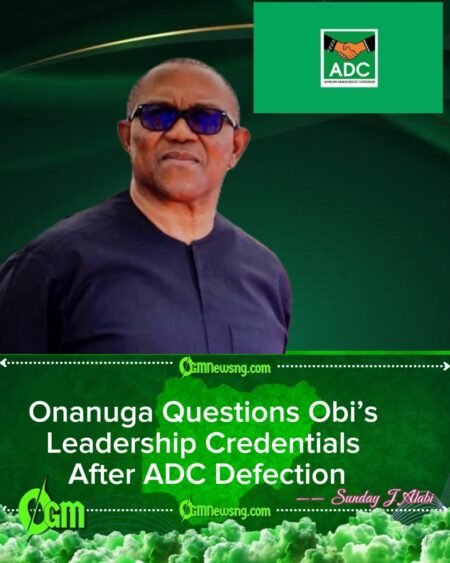
The Special Adviser to the President on Information and Strategy, Mr Bayo Onanuga, has sharply criticised former Labour Party presidential candidate, Mr Peter Obi, following his formal defection to the African Democratic Congress (ADC). Reacting to the development on Wednesday, Onanuga dismissed Obi’s political relevance, describing him as a politician without the leadership pedigree required to govern Nigeria, while suggesting that his latest move reflects lingering discontent over the outcome of the 2023 presidential election.
Mr Obi, a former governor of Anambra State, contested the 2023 presidential election on the platform of the Labour Party, where he emerged third behind President Bola Tinubu of the All Progressives Congress (APC) and former Vice President Atiku Abubakar of the Peoples Democratic Party (PDP). His defection to the ADC has since triggered fresh political debates and speculation ahead of the 2027 general election.
Defection to ADC and Renewed Political Speculation
Peter Obi’s exit from the Labour Party marks another shift in a political journey that has seen him move across several platforms, including the All Progressives Grand Alliance (APGA) and the PDP. His decision to align with the ADC has been widely interpreted by political observers as a strategic repositioning ahead of 2027, particularly amid growing expectations that Atiku Abubakar may once again seek the presidency.
Obi previously served as Atiku’s running mate in the 2019 presidential election, a partnership that ended in defeat. The renewed association being speculated upon has raised questions about whether Obi is positioning himself for a similar role in the future, rather than pursuing an independent presidential ambition.
Onanuga echoed this view in his comments, projecting that Obi would ultimately play a secondary role within the ADC. He argued that Obi’s political movements suggest a lack of ideological consistency and long-term vision, rather than a principled alignment with clearly defined policy goals.
Onanuga’s Assessment of Obi’s Leadership Record
In a post shared on his verified X handle, Onanuga described Obi as a “wandering politician,” accusing him of political instability and persistent bitterness over the 2023 election results. According to the presidential aide, empirical analyses of the election showed that Obi was never in a position to win, and that his third-place finish was aided by what he termed anomalous voting patterns in the South-East.
Onanuga further criticised Obi’s public rhetoric, particularly his frequent references to foreign models of development and academic theories. He argued that Obi’s approach reflected an overreliance on external examples, which may not be suitable for Nigeria’s unique socio-economic realities.
Drawing attention to Obi’s tenure as governor of Anambra State, Onanuga described it as unimpressive, asserting that successful private enterprise does not automatically translate into effective national leadership. He maintained that governing a complex and diverse country like Nigeria requires originality, adaptability, and a deep understanding of local challenges.
Contrasting Visions: Tinubu Administration and Economic Reforms
In contrast to his critique of Obi, Onanuga highlighted what he described as significant achievements recorded under President Bola Tinubu since assuming office on May 29, 2023. He cited the removal of petrol subsidies, economic restructuring, and reduced dependence on oil revenue as key policy decisions aimed at stabilising the economy.
According to him, the administration has also prioritised gas development, attracted both foreign and domestic investment, and improved Nigeria’s foreign reserves. He added that recent efforts have contributed to a more stable exchange rate and a gradual slowdown in inflation.
Onanuga also referenced large-scale infrastructure projects, including the Lagos–Calabar Coastal Highway and the Sokoto–Badagry Superhighway, alongside planned tax reforms expected to take effect in January. He said these reforms would harmonise Nigeria’s tax system, increase revenue, and improve the country’s tax-to-GDP ratio, arguing that such initiatives reflect what he described as purposeful and strategic leadership.
Table of Contents
Discover more from OGM News NG
Subscribe to get the latest posts sent to your email.