



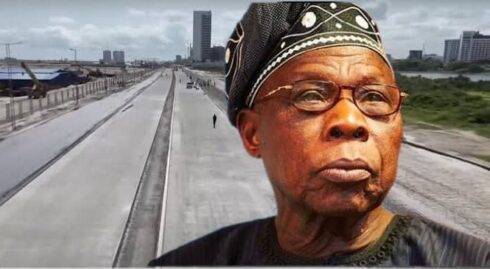
Former President Olusegun Obasanjo has sharply criticized the Bola Tinubu-led administration for what he describes as reckless and corrupt spending on infrastructure projects. In his new book, Nigeria: Past and Future, Obasanjo particularly condemned the N15.6 trillion Lagos-Calabar Coastal Highway project, calling it a misplaced priority that serves as a conduit for corruption.
The obasanjo also took issue with the government’s decision to spend N21 billion on a new residence for Vice President Kashim Shettima, labeling it another example of financial recklessness at a time when millions of Nigerians are struggling with economic hardship. His comments, which appear in Chapter Six of the book, reflect his broader concerns about governance and accountability in Nigeria.
Questions Over Transparency in Awarding the Highway Contract
The Lagos-Calabar Coastal Highway, a 700-kilometer project, has been met with widespread criticism over its cost and execution. Minister of Works, David Umahi, revealed that the project would cost N4.93 billion per kilometer and was awarded without competitive bidding to Gilbert Chagoury’s Hitech Construction Company. This has fueled suspicions of favoritism, as Chagoury is widely known to be a close ally of President Tinubu.
Many opposition figures, including former Vice President and 2023 presidential candidate Atiku Abubakar, have questioned why such a massive contract was handed out without due process. Despite the backlash, Umahi defended the decision, claiming that it was a counterpart-funded project rather than a Public-Private Partnership (PPP). The federal government has already released N1.06 trillion for the pilot phase, which covers just six percent of the highway.
Obasanjo Accuses Nigerian Leaders of Self-Enrichment
In his book, Obasanjo painted a grim picture of Nigeria’s political leadership, describing many past and present officeholders as “ill-prepared, satanic, and self-centered.” He lamented that most politicians seek office solely to amass wealth at the expense of the masses.
The former president cited examples of governors who assumed office while deeply in debt, only to become extraordinarily wealthy within a few years, even without engaging in any business. He expressed concern that state resources are routinely diverted for personal enrichment, with only a fraction being spent on governance. He also criticized those who use borrowed funds and public assets to sustain their extravagant lifestyles, calling them “criminally ridiculous.”
Economic Hardship and Questionable Government Priorities
Obasanjo did not hold back in his assessment of Tinubu’s government, stating that its financial decisions reflect a mindset of entitlement rather than responsibility. He particularly criticized the construction of a new official residence for the Vice President at a cost of N21 billion, questioning why such a project was necessary amid the country’s economic struggles.
“In a time of economic hardship, building a new Vice President’s residence is nothing but a display of misplaced priorities and an attempt to justify looting under the guise of governance,” Obasanjo wrote. He further argued that such expenditures do little to improve the lives of ordinary Nigerians and only serve the interests of a select few in power.
Calls for an African-Centric Political System
Beyond his criticisms, Obasanjo proposed a re-evaluation of Nigeria’s political system, arguing that Western liberal democracy has failed to deliver good governance. He suggested that Nigeria and other African nations should consider an alternative model—what he termed “Afrodemocracy.”
“If the West, from where liberal democracy originated, is now questioning its effectiveness, we should be wise enough to conduct introspection and find a system that reflects our unique African identity,” he wrote. He emphasized the need for a governance structure that prioritizes accountability, transparency, and cultural realities rather than blindly copying Western models.
With his latest critique, Obasanjo has once again positioned himself as a vocal watchdog of Nigerian governance, sparking debate over the direction of the country under Tinubu’s leadership. While the presidency has so far declined to respond to his comments, the concerns he raised are likely to fuel further scrutiny of the Lagos-Calabar Highway project and other government expenditures.
Table of Contents
Discover more from OGM News NG
Subscribe to get the latest posts sent to your email.