




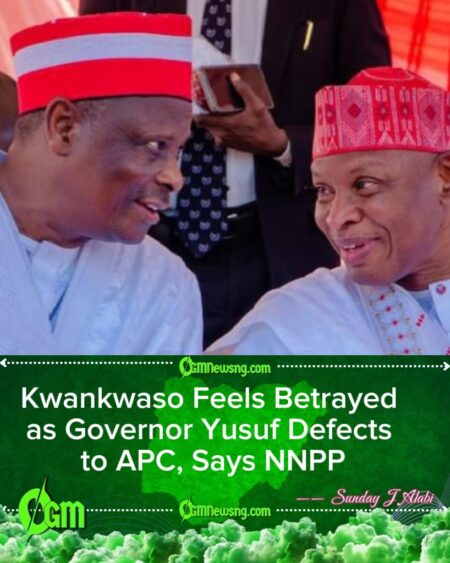
The New Nigeria Peoples Party (NNPP) has described the defection of Kano State Governor, Abba Kabir Yusuf, to the All Progressives Congress (APC) as a profound breach of trust, not only against the party’s national leader, Senator Rabiu Musa Kwankwaso, but also against the electorate that overwhelmingly backed the NNPP in the 2023 governorship election. The party’s leadership says the move undermines the mandate freely given by Kano voters after years of political realignment and electoral struggle.
Speaking during a televised interview on Politics Today on Channels Television, the NNPP National Spokesperson, Ladipo Johnson, said the decision had wider implications for democratic accountability and voter confidence in the state’s political process.
NNPP Reacts: Allegations of Betrayal and Broken Trust
Johnson said Senator Kwankwaso felt personally betrayed by the defection, given his central role in mobilising support and providing leadership that led to the party’s victory in Kano State. According to him, the sense of disappointment extends beyond party leadership to ordinary voters who placed their trust in the NNPP as an alternative to the previous administration.
He argued that Kano residents had endured what they considered eight years of ineffective governance and therefore turned out en masse in 2023 to back the NNPP under Kwankwaso’s leadership. The spokesperson maintained that the governor’s defection, without broad consultation with the electorate, amounted to a disregard for the popular will expressed at the polls.
Johnson stressed that returning power to the APC, a party voters had consciously rejected, represented a fundamental breach of trust, regardless of the political justification offered for the move.
Grassroots Support and the 2023 Electoral Mandate
The NNPP spokesperson further highlighted that the party had no established political structure in Kano prior to the 2023 elections, yet still achieved victory through grassroots mobilisation. He noted that the party lacked councillors and local government chairmen but relied heavily on popular support from ordinary citizens.
According to Johnson, supporters remained loyal to Governor Yusuf throughout prolonged legal battles, including proceedings at the election tribunal, the Court of Appeal, and ultimately the Supreme Court. He said this sustained backing reflected the depth of public commitment to the NNPP project in the state.
He dismissed claims that Governor Yusuf could have won the election without Kwankwaso’s influence, stating that such assertions were politically convenient narratives emerging after the defection.
Internal Party Response and Claims of Exclusion
Another NNPP official, Ibrahim Karaye, the party’s Public Relations Officer, described the defection as painful but insisted that the NNPP remained politically relevant and competitive in Kano State. He said the party continued to enjoy strong grassroots support despite recent developments.
Karaye rejected suggestions that internal crises forced the governor’s exit, alleging instead that party leaders were gradually excluded from the governor’s inner circle. According to him, access to the governor became limited, making it difficult for party officials to offer advice or engage meaningfully on governance issues.
He maintained that the NNPP remained resilient and capable of mounting a strong political challenge in future elections.
Governor Yusuf’s Defection and Rationale
Governor Yusuf formally joined the APC on Monday, alongside 22 members of the Kano State House of Assembly and nine members of the House of Representatives. The announcement was made during a political gathering at the Government House in Kano.
Explaining his decision, the governor said the move followed consultations across the state and was motivated by governance considerations rather than partisan loyalty. He described political parties as vehicles for service delivery and urged the public to judge his decision based on performance and results.
Yusuf’s rise to power was closely linked to Senator Kwankwaso and the Kwankwasiyya movement, whose grassroots network was widely credited with securing his 2023 electoral victory on the NNPP platform.
Table of Contents
Discover more from OGM News NG
Subscribe to get the latest posts sent to your email.