




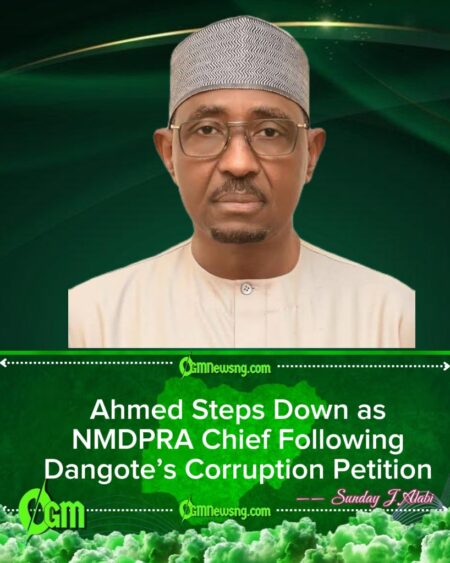
Farouk Ahmed has resigned as the Managing Director of the Nigerian Midstream and Downstream Petroleum Regulatory Authority (NMDPRA) following serious corruption allegations levelled against him by the President of the Dangote Group, Aliko Dangote. The development was confirmed on Wednesday by the Presidential Spokesman, Mr. Bayo Onanuga, who also disclosed that the Chief Executive of the Nigerian Upstream Petroleum Regulatory Commission (NUPRC), Mr. Gbenga Komolafe, has exited his position.
According to the Presidency, President Bola Tinubu has forwarded the names of two nominees to the Senate for confirmation as replacements. The President urged lawmakers to expedite the confirmation process in order to ensure continuity in the regulation of Nigeria’s critical oil and gas sector.
This high-level reshuffle comes amid heightened public scrutiny of regulatory agencies in the petroleum industry, following allegations of corruption, economic sabotage, and regulatory bias that have dominated public discourse in recent days.
Presidential Action and Regulatory Leadership Changes
In his statement, Mr. Onanuga revealed that President Tinubu nominated Mr. Oritsemeyiwa Eyesan as the new Chief Executive Officer of the NUPRC, while Mr. Saidu Mohammed was nominated as the Chief Executive of the NMDPRA. The Presidency described both nominees as seasoned professionals with extensive experience in the oil and gas industry.
The President’s decision to seek swift Senate confirmation underscores the administration’s intention to maintain stability in the energy sector, which remains central to Nigeria’s economic recovery and fiscal planning. The oil and gas industry accounts for a significant share of government revenue and foreign exchange earnings.
Hours before his resignation, Mr. Ahmed had visited President Tinubu at the State House in Abuja. The visit, which lasted less than 30 minutes, attracted media attention, though the former NMDPRA chief Mr Ahmed declined to speak with journalists afterward, stating that official work hours had ended. The purpose of the visit was not disclosed.
Dangote’s Petition and Corruption Allegations Against Mr Ahmed
Mr. Ahmed’s resignation followed a formal petition submitted to the Independent Corrupt Practices and Other Related Offences Commission (ICPC) by Aliko Dangote. Through his lawyer, Mr. Ogwu Onoja, the industrialist accused the former regulator of corruption and financial impropriety and called for his arrest, investigation, and prosecution.
In the petition, Dangote alleged that Ahmed was living beyond his legitimate means, citing the education and upkeep of four of his children in Switzerland. He claimed that approximately five million dollars was spent on secondary education and living expenses over six years, with an additional two million dollars allegedly spent on tertiary education. This included an alleged payment of 210,000 dollars for a 2025 Harvard MBA programme for one of Ahmed’s children.
Dangote urged the ICPC to act decisively in the interest of justice and to protect the image of the Tinubu administration. The anti-graft agency acknowledged receipt of the petition and assured the public that the allegations would be duly investigated.
Regulatory Dispute and Industry Tensions
Beyond the corruption allegations, the dispute between Dangote and Ahmed has exposed deeper tensions within Nigeria’s petroleum sector. Dangote recently accused the NMDPRA, under Ahmed’s leadership, of economic sabotage, alleging that regulatory actions were undermining local refining capacity.
At a press conference held at the Dangote Refinery in Lagos, the businessman claimed that the continued issuance of import licences for petroleum products was discouraging domestic refining and perpetuating Nigeria’s dependence on imports. He further alleged that the regulator was colluding with international traders and oil importers to the detriment of local operators.
In response, Ahmed dismissed the accusations as “wild and spurious,” stating that he deliberately avoided public exchanges due to the sensitivity of his position. He maintained confidence that the ICPC investigation would provide an objective platform to address the claims and clear his name.
A Longstanding Feud and Legislative Intervention
The renewed confrontation between Dangote and Ahmed traces back to 2024, when the NMDPRA accused local refiners, including the Dangote Refinery, of producing substandard products compared to imported alternatives. Ahmed also alleged that the refinery sought to monopolise Nigeria’s energy supply, a claim Dangote firmly denied.
At the time, the NMDPRA argued that the Dangote Refinery was still in a pre-commissioning phase and lacked a full operational licence. The disagreement prompted the House of Representatives to intervene, calling for a probe into the matter and recommending Ahmed’s suspension.
With Ahmed’s resignation and the nomination of new regulatory heads, attention now turns to the ICPC investigation and the broader implications for transparency, accountability, and reform in Nigeria’s oil and gas sector.
Table of Contents
Discover more from OGM News NG
Subscribe to get the latest posts sent to your email.