









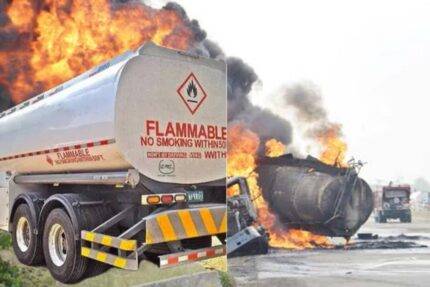
The Nigerian Midstream and Downstream Petroleum Regulatory Authority (NMDPRA) has announced that fuel tankers carrying more than 60,000 litres of petroleum products will be prohibited from operating on Nigerian roads, starting March 1, 2025. This decision comes as part of efforts to reduce road accidents caused by heavy-duty petroleum tankers.
Speaking at a press briefing in Abuja on Wednesday, Ogbugo Ukoha, the NMDPRA Executive Director for Distribution Systems, Storage, and Retailing Infrastructure, confirmed that this resolution was reached following extensive consultations with stakeholders, including security agencies and transport unions. He stated that tankers exceeding the weight limit would no longer be permitted to load at any product depots nationwide.
“This is the first time we have achieved a consensus among all stakeholders to prioritize the safe transportation of petroleum products. We will continue working collaboratively to ensure compliance and reduce the number of truck-related accidents,” Ukoha said.
Stakeholders Endorse New Safety Measures
The decision to impose the ban followed deliberations involving key agencies such as the Department of State Services (DSS), the Federal Fire Service, the Federal Road Safety Corps (FRSC), the National Association of Road Transport Owners (NARTO), the National Union of Petroleum and Natural Gas Workers (NUPENG), and industry regulatory bodies.
According to Ukoha, the primary objective of the ban is to mitigate road fatalities linked to fuel tanker accidents. He noted that overloading contributes significantly to mechanical failures, increased braking distance, and vehicle instability, which in turn lead to catastrophic road crashes.
To ensure compliance, NMDPRA has directed all petroleum product marketers and depot operators to strictly enforce the ban. “No product depot will be allowed to load trucks exceeding 60,000 litres. This is a necessary step to protect lives and properties across the country,” he added.
Regulator Dismisses Allegations of Poor Fuel Quality
Addressing recent concerns about the quality of petroleum products in circulation, Ukoha dismissed allegations suggesting that substandard fuel was being distributed in the Nigerian market. He described such claims as baseless and misleading, emphasizing that all imported and locally refined fuel undergoes rigorous testing before being sold to consumers.
“The regulator does not respond to every claim made on social media. However, it is important to remind the public that all petroleum products are tested at accredited laboratories before distribution. Anyone making unfounded allegations about fuel quality is only misleading Nigerians,” he said.
He further explained that NMDPRA, in collaboration with the Standards Organisation of Nigeria (SON), ensures that all petroleum products meet strict regulatory standards, including parameters such as Research Octane Number (RON), sulfur content, density, and oxygenate levels.
Ensuring Compliance with Petroleum Industry Standards
Ukoha assured Nigerians that NMDPRA remains committed to enforcing compliance with the Petroleum Industry Act (PIA) of 2021. He noted that hydrocarbons are not pure compounds and, therefore, must meet regulatory specifications within a defined range.
“For instance, sulfur levels must be controlled to prevent environmental pollution and engine damage. Similarly, Research Octane Number (RON) is crucial for fuel efficiency and engine performance,” he explained.
Regarding fuel color specifications, he clarified that this measure is a regulatory requirement aimed at preventing misidentification. “The only petroleum product that is colorless is aviation turbine kerosene (ATK). Differentiating fuel products by color helps to prevent mix-ups that could damage vehicle engines or industrial equipment,” Ukoha stated.
Fuel Supply and the Impact of Subsidy Removal by Nigerian Federal government
The NMDPRA executive director also provided insights into the country’s fuel supply situation, revealing that Nigeria’s daily Premium Motor Spirit (PMS) consumption has dropped from an average of 66 million litres before the subsidy removal in May 2023 to around 50 million litres.
“Before the subsidy removal, daily PMS supply was consistently over 60 million litres. However, after President Bola Tinubu’s announcement on May 29, 2023, we observed a sharp decline in fuel consumption,” Ukoha stated.
He further disclosed that local refineries currently supply less than 50% of the total fuel demand, with the shortfall being covered by imports. “None of the Oil Marketing Companies (OMCs) that own refineries in Nigeria have imported PMS this year. The shortfall is being bridged by other marketers, ensuring that there is no scarcity,” he added.
Ukoha reaffirmed the regulator’s commitment to maintaining an uninterrupted fuel supply across the country while ensuring that fuel pricing remains fair and competitive. “We continue to work diligently to support local refineries, enhance domestic refining capacity, and ensure Nigerians have access to quality petroleum products at competitive prices,” he said.
With the new ban on oversized fuel tankers and assurances on fuel quality, the NMDPRA aims to enhance road safety, ensure regulatory compliance, and improve petroleum product distribution across Nigeria.
Table of Contents
Discover more from OGM News NG
Subscribe to get the latest posts sent to your email.