







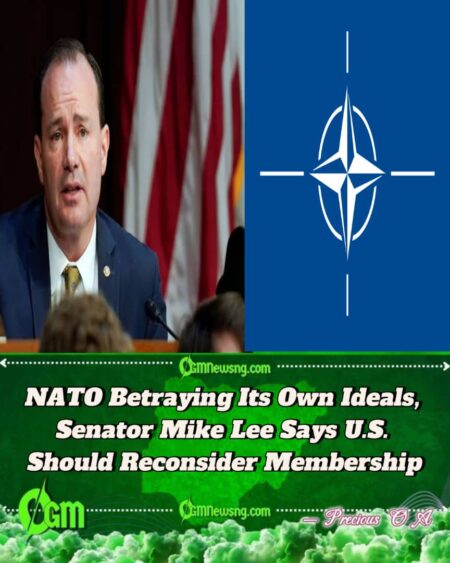
NATO is once again at the center of global debate after sharp criticism from Washington. The alliance, founded to defend liberty and democracy, is now being accused of drifting away from its founding mission as some European governments face charges of silencing opposition through censorship and prosecution.
U.S. Senator Mike Lee of Utah has emerged as one of the strongest voices questioning America’s future role in the alliance. He argued that these practices directly contradict the organization’s stated values and warned that the United States may need to reconsider its membership if the trend continues.
“This violates the very principles that have long united member nations,” Lee declared. “And it undermines the alliance charter. Are we supposed to ignore that?” His words have placed the future of the alliance at the forefront of both American and international political debate.
NATO’s founding charter, signed in 1949, established the alliance on shared values: democracy, individual liberty, and the rule of law. These principles justified a military partnership meant to defend freedom against authoritarian adversaries.
Lee contends that when member states themselves erode these values, the credibility of the alliance suffers. According to him, America cannot indefinitely support an organization that no longer enforces the standards upon which it was built.
This dilemma forces policymakers to confront a difficult question: should the U.S. prioritize strategic security ties at any cost, or should it demand that its allies live up to the commitments they signed onto decades ago?
European Governments in the Spotlight
NATO allies across Europe have come under growing scrutiny for actions viewed as politically motivated. Restrictions on press freedom, prosecutions of opposition leaders, and new controls over digital expression have been condemned by critics as incompatible with democratic norms.
Supporters of these measures defend them as tools to preserve stability and counter extremism. Yet, Lee warns that tolerating such practices without consequences could strip the alliance of its moral authority.
If ignored, these trends may encourage other governments to follow the same path, slowly transforming the alliance from a coalition of democracies into a bloc bound only by convenience.
Divided Opinions in Washington
NATO has long divided American lawmakers. Supporters see it as a vital shield against aggression, particularly from Russia, while critics point to Europe’s dependence on U.S. funding and military might.
Lee’s comments have sharpened this divide by adding a moral argument to the existing financial debate. Some Republicans agree that the alliance has strayed from its ideals, while Democrats insist it remains essential to America’s global role.
The clash reflects an enduring tension: is the alliance purely a strategic tool, or must it also be a principled community of free nations?
The White House Position
NATO has faced repeated criticism from President Trump, who has pushed allies to increase defense spending and assume greater responsibility. He has warned that Washington cannot continue bearing most of the financial and military costs.
Lee’s perspective mirrors this frustration but extends it to values as well as money. His argument implies that unless reforms are made, America risks supporting an alliance that no longer matches its ideals.
The White House has not officially responded, but Lee’s words may shape ongoing discussions inside the administration about the future of the alliance.
Global Consequences of a U.S. Shift
NATO could undergo a seismic shift if the United States were to step back or withdraw. Analysts warn such a move would unsettle European capitals, embolden rivals like Russia, and force Europe into hastily building independent defense structures.
At the same time, remaining within the alliance while some members suppress freedoms may erode America’s credibility as a defender of democracy. This dual risk—strategic instability if Washington leaves and moral compromise if it stays—captures the essence of Lee’s warning.
Global observers now see the debate not only as a budgetary dispute but as a question of whether the alliance still represents the free world.
The Road Ahead
NATO now stands at a decisive crossroads. Lee’s intervention has brought into the open questions that were often confined to diplomatic corridors: whether the alliance is still true to its charter, and whether America should continue to anchor it unconditionally.
The future remains uncertain. Reform could renew the alliance, renewed pledges could restore unity, or unresolved disputes could deepen into fractures. What is clear is that the debate has shifted from quiet criticism to a matter of urgent global concern.
Table of Contents
Discover more from OGM News NG
Subscribe to get the latest posts sent to your email.