




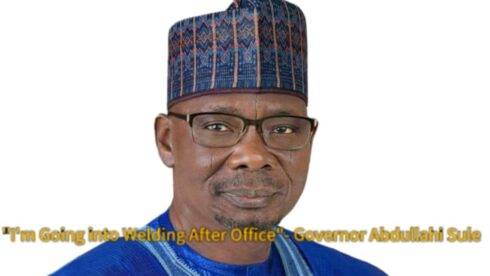
Governor Abdullahi Sule declared -“I’m going into welding,” in a stunning announcement that disrupted the traditional script of Nigerian political retirement. Speaking at a roundtable organized by the Rural Electrification Agency (REA) in Abuja, Sule said he intends to return to his first love—shielded arc and oxyacetylene welding—after leaving office. “I actually started my education as a technician, as a welder, before I became a CNC machinist,” he said.
The governor’s statement was met with surprise and intrigue, sparking conversation about leadership humility, skill valorization, and the need to reframe how Nigerian society views vocational careers. In a political class often accused of clinging to privilege, Sule’s plan to swap agbada for overalls is either an audacious act of authenticity—or a deeply strategic political statement.
A Governor’s Journey from Workshop to Government House—and Back
Abdullahi Sule’s path to power is grounded in industry, not just politics. Having started his career in metal fabrication and machining, he rose through corporate ranks before entering the public sphere. Now, as his second term winds down, he appears eager to return to where it all began—not in a consulting boardroom or diplomatic post, but in the welding bay.
This reversal of career norms is a rarity among Nigeria’s political elite. Most former governors retreat into quiet affluence or vie for federal appointments. Abdullahi Sule’s pivot has drawn both praise and skepticism—some herald it as a powerful statement on dignity in labor, while others see it as a calculated image overhaul amid future political ambitions.
Nasarawa’s Technical Renaissance: From Vision to Execution
At the heart of Abdullahi Sule’s remarks lies a broader vision: a skilled, employable youth population built through institutional reforms. “We made skills acquisition in Nasarawa something of pride,” he said, citing the establishment and elevation of technical colleges that now train staff for major companies, even from Abuja. These centers reportedly offer programs in welding, mechatronics, solar technology, and CNC machining.
The governor’s administration has funneled resources into equipping these institutions and forging partnerships with industry players. Observers credit the initiatives with reducing dependency on white-collar jobs, though some critics argue the impact has yet to be equitably felt across rural communities. Still, Nasarawa appears poised to be a case study in vocational reinvention.
Economic Intent or Elective Symbolism?
Governor Abdullahi Sule insists that his welding ambition reflects a lifelong belief in economic self-reliance. “Most of what we do for investment protection is backed by law,” he noted, referencing the legal frameworks created to attract and safeguard businesses. These include streamlined land access, business registration protocols, and investor-friendly tax incentives.
Yet, detractors raise flags over the true motive behind his welding narrative. Is it a genuine return to roots or a symbolic act to shape legacy? Economic development experts warn that public statements must be followed by measurable outcomes. Until Nasarawa’s local industries and artisans feel real transformation, Sule’s welding pledge may risk being interpreted as rhetorical metallurgy.
Challenging Elitism, Elevating Enterprise
The societal message embedded in Abdullahi Sule’s announcement is profound. In a culture where technical and vocational trades are often sidelined in favor of ‘prestigious’ degrees, a sitting governor openly aligning with welding is a seismic cultural shift. His story challenges Nigeria’s long-standing classism around labor and highlights the need to dignify every form of work.
This messaging is particularly critical at a time when youth unemployment continues to soar. Sule’s statement may inspire both policy and perception change, but long-term impact depends on a collective societal shift. Experts urge federal and state governments to replicate such bold vocational advocacy and embed it into curriculum, funding, and infrastructure development.
A Torchbearer or Just Smoke and Sparks?
As Abdullahi Abdullahi Sule approaches the twilight of his administration, the nation watches to see whether his post-office promise will manifest in real terms. Will he truly pick up a welding torch, or will this become another forgotten footnote in Nigeria’s political playbook? If genuine, Sule may set a precedent unlike any other in Nigerian governance history.
Whether viewed as a symbolic act or a sincere declaration, the conversation he’s started is critical. Abdullahi Sule’s words have lit a spark—now the challenge is to build a flame that outlives his time in office. For a nation in search of skilled hands and credible leadership, welding may yet become the metaphor for the bridge between the two.
Table of Contents
Discover more from OGM News NG
Subscribe to get the latest posts sent to your email.