









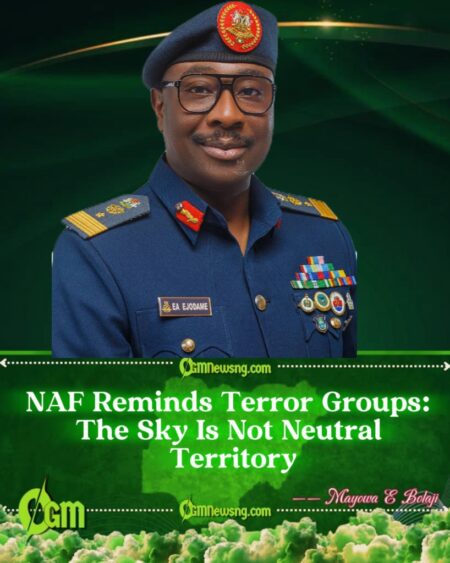
The Nigerian Air Force (NAF) has intensified its aerial campaign against terrorist groups operating across Nigeria’s North-East and North-West, executing a series of precision air interdiction missions that significantly disrupted enemy networks. The operations, carried out between January 1 and 2, were conducted under Operations HADIN KAI and FASAN YAMMA Sector 2, reflecting a coordinated and intelligence-driven approach to counterterrorism.
According to the Director of Public Relations and Information of the NAF, Air Commodore Ehimen Ejodame, the air strikes were based on actionable intelligence obtained through sustained surveillance and reconnaissance. The intelligence pinpointed terrorist movements, hideouts, assembly points, and key supply routes, enabling the Air Force to strike with accuracy and minimal collateral damage.
Ejodame explained that NAF aircraft were deployed to engage identified enclaves and transit corridors deliberately used by terrorist elements to plan attacks and transport logistics. By denying these groups freedom of movement and safe havens, the air operations aimed to weaken their operational momentum and create an enabling environment for ground forces to consolidate gains.
Precision Strikes Cripple Terrorist Strongholds in the North-East
In the North-East theatre, the Nigerian Air Force executed precision strikes on confirmed terrorist hideouts located at Abirma and Chiralia within the notorious Timbuktu Triangle. These locations had been under sustained aerial surveillance, which confirmed their use as facilities for improvised explosive device (IED) production, logistics storage, and attack coordination.
The air strikes successfully destroyed the targeted structures, with multiple secondary explosions observed in the aftermath. According to NAF assessments, these explosions strongly indicated the destruction of concealed explosive stockpiles and other critical logistics, dealing a major blow to the terrorists’ capacity to manufacture and deploy IEDs against both military and civilian targets.
Further interdiction missions were conducted at Guva in the Mandara Mountains, where additional terrorist storage sites and coordination points were identified and neutralised. Ejodame noted that these strikes significantly degraded the groups’ ability to regroup, communicate, and launch further attacks, thereby reducing the immediate threat to surrounding communities.
Expanded Air Campaign Hits Terrorist Convoys in the North-West
The air operations were also extended to the North-West, where NAF aircraft targeted terrorist elements operating around Karaduwa Giginya Na in Matazu Local Government Area of Katsina State.
Intelligence reports revealed that the fighters were moving in large motorcycle convoys, a common tactic used to evade ground patrols and strike vulnerable communities swiftly.
NAF platforms tracked the convoys to a forested convergence point, where the terrorists were engaged in a decisive air strike. The operation resulted in the neutralisation of several fighters, the destruction of multiple motorcycles, and the recovery of assorted weapons believed to have been intended for future attacks.
Air Commodore Ejodame stated that the sustained air campaign underscores the Nigerian Air Force’s unwavering commitment to supporting joint military operations and dismantling terrorist networks across the country. He assured that precision air missions would continue in close coordination with ground forces, with the overarching goal of protecting civilians, degrading terrorist capabilities, and restoring lasting peace and security nationwide.
Table of Contents
Discover more from OGM News NG
Subscribe to get the latest posts sent to your email.