





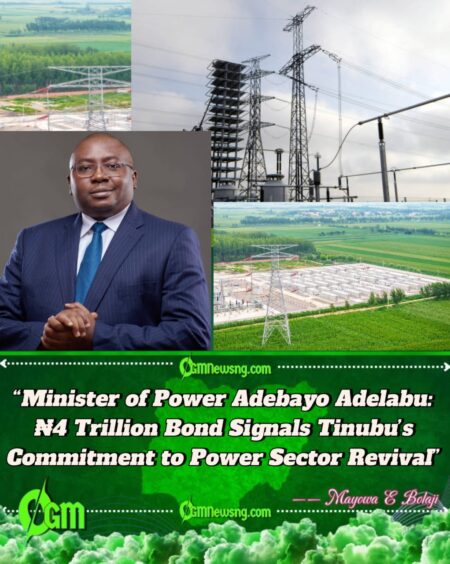
Minister of Power Adebayo Adelabu revealed that President Tinubu’s approval of the ₦4 trillion bond followed extensive consultations with economic advisers, the Ministry of Finance, and relevant stakeholders in the power sector. According to him, the government concluded that resolving the debt overhang was critical to ensuring energy stability and preventing a further decline in generation capacity.
Adebayo Adelabu stressed that the bond issuance is not merely a financial instrument but a strategic intervention to restore liquidity to the sector. By clearing the debts owed to GenCos and gas companies, the government aims to boost confidence, reduce operational bottlenecks, and ensure uninterrupted power generation. He noted that many GenCos had been struggling to stay afloat due to mounting unpaid invoices, while gas firms faced cash-flow challenges in supplying fuel for power plants.
Adebayo Adelabu added that the bond, once implemented, would also help reposition Nigeria’s electricity market. He explained that settling these debts would enable energy firms to reinvest in infrastructure upgrades, expand generation capacity, and provide better service delivery to consumers who have long endured erratic supply.
Adebayo Adelabu on the Challenges Facing the Power Sector
Adebayo Adelabu acknowledged that the Nigerian power sector has suffered decades of inefficiency, underfunding, and systemic problems. He pointed out that the accumulation of debt to GenCos and gas suppliers is only one aspect of a much deeper challenge. Poor transmission networks, electricity theft, non-cost-reflective tariffs, and weak regulatory enforcement remain significant obstacles to achieving steady electricity supply.
Adebayo Adelabu explained that the federal government is working on a comprehensive reform plan that goes beyond settling debts. He noted that the plan includes investments in transmission infrastructure, improving metering systems, and ensuring that tariffs reflect the true cost of production while protecting vulnerable consumers through subsidies.
Adebayo Adelabu also remarked that while ₦4 trillion is a substantial figure, it represents the scale of the problem inherited by the Tinubu administration. He emphasized that unless decisive action is taken now, Nigeria risks further decline in generation capacity and worsening blackouts, which would harm industries, small businesses, and households.
Adebayo Adelabu on the Way Forward and Stakeholder Confidence
Adebayo Adelabu stated that President Tinubu’s approval of the bond is a signal of the government’s seriousness about reforming the sector. He explained that negotiations with GenCos and gas suppliers are already underway to ensure a smooth settlement of the debts. He said the government would work closely with the Debt Management Office (DMO) and financial institutions to structure the bond in a way that is sustainable and transparent.
Adebayo Adelabu further expressed optimism that the move would attract renewed investment into Nigeria’s electricity sector. By settling outstanding obligations, international and local investors are expected to view the Nigerian power market as more bankable and less risky, opening the door to fresh capital inflows.
Adebayo Adelabu concluded by reaffirming the administration’s commitment to ending the cycle of inefficiency. He called for patience from Nigerians, saying that while challenges remain, the bond approval is a turning point that could mark the beginning of stability in the sector. “With this bold step,” he said, “we are laying the foundation for reliable, affordable, and sustainable electricity supply across Nigeria.”
Table of Contents
Discover more from OGM News NG
Subscribe to get the latest posts sent to your email.