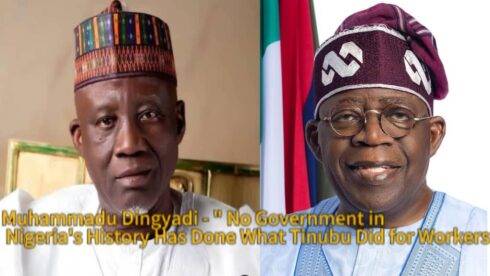
Muhammadu Dingyadi declared with pride that “There has never been a time when any government in this country has raised the take-home pay of workers like President Tinubu did; he raised it from ₦30,000 to ₦70,000.” The Labour Minister made this bold statement on Workers’ Day, igniting a wave of political debates, skepticism, and fact-checks. According to him, the move signals an “unprecedented commitment” to the welfare of Nigerian workers—a historic decision that cements President Tinubu’s legacy in labor relations.
Muhammadu Dingyadi’s sweeping commendation, however, has raised eyebrows. Critics question the metrics, scope, and sincerity of the raise, citing ambiguous implementation timelines and unclear coverage across both public and private sectors. While his words seek to etch Tinubu into labor history, many see them as politically charged and lacking empirical backing, especially as inflation and fuel subsidy removal continue to diminish workers’ real income.
The Economics Behind the Applause: Can Nigeria Afford It?
Muhammadu Dingyadi argued that the wage increment was both “a social necessity and an economic imperative,” describing it as a federal intervention to counteract the mounting pressures of inflation, currency devaluation, and fuel subsidy withdrawal. He claimed the ₦70,000 wage will help “rekindle the dignity of labor,” increase household purchasing power, and stimulate demand across local industries.
Muhammadu Dingyadi’s optimism is not universally shared by economists. Fiscal policy experts warn that without simultaneous productivity gains and inflation control, the wage increase could trigger a spiral of wage-push inflation. They caution that states with weak internally generated revenue (IGR) could default, turning the policy into another federal announcement with no grassroots impact.
Labour Unions Torn Between Commendation and Criticism
Muhammadu Dingyadi urged Nigerian labor unions to “embrace this moment as a turning point for labor relations in the country,” calling on them to “work in synergy with a government that has dared to be different.” His statement was met with cautious optimism from the Nigerian Labour Congress (NLC), which acknowledged the policy’s potential to ease suffering, provided implementation is genuine and uniform.
Muhammadu Dingyadi’s appeal, however, failed to pacify the Trade Union Congress (TUC), which described the announcement as “premature and theatrically inflated.” TUC leaders pointed out that many state workers and even federal agency employees are still receiving the old ₦30,000 wage, months after the supposed increase. Without a codified implementation timeline and actionable benchmarks, they argue, the announcement remains performative.
State Governments Missing in Action Amidst Wage Pressure
Muhammadu Dingyadi maintained that “governors were adequately consulted” and are “equipped with implementation frameworks” to adopt the new minimum wage. He emphasized that the Federal Government cannot be expected to implement the policy in isolation and that state-level compliance is “both expected and essential for national equity.”
Muhammadu Dingyadi’s assertion stands in sharp contrast to the silence from the Nigerian Governors’ Forum. Many state executives have neither acknowledged the policy nor initiated fiscal adjustments to accommodate it. In some states like Kogi, Zamfara, and Abia, workers claim they are still owed arrears based on the old wage scale. The disconnect between federal announcements and state-level realities underscores a recurring failure in policy decentralization.
Dingyadi Accused of Peddling Political Propaganda
Muhammadu Dingyadi defended the wage policy against opposition attacks, accusing critics of “politicizing a people-centric reform.” He stated that Tinubu’s administration has shown “rare courage” in standing with workers even amid economic headwinds. He challenged lawmakers and opposition figures to “bring forward any administration that has done more for Nigerian labor.”
Muhammadu Dingyadi’s tone has nonetheless attracted sharp rebuke. Members of the opposition, particularly from the PDP and Labour Party, dismissed his statements as “deliberate misinformation.” According to them, the policy is yet another populist stunt, designed to distract from economic hardship, inflation, and fuel scarcity that have worsened since the current administration took office.
Public Reaction: Between Rising Expectations and Ground Realities
Muhammadu Dingyadi insisted that the government’s resolve is not mere rhetoric. “Workers will begin to feel the impact within weeks,” he claimed, stating that payment audits and state collaborations are already underway. He added that the Tinubu administration “will not betray the trust of Nigerian labor.”
Muhammadu Dingyadi’s assurances, however, have done little to calm public doubt. Across social media platforms, citizens have expressed skepticism, with many asking if the wage increase is yet another phantom policy. From unpaid arrears to erratic power supply and skyrocketing transportation costs, Nigerians are asking: what is the value of a promised ₦70,000 when the naira keeps losing value daily?
Table of Contents
Discover more from OGM News NG
Subscribe to get the latest posts sent to your email.