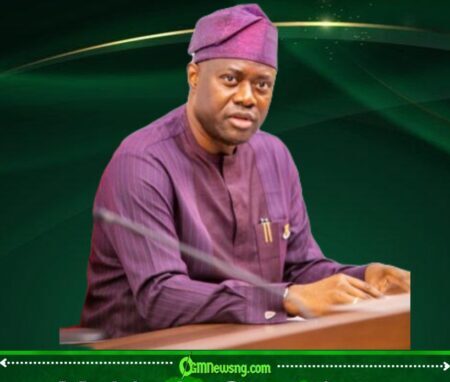





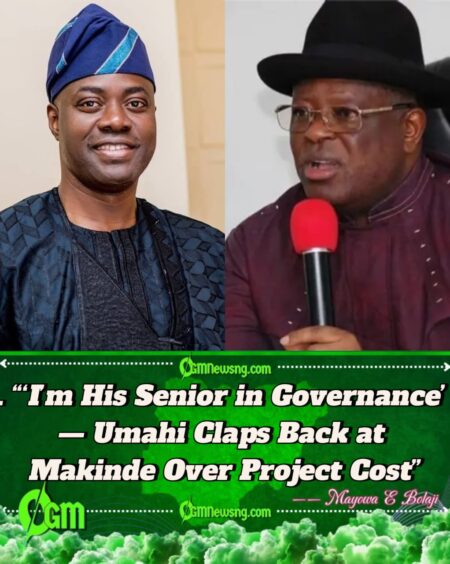
Minister of Works, Engr. Dave Umahi, has openly fired back at Oyo State Governor, Seyi Makinde, over his comment on the cost per kilometer of the ongoing Lagos–Calabar Coastal Highway. Governor Makinde, in a recent statement, questioned the transparency and valuation process of the project, suggesting that the figures released by the Federal Ministry of Works were inflated beyond reasonable benchmarks. His remarks sparked debate across political and professional circles, drawing attention to Nigeria’s long-standing controversy over infrastructure costing and procurement transparency.
Reacting while briefing journalists in Abuja, Umahi dismissed Makinde’s criticism in a tone both technical and sarcastic. “Somebody show me what Governor Makinde of Oyo State said,” Umahi remarked. “I didn’t want to join issues with him. I think he is an engineer—an electrician. Oh sorry, they call it elect elect. This is road construction; elect elect no reach there. I’m his senior in governance.” The comment, though delivered in jest, has since gone viral, stirring conversations about inter-governmental relations and professional rivalry within Nigeria’s leadership class.
Umahi emphasized that his priority as Minister of Works is to deliver durable infrastructure that would stand the test of time, not to engage in unnecessary political squabbles. According to him, “When I speak, I speak as a structural engineer and as someone who has governed a state and managed major construction projects. It’s important that those who speak on such matters do so from a position of knowledge and not politics.”
Minister David Umahi Defends Technical Integrity of Lagos–Calabar Coastal Highway
Umahi went on to defend the Lagos–Calabar Coastal Highway project, describing it as one of the most technically demanding infrastructure undertakings in Africa. He noted that constructing a highway along Nigeria’s coastline involves extensive soil stabilization, shoreline protection, drainage control, and concrete reinforcement—factors that naturally elevate the cost beyond what is obtainable in standard inland road construction. “People must understand that coastal engineering is in a class of its own. It’s not just about pouring asphalt; it’s about safeguarding infrastructure against erosion, flooding, and sea-level pressure,” the minister explained.
The Works Minister further stated that the coastal highway, which spans approximately 700 kilometers and cuts across several southern states, is being executed with reinforced concrete pavement to ensure longevity. He added that the highway’s life expectancy is estimated to exceed 50 years with minimal maintenance, emphasizing that it represents value for money when assessed through an engineering lens rather than a political one. Umahi asserted that public discourse around such a transformative project should be guided by facts and technical understanding, not conjecture or opposition rhetoric.
He also credited President Bola Ahmed Tinubu for approving the project, which he described as visionary and economically strategic. According to Umahi, “The Lagos–Calabar Coastal Highway will become a trade corridor for the entire Gulf of Guinea, linking ports, tourism zones, and industries. It will create jobs, boost logistics efficiency, and open up new business corridors. Such a project deserves informed conversation, not ridicule.”
Political Reactions and Governance Implications
Umahi’s remarks, particularly the “elect elect” jab and the claim that he is Makinde’s “senior in governance,” have sparked a wave of political reactions. Observers note that his tone reflects simmering tension between federal appointees and opposition governors, especially those who frequently question national projects. Some commentators interpret Umahi’s words as a veiled attempt to assert federal supremacy, while others see it as a spontaneous reaction from a technocrat defending his integrity. Political analysts have since warned that such exchanges, though colorful, could deepen partisan divides within Nigeria’s governance structure.
In Oyo State, Makinde’s allies have maintained that the governor’s comments were not personal but aimed at ensuring accountability in the use of public funds. They insist that as a sitting governor, Makinde has a duty to question and seek clarity on major national expenditures, especially those with potential long-term fiscal implications. “Governor Makinde only asked for transparency, not confrontation,” a member of his team reportedly said. “The minister should take the criticism as part of democratic dialogue, not an attack.”
Meanwhile, in Abuja, Umahi’s supporters argue that his statement was taken out of context and that he merely highlighted the need for technical competence when discussing complex infrastructure projects. They describe the minister as a seasoned engineer who built hundreds of kilometers of concrete roads during his tenure as Ebonyi State governor, emphasizing that his response to Makinde was both defensive and instructive. The Ministry of Works has also reaffirmed its commitment to transparency and quality delivery, saying that the Lagos–Calabar Coastal Highway will remain a signature project of the Tinubu administration.
Table of Contents
Discover more from OGM News NG
Subscribe to get the latest posts sent to your email.