








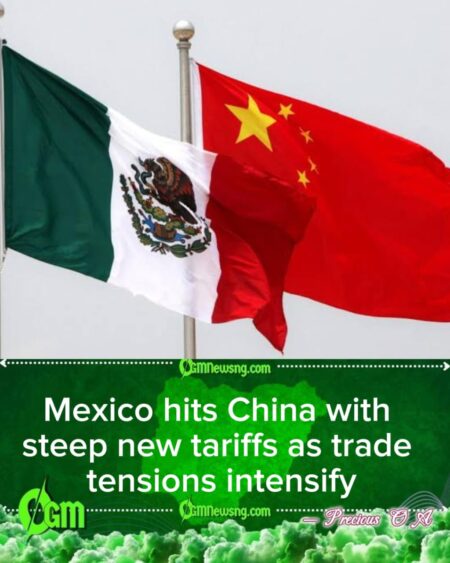
Mexico has imposed tariffs of up to 50% on a wide range of Chinese imports, signaling a major shift in trade strategy as the government seeks to protect domestic industries from mounting competitive pressure. The move has sent shockwaves through regional markets, prompting analysts to reassess the balance of trade influence across North America. Early reactions suggest that policymakers are bracing for ripple effects that could redefine long-term economic relations.
Mexico has positioned this tariff expansion as a safeguard against what officials describe as unprecedented import surges from China, which have strained local manufacturers across automotive, steel, and electronics sectors. Trade officials insist the policy aims to strengthen industrial resilience ahead of global market fluctuations. Business associations, meanwhile, are cautiously evaluating how production costs may shift in the immediate aftermath.
Mexico has triggered new bilateral questions as U.S. and Canadian observers examine whether the tariff escalation could indirectly affect supply chain collaborations under the USMCA framework. Economists note that price adjustments, sourcing shifts, and rerouted procurement strategies may accelerate in the coming months. Stakeholders are now monitoring how global manufacturers operating within Mexico recalibrate their long-term logistics models.
DOMESTIC INDUSTRY REACTIONS
Mexico has seen swift responses from local manufacturers who largely support the protectionist measure, describing it as overdue in the face of prolonged competitive imbalance. Factory owners across multiple states argue that sustained tariff protections could enable them to rehire workers and expand production capacity. Early sentiment suggests a renewed optimism among small and medium-scale producers.
Leading industry groups have emphasized the urgency of stabilizing critical sectors that have struggled under heightened import pressures. Representatives argue that stronger border controls and targeted tariffs may help prevent market saturation from low-cost goods. Many are now urging the government to pair the tariff policy with subsidies and technology grants to boost long-term competitiveness.
Regional business leaders have expressed interest in negotiating new public-private programs designed to modernize local plants and reduce operational bottlenecks. They highlight that strategic reinvestment could help domestic industries capture new market share, particularly in areas where Chinese goods previously dominated. Analysts are optimistic that the tariff shift, if paired with structural reforms, could yield measurable industrial recovery.
GLOBAL DIPLOMATIC RESPONSE
Mexico has drawn rapid attention from Beijing, where officials have called the move concerning and potentially disruptive to bilateral trade. Though no immediate retaliatory actions have been announced, Chinese commerce authorities are expected to review Mexico’s decision closely. The global market is preparing for possible adjustments in export strategies toward Latin America.
Diplomatic observers note that China may attempt to leverage multilateral forums to challenge the tariff imposition if it perceives the measure as excessive or discriminatory. Some experts suggest a negotiated settlement remains possible, depending on how the tariff schedule evolves in the next quarter. Others warn that prolonged tension could reverberate through broader Asia-Latin America trade relations.
International partners across Europe and Asia are monitoring the development for signs of shifting geopolitical alignment. Analysts believe Mexico’s stance could influence other middle-income nations to reassess their dependency on low-cost imports. The unfolding situation has already prompted discussions among global trade advisors about the long-term sustainability of tariff-focused economic strategies.
SUPPLY CHAIN AND MARKET EFFECTS
Mexico has introduced jolting uncertainty into multinational supply chains, prompting manufacturers to reevaluate sourcing routes that rely heavily on Chinese components. Corporations operating within Mexico’s industrial hubs are exploring alternative suppliers across Southeast Asia, Latin America, and the U.S. Changes in production logistics could reshape regional manufacturing patterns.
Analysts predict short-term market turbulence as companies adjust to higher input costs driven by the tariff increases. Economists warn that consumer prices may gradually rise if manufacturers pass additional expenses along the supply chain. Retailers are already preparing for potential stock fluctuations as procurement teams assess new price projections.
Despite concerns, some experts believe that the tariff decision could foster long-term diversification benefits. Supply chain strategists argue that reducing overdependence on a single country could enhance resilience during global disruptions. The policy may ultimately encourage firms to invest in more geographically balanced production networks.
NORTH AMERICAN TRADE IMPLICATIONS
Mexico has inadvertently intensified discussions within North America regarding shared economic vulnerabilities tied to overreliance on Chinese imports. U.S. officials are quietly evaluating whether their own industries might benefit from similar protective measures. Trade analysts believe this could open the door to new trilateral negotiations under the USMCA framework.
Observers in Canada and the United States note that Mexico’s tariffs could shift demand toward North American manufacturers, depending on how companies adapt to the new pricing environment. Export-oriented firms are assessing whether the policy might create opportunities to gain market share previously controlled by low-priced Chinese imports. Analysts expect increased dialogue among policymakers as effects unfold.
Regional economists suggest that Mexico’s decision might catalyze broader discussions about industrial self-sufficiency across the continent. Supply chain strategists have stated that the development could reignite efforts to strengthen domestic manufacturing clusters in automotive, electronics, and consumer goods. Long-term outcomes will depend on how each nation balances protectionism with competitive pressures.
ECONOMIC OUTLOOK AND NEXT STEPS
Mexico has initiated a pivotal moment for its economic trajectory, with early indicators showing mixed short-term consequences but potentially substantial long-term advantages. While increased costs may challenge import-heavy sectors, domestic producers stand to benefit from a more level competitive landscape. Officials insist the policy is part of a broader plan to fortify national industry.
Economists caution that sustained tariff reliance could introduce new obstacles if not supported by coordinated investment in technology, infrastructure, and workforce development. They emphasize that productivity reforms must accompany protectionist measures to secure lasting gains. Policymakers are expected to outline supplemental initiatives in the months ahead.
Financial analysts are preparing revised forecasts reflecting both the risks and opportunities arising from the tariff expansion. Many anticipate that Mexico’s stance will continue to shape regional trade strategy and influence global manufacturing decisions. As the situation evolves, stakeholders across multiple sectors are watching closely for signs of stabilization, adaptation, or escalation.
Table of Contents
Discover more from OGM News NG
Subscribe to get the latest posts sent to your email.