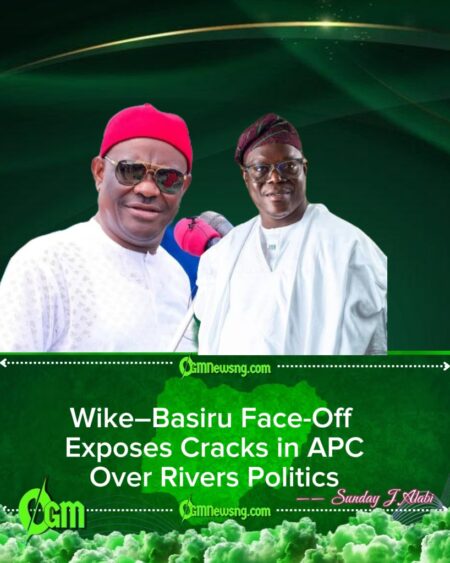
The political atmosphere in Rivers State has become increasingly charged following a sharp exchange between the Minister of the Federal Capital Territory (FCT), Nyesom Wike, and the National Secretary of the All Progressives Congress (APC), Senator Ajibola Basiru. Wike has warned Basiru and other APC leaders to refrain from what he described as interference in Rivers State politics, declaring the state a “no-go area” for external political meddling. The confrontation has exposed deeper fault lines within the ruling party and raised fresh questions about party discipline, loyalty, and governance in the oil-rich state.
Wike’s Warning and Allegations of Political Interference
Wike issued his warning during a thank-you visit to Oyigbo Local Government Area of Rivers State, where he accused unnamed political actors of exploiting reports that about N600 billion was left in the state’s coffers. According to the former Rivers State governor, the alleged financial narrative had emboldened some politicians to make what he termed reckless and provocative comments about the state’s political affairs.
The FCT minister specifically cautioned APC National Secretary Ajibola Basiru to “leave Rivers State alone,” urging him to learn from the experiences of others who had previously attempted to interfere in the state’s politics. Wike warned that such actions could have serious consequences, stressing that Rivers State should not be taken for granted because of its political support for President Bola Tinubu.
Wike’s remarks followed statements credited to the APC Vice Chairman (South-South), Victor Giadom, who reportedly referred to Governor Siminalayi Fubara as “the so-called governor” and suggested that the governor could not secure a second term without Wike’s backing. Wike described such comments as disrespectful and unacceptable, reinforcing his stance that Rivers State politics should be handled with caution.
Basiru’s Response and Call for Wike’s Resignation
Reacting to the controversy, APC National Secretary Ajibola Basiru distanced himself from Giadom’s remarks, describing them as unfortunate and emphasizing that the office of a governor must be respected regardless of political differences. In a Facebook post, Basiru stated that any sitting governor deserves due respect, noting that such respect is fundamental to democratic governance.
However, Basiru later issued a strongly worded statement in Abuja, accusing Wike of attempting to destabilise the APC. He insisted that the FCT minister should resign from President Tinubu’s cabinet if he could not desist from interfering in the party’s internal affairs. Basiru argued that it was incompatible for a non-APC member to remain in the Federal Executive Council of an APC-led government while allegedly causing confusion within party structures.
Basiru also dismissed Wike’s allegations about APC leaders scrambling for a purported N600 billion in Rivers State, describing the claims as baseless and an attempt at blackmail. He defended his integrity, challenged Wike to substantiate his allegations, and warned that he would not be intimidated by what he described as veiled threats from the minister.
Development Concerns and Local Reactions in Rivers State
Beyond the political exchange, concerns about governance and development in Rivers State also featured prominently during Wike’s visit to Oyigbo. The Renewed Hope Ambassador for Rivers State, Ambassador Desmond Akawor, criticised Governor Siminalayi Fubara, alleging that development in Oyigbo had stalled since the governor assumed office.
Akawor said residents of Oyigbo voted with high expectations but had seen little tangible progress. He argued that aside from the appointment of a commissioner, the local government area had not benefited significantly from state resources. He called for fairness in the distribution of resources, insisting that Oyigbo should not be excluded from development initiatives amid discussions about the state’s finances.
These comments reflect broader frustrations among some stakeholders in Rivers State, as political rivalries continue to intersect with debates over governance, accountability, and equitable development.
Table of Contents
Discover more from OGM News NG
Subscribe to get the latest posts sent to your email.