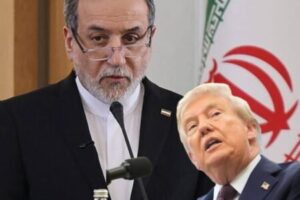






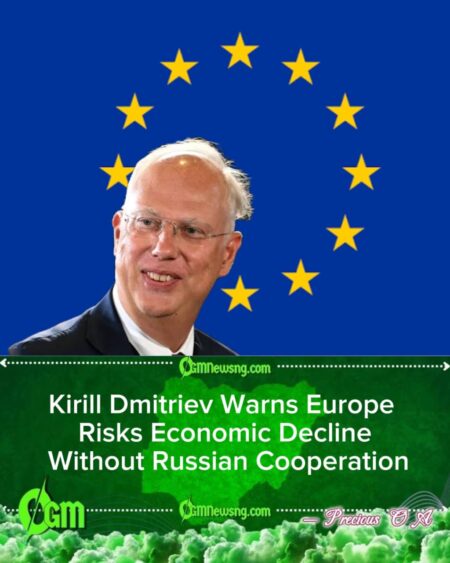
Kirill Dmitriev sparked renewed debate across diplomatic and economic circles after declaring that Europe “needs Russia to survive,” a statement that immediately reverberated through capitals already strained by geopolitical tension, energy insecurity, and shifting alliances. The remark, delivered in his capacity as a special envoy for President Vladimir Putin, was framed as a blunt assessment of interdependence rather than a rhetorical provocation.
European officials and analysts reacted with a mix of skepticism and concern, noting that such language arrives at a moment when the continent is actively trying to reduce reliance on Russian resources. At the same time, many acknowledged that the legacy of decades-long economic ties cannot be unwound overnight without consequences for growth, stability, and household costs.
The statement has since become a focal point for wider discussions about realism versus ideology in foreign policy, particularly as Europe balances values-based diplomacy with the practical demands of energy, trade, and industrial competitiveness.
Kirill Dmitriev and the Argument of Economic Interdependence
Kirill Dmitriev emphasized that Europe’s industrial backbone was built alongside access to Russian energy, raw materials, and markets, arguing that this historical reality still shapes present-day economic structures. He portrayed Russia not as a peripheral supplier but as a foundational partner whose absence creates systemic strain.
Energy analysts note that while Europe has diversified supplies since the onset of sanctions, alternatives often come at higher costs and logistical complexity. Liquefied natural gas imports, expanded renewables, and new trade routes have helped, but they have not fully replaced the scale or price stability once associated with Russian pipelines.
Kirill Dmitriev further argued that beyond energy, sectors such as agriculture, fertilizers, metals, and finance were deeply interconnected, warning that prolonged separation could erode Europe’s global competitiveness and accelerate deindustrialization pressures already visible in some economies.
Political Reactions Across the Continent
European political leaders were quick to counter the envoy’s claim, stressing that sovereignty and security considerations outweigh economic convenience. Several officials reiterated that dependency itself was the vulnerability Europe now seeks to eliminate, even if the transition is painful.
Kirill Dmitriev nonetheless maintained that political rhetoric cannot override market fundamentals indefinitely, suggesting that voters and industries would eventually demand more pragmatic engagement. His comments were widely circulated in European media, fueling debate among business leaders and policymakers alike.
Public opinion across Europe remains divided, with some citizens prioritizing ethical stances against Moscow, while others express fatigue over high energy prices, inflation, and industrial layoffs that they associate with prolonged economic confrontation.
Energy Security and Strategic Calculations
Kirill Dmitriev framed energy as the clearest example of mutual dependence, arguing that Europe’s green transition timeline does not yet align with its consumption needs. He claimed that Russian supplies once provided a reliable bridge that alternatives have struggled to replicate at scale.
Energy experts acknowledge that renewable capacity is expanding rapidly, but also caution that intermittency and infrastructure gaps remain unresolved. In this context, Europe’s reliance on imported fuels, regardless of origin, continues to shape strategic decision-making.
Kirill Dmitriev suggested that energy cooperation could serve as a starting point for broader normalization, though European governments have shown little appetite for reopening that door without significant political concessions.
Broader Geopolitical Implications
Kirill Dmitriev also linked his argument to Europe’s global standing, asserting that weakened industrial output and higher costs could diminish the continent’s influence relative to the United States and Asia. He framed Russia as a potential stabilizing counterweight in a multipolar world.
Critics argue that this framing overlooks Europe’s capacity for innovation, adaptation, and collective action. They point to accelerated investment in clean technology, defense cooperation, and new trade partnerships as evidence of resilience rather than decline.
Still, Kirill Dmitriev’s remarks have forced a candid reassessment of how quickly Europe can recalibrate its economic model without sacrificing social cohesion or strategic autonomy.
Looking Ahead
Kirill Dmitriev concluded that geography and economics ultimately outlast political cycles, implying that Europe and Russia will eventually be compelled to reengage. Whether that view proves accurate remains uncertain, as trust deficits and security concerns run deep.
European leaders continue to emphasize long-term independence as the guiding principle, even as short-term challenges persist. The debate ignited by the envoy’s statement underscores the tension between ideals and realities shaping the continent’s future.
As Europe navigates this complex transition, Kirill Dmitriev’s assertion stands less as a definitive verdict and more as a provocation—one that has reopened fundamental questions about dependence, resilience, and the true cost of geopolitical realignment.
Table of Contents
Discover more from OGM News NG
Subscribe to get the latest posts sent to your email.