








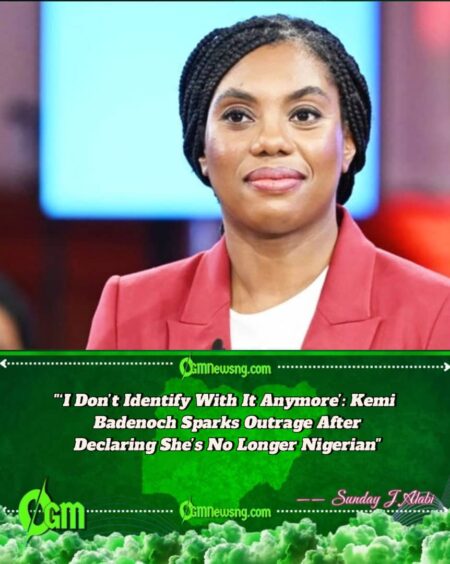
British Conservative Party leader and Secretary of State for Business and Trade, Kemi Badenoch, has publicly renounced her Nigerian identity, stating unequivocally that she no longer considers herself Nigerian. In an episode of the Rosebud podcast, Badenoch disclosed that she has not held a Nigerian passport for over two decades and has no intention of renewing one.
“I have not renewed my Nigerian passport, I think, not since the early 2000s,” she stated. “I don’t identify with it any more. Most of my life has been in the UK and I’ve just never felt the need to.”
Born in Wimbledon in 1980 and taken to Nigeria shortly after birth, Badenoch spent her formative years in Lagos before returning to the UK at 16. While acknowledging her upbringing in Nigeria and deep familial ties, she now sees her identity as firmly rooted in Britain. “I know the country very well, I have a lot of family there… But home is where my now family is — my children, my husband, my brother and his children,” she said.
Nigerian Roots, British Belonging
Despite her Yoruba ancestry and years spent in Nigeria, Badenoch drew a clear distinction between cultural familiarity and personal identity. She reflected on her return to Nigeria in 2022 to bury her father, Dr. Femi Adegoke, noting that she had to apply for a visa — a bureaucratic experience she described as a “big fandango.”
She emphasized, “I’m Nigerian through ancestry, by birth despite not being born there because of my parents, but by identity I’m not really.” Her remarks underscore a deep sense of personal detachment from the country of her early years, contrasting with her strong affinity to the UK, where she now lives and serves as a senior government figure.
Badenoch painted a vivid picture of a dual upbringing, explaining that while growing up in Lagos she often felt “both British and Nigerian” but never truly belonged. “I remember never quite feeling that I belonged there,” she said. According to her, her parents always feared for her future in Nigeria and encouraged her to return to the UK to pursue a more secure and promising life.
Conservative Party as ‘Extended Family’
In her podcast appearance, Badenoch also offered insights into her political journey and strong allegiance to the Conservative Party. She described the party as her “extended family,” drawing parallels between political dynamics and family drama. “It’s instinct, we recognise each other, we have the same sort of squabbles… Anybody who’s got an extended family with lots of drama will recognise that,” she said.
Badenoch’s commitment to Conservative principles has helped her rise through the ranks of British politics, earning her a reputation for straight-talking and policy-driven leadership. Her views, often provocative, have drawn criticism but also admiration among her political base in the UK. Her remarks on identity may further cement her British credentials among conservative voters.
Mixed Reactions from Nigerians at Home and Abroad
Badenoch’s latest comments have stirred strong reactions among Nigerians, both within the country and in the diaspora. Many have viewed her renunciation of Nigerian identity as a betrayal of her heritage, especially given her past criticisms of Nigerian governance, corruption, and military rule. In December, Nigeria’s Vice President publicly questioned her pride in her roots, suggesting she might as well “remove ‘Kemi’ from her name.”
At the time, Badenoch’s spokesman responded that she “is not the PR for Nigeria” and would continue to speak truthfully about her experiences. Her current statements are likely to reignite debates on national identity, diaspora loyalty, and the expectations placed on individuals of African descent in Western politics.
On social media, reactions ranged from disappointed to supportive. While some Nigerians criticized her for denying her origins, others defended her right to choose her identity based on personal experiences and circumstances. “She’s lived in the UK for most of her life. That’s her home. Let her be,” wrote one British-Nigerian user on X (formerly Twitter).
Kemi Badenoch:A Rising Star in British Politics, Shaped by Two Worlds
Kemi Badenoch’s life story is emblematic of the modern diasporan experience — shaped by two worlds but rooted in one. Her decision to publicly distance herself from Nigeria may be interpreted as a political move as much as a personal declaration, aligning her identity firmly with her adopted homeland as she continues to ascend within the Conservative Party.
“I did not experience prejudice in any meaningful form,” she said of her early years in Britain, adding, “That doesn’t mean prejudice doesn’t exist… But I didn’t, not seriously.” Her story reflects the complexity of race, migration, and belonging in a post-colonial, globalised world.
As Badenoch positions herself for a potentially even higher role in British politics — with speculation about future Tory leadership bids — her comments may help solidify her image as a British-first conservative. But back in Nigeria, the nation she no longer claims, her statements are sure to spark introspection about identity, pride, and the meaning of home.
Table of Contents
Discover more from OGM News NG
Subscribe to get the latest posts sent to your email.