








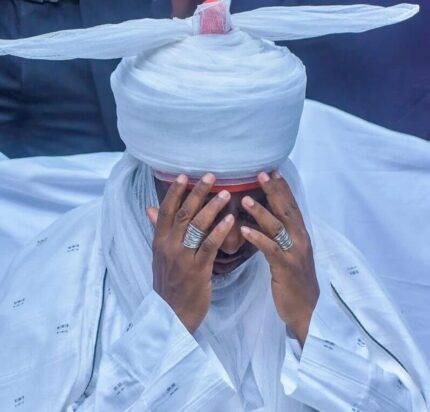
The legal battle over the Kano Emirate took another turn on Friday, March 14, 2025, when the Court of Appeal in Abuja suspended its earlier judgment that had reinstated Muhammadu Sanusi II as the Emir of Kano. This decision came in response to applications seeking a stay of execution on the reinstatement, pending the outcome of an appeal before the Supreme Court.
A three-member panel of the appellate court, led by Justice Okon Abang, ruled unanimously to halt the implementation of its January 10 judgment, which had reversed Sanusi’s dethronement. The court stated that suspending the execution was necessary to preserve the rights of all parties involved and maintain legal order until the Supreme Court delivers a final verdict.
The ruling is the latest in a series of legal and political confrontations surrounding the Kano Emirate throne, which has been the subject of conflicting court orders and intense political maneuvering since Sanusi was first removed from office in 2020.
Legal Grounds for the Suspension
The court found merit in two applications marked CA/KN/27M/2025 and CA/KN/28M/2025, which were filed to challenge the reinstatement of Sanusi. These applications were brought before the appellate court by parties seeking to prevent his return to the throne until the Supreme Court reviews the matter.
Specifically, the Court of Appeal issued an injunction restraining the Kano State House of Assembly, the Kano State Government, and other stakeholders from enforcing the reinstatement of Sanusi as Emir. The court emphasized that allowing the execution of its earlier judgment could lead to further legal complications should the Supreme Court eventually rule differently.
Additionally, the appellate court ordered all parties involved to maintain the status quo ante bellum, meaning the situation before the reinstatement should remain unchanged. It also directed the applicant to file an undertaking within 48 hours, agreeing to compensate the respondents if it is later determined that the suspension order should not have been granted.
Background of the Kano Emirate Dispute
The ongoing battle over the Kano Emirate dates back to March 2020, when Muhammadu Sanusi II was dethroned by the administration of then-Governor Abdullahi Ganduje. Sanusi, who had served as the 16th Emir of Kano, was accused of insubordination and political interference, leading to his sudden removal. His dethronement was seen by many as a politically motivated move aimed at silencing his outspoken views on governance and economic policies.
In May 2024, the situation took another dramatic turn when the Kano State House of Assembly, under the leadership of Governor Abba Yusuf, repealed the Kano State Emirates Council Law 2020. This law had earlier split the Kano Emirate into five smaller emirates, weakening the influence of the traditional Kano Emirate. With the law repealed, Sanusi was reinstated as Emir, sparking both public celebration and legal challenges from rival factions.
The Federal High Court, presided over by Justice Abubakar Liman, initially ruled against the reinstatement, declaring it unlawful. However, in January 2025, the Court of Appeal overturned this ruling, declaring that the lower court lacked jurisdiction. The decision in favor of Sanusi was seen as a legal victory for his supporters, but it has now been put on hold due to the latest injunction by the appellate court.
Political and Legal Reactions
The latest ruling by the Court of Appeal has drawn mixed reactions from political leaders, legal experts, and traditional institutions. Supporters of Sanusi, including key members of the New Nigeria Peoples Party (NNPP), which governs Kano State, have expressed displeasure over the decision, arguing that it undermines the will of the Kano people. Governor Abba Yusuf, a strong ally of Sanusi, has vowed to pursue all legal options to uphold the reinstatement.
On the other hand, members of the opposition All Progressives Congress (APC) and supporters of Aminu Ado Bayero, the rival emir who was appointed after Sanusi’s removal in 2020, welcomed the appellate court’s ruling. Some analysts believe the suspension of Sanusi’s reinstatement signals a prolonged legal struggle that could drag on until after the 2027 elections, with political implications beyond Kano.
Legal experts argue that the Supreme Court’s final verdict will be crucial in determining the fate of the Kano Emirate. Some have called for a political resolution rather than prolonged litigation, warning that continued legal disputes could weaken the authority and relevance of the Kano Emirate in Nigeria’s traditional leadership system.
Implications and the Road Ahead
The suspension of the Court of Appeal’s judgment reinforces the deep divisions surrounding the Kano Emirate leadership. Until the Supreme Court delivers its final ruling, the emirate remains in a state of uncertainty, with two factions vying for legitimacy.
Observers believe that beyond the legal dimensions, the tussle over the Kano Emirate has far-reaching consequences for traditional institutions in Nigeria. The case is seen as a test of the balance between political power and traditional authority, with the potential to set a legal precedent for similar disputes across the country.
For now, the Kano Emirate remains embroiled in legal and political uncertainty, awaiting the Supreme Court’s intervention to bring final clarity to one of the most contentious royal disputes in Nigeria’s history.
Table of Contents
Discover more from OGM News NG
Subscribe to get the latest posts sent to your email.