








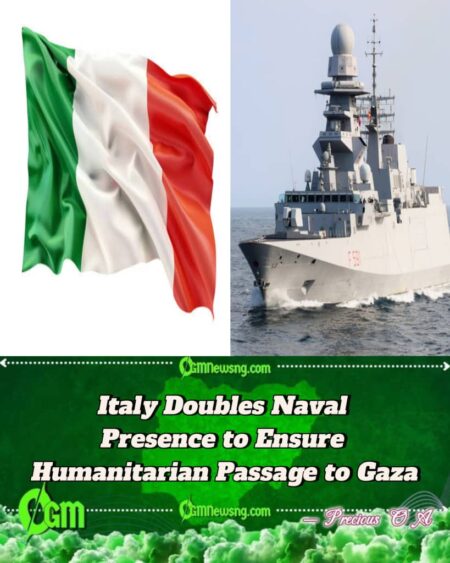
Italy has strengthened its involvement in the Global Sumud Flotilla by dispatching a second navy ship to protect humanitarian vessels bound for Gaza. The flotilla, carrying food, medicine, and other relief supplies, has drawn global attention as a test of international resolve to ensure aid delivery in one of the world’s most politically sensitive regions.
This latest move underscores a growing commitment to humanitarian principles at a time when aid missions face heightened risks. Government officials have emphasized that the naval deployment is strictly humanitarian in nature, intended to safeguard the volunteers, crew members, and essential cargo aboard the convoy.
Italy has historically balanced its Mediterranean diplomacy with a cautious approach to regional disputes. However, by actively defending the flotilla, Rome signals that it is prepared to take a more visible stance when civilian welfare is at stake. Analysts view this as both a humanitarian necessity and a potential diplomatic turning point.
The action also highlights the European debate on how nations should respond to crises in Gaza. While other states issue statements of concern, Rome has opted for concrete action, deploying naval resources to guarantee safe passage. This demonstrates not only solidarity with the Palestinian people but also a willingness to challenge the assumption that aid must remain vulnerable to regional tensions.
Global Implications of Italy’s Decision
Italy’s decision to deploy a second naval ship has significant international implications. Humanitarian organizations have welcomed the move as a strong affirmation that civilian protection must remain a priority, even in contested waters. For many, the act represents more than just military escort—it symbolizes the importance of state-backed humanitarian support.
The bold step could set a precedent for other European nations. Some analysts believe Rome’s actions might encourage broader cooperation among EU members to defend humanitarian missions in volatile regions. Others caution, however, that naval deployments may escalate tensions with regional actors who view such escorts as political rather than humanitarian.
Rome has framed the deployment as consistent with international humanitarian law. Officials insist that the mission is defensive, ensuring the flotilla’s safety without engaging in regional conflicts. This narrative seeks to shield the country from accusations of partisanship while keeping the focus on the needs of Gaza’s civilian population.
The choice also amplifies the symbolic power of the Global Sumud Flotilla. Activists on board have repeatedly described their mission as a stand for human dignity, and the presence of military escorts raises its global profile. For humanitarian networks, this development strengthens the message that aid is not just charity but a right that must be protected.
Reactions from other Mediterranean nations remain mixed. While some acknowledge the humanitarian motives, others worry that such deployments risk altering naval dynamics in the region. Still, supporters argue that moral obligations should outweigh political caution.
Italy: Balancing Humanitarian Duty and Political Risks
Italy’s naval presence in support of the flotilla raises questions about the balance between humanitarian duty and political consequences. By dispatching two navy ships, Rome demonstrates resolve, but also accepts the responsibility that comes with heightened visibility in a region fraught with tension.
The government has made clear that its involvement is not about choosing sides but about upholding humanitarian values. Officials stress that preventing the obstruction of aid delivery is consistent with international law and basic human decency. Such statements are intended to reassure the global community that the move is grounded in universal principles.
Critics, however, argue that any deployment of naval forces inevitably carries political weight. They warn that even defensive missions can be misinterpreted as provocative, particularly in a climate where regional actors remain sensitive to outside interference. Despite these concerns, many humanitarian advocates applaud the decision as evidence that humanitarian duty should not be compromised by fear of political fallout.
Italy’s leadership in this mission may inspire other nations to reconsider their role in safeguarding aid delivery. The Global Sumud Flotilla has become a symbol of resilience, and its safe arrival in Gaza will be a tangible reminder of what determined humanitarian action can achieve. For Rome, the decision represents both a moral statement and a diplomatic gamble that may reshape its image on the world stage.
The deployment ensures that the flotilla’s journey carries more than cargo—it carries a message that the international community must act, not just speak, when human lives are at risk. The two navy ships now accompanying the convoy are more than steel vessels; they are emblems of a nation’s choice to put humanitarian duty into action.
Table of Contents
Discover more from OGM News NG
Subscribe to get the latest posts sent to your email.