








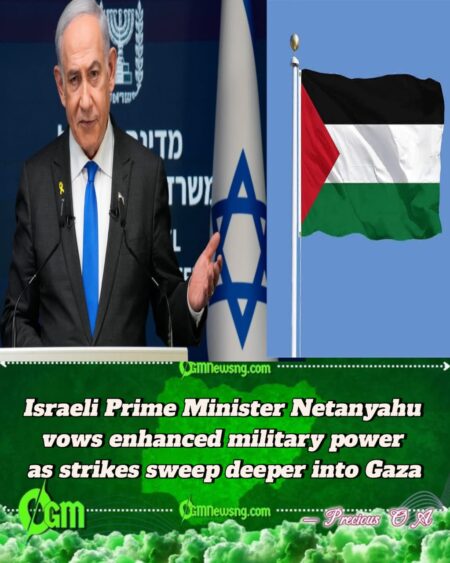
Israeli Prime Minister Netanyahu announced that he has directed the Israel Defense Forces to launch immediate and powerful strikes in the Gaza Strip after what he described as a clear and unacceptable violation of the cease-fire agreement. He declared that Israel’s security cannot rely solely on signed understandings that become meaningless when one party acts with impunity. His office emphasized that the timing of the order reflects Israel’s readiness to act the moment hostile actions emerge, ensuring that the country never appears hesitant or vulnerable in the face of threats.
Urgent security consultations preceded the renewed offensive, which comes in direct response to attacks on Israeli troops operating near Rafah, signaling that the situation had reached a breaking point. The Israeli war cabinet reportedly weighed multiple response options, ultimately concluding that strong and fast retaliation was the only measure capable of sending a message powerful enough to deter further aggression. Military analysts believe the chosen strategy reflects growing frustration inside the government over what they see as continuous provocations under the cover of the truce.
Netanyahu emphasized that the strikes are meant to restore deterrence and demonstrate that Israel will not tolerate any actions that undermine territorial security or the hostage-exchange framework established under the truce. He argued that if Hamas is allowed to selectively comply with agreements while still engaging in attacks, the entire structure of regional negotiations will collapse. This operation, he insisted, is driven by necessity, not preference, and is designed to curb what Israel sees as a calculated effort by Hamas to regain offensive capacity.
Netanyahu warned that this military response will continue with force and precision if further hostilities persist, declaring that cease-fire terms must be respected by all sides if calm is to be restored. He stressed that Israel has no interest in indefinite warfare but cannot allow loopholes that endanger communities near Gaza. The prime minister made it clear that any hope for renewed calm depends entirely on whether militants immediately cease attacks and adhere strictly to every clause of the agreement.
Geopolitical Fault-Lines & Cease-fire Fragility
Netanyahu declared that the U.S.-brokered truce, which took effect earlier this month, is now under serious strain due to what he called repeated violations by Hamas militants inside Gaza. He described the cease-fire as a fragile framework requiring strict enforcement, stating that each breach erodes the foundation of international diplomacy and makes future negotiations more difficult. Israel, he said, cannot continue to uphold its commitments if the opposing side treats the terms as optional rather than binding.
Hostile activity near border zones, including armed engagements with Israeli forces, represents a deliberate breach designed to provoke a military retaliation and destabilize the agreement. Israeli officials view these attacks as a strategy by Hamas to test the limits of Israel’s patience and extract additional concessions under pressure. Regional observers warn that each small escalation risks spiraling into broader confrontation, especially if armed groups elsewhere in the region interpret Israel’s restraint as a sign of weakening resolve.
Netanyahu condemned the return of the remains of an already-identified soldier, characterizing the action as both deceptive and deeply disrespectful, and insisted that such conduct cannot be overlooked. He argued that the gesture was presented as compliance while simultaneously undermining trust by exploiting the sensitive issue of captives and their families. His administration now questions whether Hamas is negotiating in good faith or leveraging humanitarian matters as tools of strategic manipulation.
Netanyahu framed the strikes as a necessary measure to preserve regional stability, asserting that diplomatic negotiations cannot hold if one party continually disrupts the foundational terms of peace. According to him, Israel is being forced into action to preserve not only its own security but also the prospects for future agreements that require mutual accountability. Failure to respond, he contends, would reward violations and invite further destabilization.
Humanitarian Alarm & The Path Forward
Netanyahu acknowledged that military action in densely populated Gaza neighborhoods carries significant humanitarian risk, but maintained that Israel must act decisively to prevent Hamas from exploiting civilian areas for operational gain. He noted that militants embed themselves among civilians specifically to deter retaliation, turning neighborhoods, schools and hospitals into unwilling shields — a tactic he insists Israel will no longer allow to dictate its responses.
The protection of Israeli citizens and the immobilization of threats take priority, while Israel aims to minimize civilian casualties and infrastructure damage wherever feasible. Officials describe their operations as precise strikes designed to neutralize active threats without inflicting unnecessary harm, though the international community remains intensely concerned about the humanitarian fallout that accompanies any renewed conflict in Gaza.
Netanyahu cautioned that without immediate compliance from Hamas regarding hostages and cessation of hostile activity, Israel is prepared for an extended campaign that could reshape conditions on the ground. The government sees the current moment as a test of resolve — a turning point that will determine whether security reforms succeed or whether hostilities return to a long-cycle conflict with no predictable end.
Netanyahu concluded by declaring that Israel remains open to diplomatic resolution, but only once tangible steps are taken by Hamas to honor the cease-fire, restore confidence, and ensure that security obligations are fully upheld. Negotiations, he emphasized, cannot be conducted under fire, and any future discussions must be built on a foundation of verified compliance rather than assumptions of cooperation.
Table of Contents
Discover more from OGM News NG
Subscribe to get the latest posts sent to your email.