








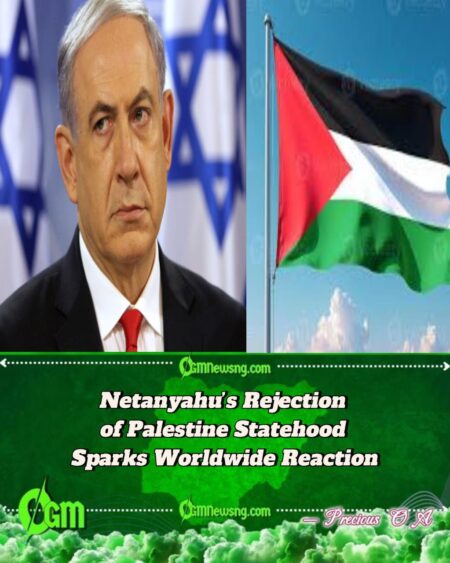
Israeli Prime Minister Benjamin Netanyahu has once again restated his firm opposition to the establishment of a Palestinian state, declaring that “we are going to fulfill our promise that there will be no Palestinian state, this place belongs to us.” His comments, delivered during a closed-door meeting with members of his coalition, quickly made headlines worldwide, reigniting one of the most contentious debates in Middle Eastern politics.
Netanyahu’s remarks come at a time of heightened regional tension and renewed international discussions around peace negotiations. For decades, the creation of an independent Palestinian state alongside Israel has been at the center of the two-state solution—a vision endorsed by much of the international community, including the United Nations and successive U.S. administrations. His words, however, underscored his government’s long-standing rejection of such proposals.
According to officials close to him, Netanyahu believes that any concession of land would compromise Israel’s security. He cited past experiences, particularly the withdrawal from Gaza in 2005, which he argued allowed militant groups to strengthen near Israeli borders. By framing the land as belonging solely to Israel, he tied security concerns to historical and religious claims.
Netanyahu’s stance has been welcomed by hardline members of his coalition, many of whom campaigned on expanding Israeli settlements and tightening control over the West Bank. Yet outside Israel, the statement has drawn criticism and deep concern, with many warning that it pushes the possibility of a negotiated peace further out of reach.
Regional and International Reactions
The Palestinian leadership immediately condemned Netanyahu’s comments, describing them as proof that his government has no interest in meaningful negotiations. Officials in Ramallah reiterated their call for international recognition of Palestine as an independent state, insisting that denial of their right to self-determination will only prolong conflict and suffering in the region.
Regional actors, including Jordan and Egypt—both of which maintain peace treaties with Israel—expressed concern that such rhetoric could inflame tensions and destabilize fragile relations. Jordan’s Foreign Ministry emphasized that rejecting Palestinian statehood undermines international law, while Egypt urged renewed dialogue under international mediation.
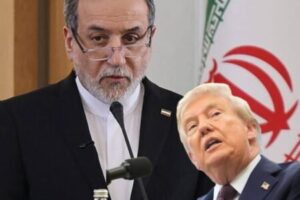
Netanyahu’s statement also drew attention in Washington. While the United States remains Israel’s closest ally, U.S. officials have consistently voiced support for a two-state solution. Members of President Trump’s administration, currently serving a second term, acknowledged Israel’s security concerns but stressed that lasting peace requires compromise. This reflects Washington’s ongoing struggle to balance support for Israel with its role as a mediator in Middle Eastern affairs.
European leaders echoed similar concerns. The European Union reiterated its backing for Palestinian statehood as part of a negotiated settlement, with foreign policy chief Josep Borrell warning that Netanyahu’s position undermines decades of diplomatic work. Inside Israel, opposition parties criticized the remarks, saying they risk isolating the country diplomatically and worsening divisions abroad.
The Road Ahead for Peace Efforts
Netanyahu’s comments present new challenges for peace brokers seeking to revive negotiations. Analysts argue that outright rejection of Palestinian statehood makes it increasingly difficult to build consensus around the two-state framework, long considered the most viable solution to the conflict.
For Palestinians, the declaration signals diminishing prospects. Many fear that expanding Israeli settlements and the formal rejection of statehood aspirations will leave them with little ground for negotiation. Civil society groups have urged the international community to adopt stronger measures, including sanctions, to pressure Israel back toward talks.
Netanyahu’s coalition, meanwhile, reflects the growing influence of nationalist and religious parties who see sovereignty over the West Bank as both a security necessity and a fulfillment of historic destiny. This political reality makes compromise within Israel increasingly difficult, complicating international efforts to mediate.
International observers warn that Netanyahu’s hard line risks intensifying instability at a time when the region faces crises in Lebanon, Syria, and the Gulf. Without credible talks, frustration may escalate into violence, placing both Israeli and Palestinian lives at risk. The future of peace efforts, many believe, now hinges on whether global powers can apply sufficient pressure to bring both parties back to the negotiating table.
Table of Contents
Discover more from OGM News NG
Subscribe to get the latest posts sent to your email.