







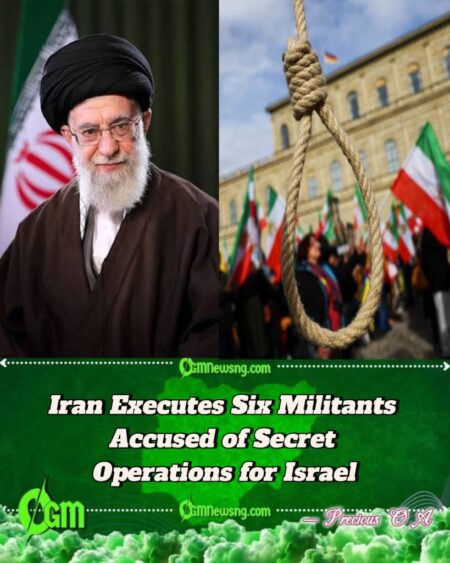
Iran has intensified its security measures by executing six men convicted of militant activities allegedly linked to Israel. The judiciary described the group as “terrorist elements” whose operations destabilized Khuzestan province through bombings, assassinations, and sabotage campaigns between 2018 and 2019. State outlets emphasized that the verdicts were confirmed by higher courts and represented a decisive step to dismantle foreign-backed networks accused of attacking the country’s internal security.
Iran’s judiciary also announced that alongside the six militants, Saman Mohammadi, a Kurdish fighter accused of killing a cleric in 2009, was executed under the charge of “moharebeh” (waging war against God). Officials argued that his case symbolized a broader struggle against insurgent groups and their foreign sponsors. Human rights lawyers have criticized these charges for their broad application, noting that they can encompass both violent and non-violent opposition.
The six militants were reportedly accused of supplying intelligence to Israeli operatives, facilitating weapons transfers, and plotting coordinated assaults on security personnel. Although state television broadcast clips purporting to show evidence of the men’s activities, defense lawyers contend that much of the trial was closed to the public and that confessions may have been obtained under duress. This lack of transparency has drawn renewed attention to Iran’s judicial system and its adherence to due process.
Iran has a long-standing policy of imposing the death penalty on individuals convicted of espionage or terrorism-related offenses. Over the past two years, the number of such executions has increased sharply, particularly after escalations with Israel and domestic unrest. Observers believe this surge is intended to send a warning to both internal dissidents and external adversaries.
Reports from state media did not release full identities of the executed men, leaving human rights monitors to piece together details from unofficial sources. Advocacy groups have called for an independent investigation into the cases, arguing that the lack of public records makes it impossible to verify the charges or the fairness of the trials.
Regional Impact and Growing International Concerns
Iran’s decision to carry out the executions comes at a volatile moment in Middle Eastern politics. The country’s brief conflict with Israel earlier in the summer reignited its security apparatus and led to a string of arrests of alleged spies, informants, and saboteurs. Officials claim these operations have thwarted plots against infrastructure and key military installations. Critics argue, however, that mass arrests risk ensnaring peaceful activists and ethnic minorities, who are disproportionately represented among those executed.
Iran has also executed Bahman Choobiasl, accused of acting for Mossad by infiltrating the country’s telecommunications sector. Rights organizations say such cases, combined with the six executions, reflect a “new normal” of state security policy in which the death penalty is deployed as a frontline defense rather than as a punishment of last resort. According to some estimates, the country may exceed 1,000 executions this year—a figure that would represent the highest use of capital punishment in decades.
Human rights groups, including Amnesty International and the Center for Human Rights in Iran, have condemned the spike in executions. They argue that these measures undermine international commitments and tarnish Tehran’s global image. The groups have urged the government to allow independent observers into courtrooms and prisons, stressing that transparency would strengthen rather than weaken national security.
Iran faces mounting criticism from the United Nations human rights office. UN experts have repeatedly warned that the country’s anti-espionage laws are vague and susceptible to misuse. They point out that individuals accused of “collaboration with hostile states” can be denied legal representation or family contact for extended periods, a practice inconsistent with international human rights law.
The executions have also unsettled neighboring countries. Gulf states such as Saudi Arabia and the UAE, which have recently engaged in tentative dialogues with Tehran, are monitoring how these domestic crackdowns may spill over into regional proxy conflicts or border security. European diplomats have similarly expressed unease, linking Iran’s human rights record to ongoing talks over sanctions relief and nuclear oversight.
Diplomatic Fallout and Shifting Power Dynamics
Iran’s internal security campaign has complicated Washington’s approach to Tehran. The Trump administration, which is managing delicate negotiations over Iran’s nuclear and surveillance programs, now faces pressure from Congress and human rights lobbies to address the executions in official channels. Analysts suggest that if Washington raises the issue too forcefully, it could jeopardize talks over regional de-escalation or prisoner exchanges.
Iran’s actions also challenge Israel’s long-standing policy of plausible deniability regarding operations inside Iranian territory. While Israeli officials have not commented publicly on the executions, past practice suggests they will neither confirm nor deny the alleged ties of the executed men. Nevertheless, the event sends a message to Israeli intelligence networks about the risks of infiltration and the severity of Iran’s reprisals.
Human rights monitors say the scale of executions represents a shift from sporadic retaliatory measures to a systematic deterrence strategy. They believe this approach aims to reassert state authority after months of domestic protests and international scrutiny. However, they warn it could instead deepen public resentment and fuel cycles of violence.
Iran’s regional posture, combined with high-profile executions, has galvanized global NGOs and some European governments to push for UN resolutions on judicial reform and moratoria on the death penalty. Such moves, if adopted, could intensify Iran’s diplomatic isolation or spark new bargaining over human rights benchmarks in future negotiations.
As international criticism grows, Tehran appears determined to frame the executions as part of a lawful struggle against foreign aggression rather than as human rights violations. State media has doubled down on narratives of sabotage networks and national security threats, presenting the hangings as essential to maintaining sovereignty and stability.
Table of Contents
Discover more from OGM News NG
Subscribe to get the latest posts sent to your email.