



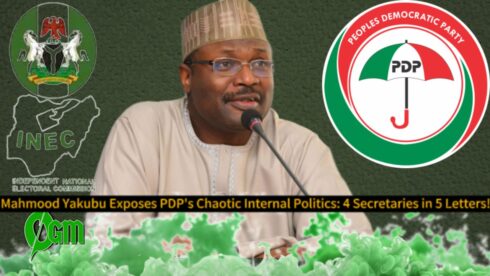
INEC Chairman, Mahmood Yakubu, has openly criticized the People’s Democratic Party (PDP) for what he described as a “chaotic and inconsistent” presentation of its National Secretary. In a tone rarely used in public briefings, Mahmood Yakubu unveiled a trail of conflicting correspondences sent to INEC by the PDP, all bearing different names as the authentic secretary of the party.
Mahmood Yakubu said, “In the last couple of months, we received letters from the party saying that one Mr. Sunday Udeh-Okoye was the secretary. Thereafter, the party changed its mind and said it was Samuel Anyanwu. Then they said it is Mr. Setonji Koshoedo. And again, they changed their mind back to Anyanwu.” He further noted that the latest letter had no name for secretary at all, only the chairman’s signature—a move that has raised serious legal and procedural questions about the party’s internal coherence.
Party of Confusion? PDP Sends INEC on a Wild Goose Chase
This internal flip-flop within Nigeria’s primary opposition party has not only unsettled electoral stakeholders but also signaled deep-rooted fractures within the PDP. According to electoral observers, INEC’s public expression of frustration is unprecedented and suggests a potential breakdown in the democratic order of party administration.
Each conflicting submission from the PDP not only confused the electoral body but also stymied its record-keeping and verification processes. “We responded to the last letter, but there was no name for secretary at all. This is not how serious political entities function,” Mahmood Yakubu noted with marked displeasure, adding that the commission is unable to keep processing contradictory documents without clear legal validation.
Legal Uncertainty Looms Over PDP Activities
With these discrepancies, the PDP might soon find itself entangled in legal showdowns over who is constitutionally empowered to function as National Secretary. Electoral lawyers warn that any documentation signed by a disputed secretary could be deemed invalid, thereby putting the party’s internal decisions in legal jeopardy.
The Electoral Act demands clarity and consistency in party representation, especially for national officers who play crucial roles in nomination and election processes. If the PDP fails to harmonize its official designations, it risks disqualification in key procedural filings and could hand a strategic advantage to rival political platforms ahead of the 2027 elections.
A Party at War with Itself? Insiders Blame Power Struggles
Sources within the PDP blame the conflict on regional power blocs and unresolved leadership tussles that have plagued the party since the last presidential election loss. The frequent switch between names like Udeh-Okoye, Koshoedo, and Anyanwu reflects deeper factional warfare rather than mere administrative error.
Insiders suggest that certain party heavyweights are leveraging the secretary position as a bargaining chip ahead of 2027, with each camp attempting to install a loyal figure. The recurring changes have paralyzed the National Working Committee (NWC) and are reportedly stalling key policy rollouts meant to reposition the party for future contests.
Mahmood Yakubu: INEC’s Patience Wears Thin: Electoral Integrity at Risk
Mahmood Yakubu’s tone indicates growing irritation with political parties undermining INEC’s institutional stability. “We cannot serve as a referee in a game where the rules keep changing every week,” he remarked pointedly, underscoring the commission’s readiness to call out errant political actors.
Election monitors have warned that if major parties like the PDP continue this level of inconsistency, it may affect Nigeria’s democratic ratings globally. “If INEC cannot confidently identify key officeholders in parties, what does that say about the credibility of internal democracy?” one observer questioned, calling on stakeholders to demand greater accountability.
Where Does the PDP Go From Here? Crisis or Opportunity?
While this saga may seem like a disaster for the PDP, some analysts believe it presents a rare opportunity for reform. The party has a chance to overhaul its internal operations, establish clear leadership lines, and reaffirm its commitment to democratic values—before it’s too late.
However, if unresolved, this identity crisis could morph into electoral suicide. As Mahmood Yakubu revealed, “The last letter from the party had no secretary at all.” This symbolic void may be the clearest sign yet that Nigeria’s oldest opposition party is grappling with an existential threat from within.
Table of Contents
Discover more from OGM News NG
Subscribe to get the latest posts sent to your email.