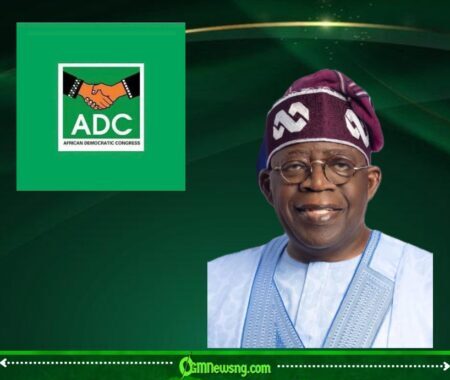




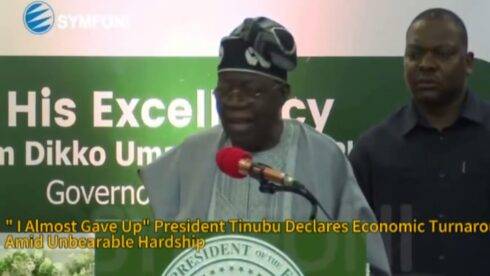
President Bola Ahmed Tinubu has confidently asserted that Nigeria’s economy is on a recovery path, despite widespread economic hardship. Speaking at a recent event, Tinubu stated,
“The economy is turning around; it has turned the corner. When we started, it was challenging, I almost ran away from watching the news or reading the newspapers. I just discouraged and stayed put on my decisions.”
However, many Nigerians remain unconvinced. Inflation soared to 33.2% in March 2025, with food prices skyrocketing. Despite government policies aimed at stabilizing the naira and curbing inflation, the cost of living crisis persists. Many citizens are struggling to afford basic necessities, raising doubts about the president’s optimism.
Currency Devaluation and Its Widespread Impact
Tinubu’s administration implemented a controversial foreign exchange unification policy, allowing the naira to float freely. While this move was intended to attract foreign investment and stabilize the economy, it led to an initial sharp devaluation of the naira. Businesses faced rising import costs, and ordinary Nigerians saw their purchasing power eroded.
The World Bank reported that nearly 4 million Nigerians fell into extreme poverty in the past year due to the currency crisis. Despite government interventions, such as increased minimum wage discussions and targeted palliatives, the economic downturn has disproportionately affected the lower and middle classes. Critics argue that while the economy might be “turning the corner” for investors, the average Nigerian is still in survival mode.
Fuel Subsidy Removal: A Necessary Evil or Economic Sabotage?
One of Tinubu’s first major economic reforms was the removal of fuel subsidies, a policy long considered a financial burden on Nigeria’s economy. He defended the move, stating it was necessary to free up resources for infrastructure and social programs. However, the immediate impact was devastating—fuel prices tripled overnight, transportation costs surged, and small businesses struggled to cope with rising operational expenses.
While some economists praise the policy for curbing government expenditure, others argue that the timing was disastrous. The absence of a functional public transport system and alternative energy sources made the transition harsher than expected. Protests erupted nationwide as citizens demanded relief measures, but the government’s response has been slow and largely ineffective.
Foreign Investments and Capital Flight: A Mixed Bag
Tinubu’s administration has actively sought to attract foreign direct investment (FDI), launching initiatives to improve the ease of doing business in Nigeria. Some progress has been made, with companies in the oil and gas sector announcing new investment deals. However, the business climate remains volatile due to insecurity, inconsistent policies, and high operational costs.
Conversely, capital flight remains a major concern. Nigerian billionaires and multinational corporations continue to relocate assets abroad, fearing currency instability and policy reversals. According to the Nigerian Bureau of Statistics, capital importation dropped by 35% in Q1 2025, indicating that investor confidence remains shaky despite government assurances.
Job Creation vs. Rising Unemployment: A Contradiction?
Tinubu has emphasized job creation as a key priority, citing programs designed to boost employment in agriculture, technology, and manufacturing. His administration has launched several initiatives, such as the Presidential Initiative on Digital Jobs, aimed at training young Nigerians for the global tech industry.
Yet, unemployment remains stubbornly high, hovering at 37.7%, according to recent government data. Many of the new jobs created are either temporary or in the informal sector, offering little job security or benefits. Youth unemployment, in particular, has become a ticking time bomb, fueling social unrest and increasing migration to foreign countries.
Public Sentiment: Optimism or Deepening Distrust?
Despite Tinubu’s assurances that Nigeria is on the path to recovery, public sentiment tells a different story. Many citizens believe that economic policies favor the elite while the masses bear the brunt of reforms. Social media platforms are filled with criticisms, with hashtags like #TinubuEconomy and #NairaCollapse trending frequently.
As 2025 progresses, the Tinubu administration faces a critical challenge: translating economic policies into tangible benefits for everyday Nigerians. The president’s optimism might be well-intended, but without visible relief for citizens struggling with food prices, rent hikes, and job losses, skepticism will continue to grow. Can Tinubu’s economic policies truly turn the corner, or is Nigeria heading toward deeper financial distress?
Table of Contents
Discover more from OGM News NG
Subscribe to get the latest posts sent to your email.