









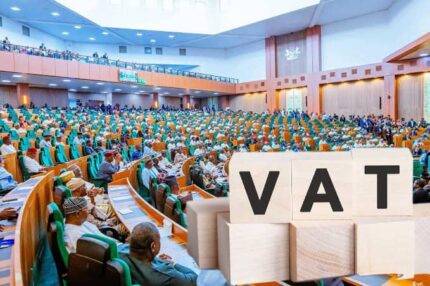
The House of Representatives, on Thursday, approved a new Value Added Tax (VAT) sharing formula, significantly increasing the revenue allocation to states and local government councils. Under the revised framework, 55% of VAT revenue will be allocated to states, while local governments will receive VAT revenue of 35%. This decision comes as part of a broader tax reform effort led by the House of Representatives Committee on Finance, following months of deliberation.
The approval was granted after house of Representatives lawmakers reviewed a report submitted by the committee, chaired by Abiodun Faleke, which examined four tax bills transmitted to the National Assembly by President Bola Tinubu in October 2024. The changes aim to address long-standing concerns about fiscal federalism and revenue allocation among states.
Breakdown of the New VAT Sharing Formula
The revised VAT distribution framework, outlined in Section 77 of the committee’s report, modifies how VAT revenue is allocated among states and local governments. According to the new formula, states will receive 55% of VAT revenue, distributed as follows:
50% equally among all states
20% based on population
30% based on consumption patterns
For local governments, 35% of VAT revenue will be allocated under a similar structure, ensuring a fairer distribution of funds. The emphasis on consumption patterns rather than the location of corporate headquarters seeks to ensure that states where economic activities occur receive a fair share of VAT tax revenue.
Additionally, the timeline for issuing Taxpayer Identification Numbers (TINs) has been extended from two to five working days to accommodate administrative challenges. The report mandates that any refusal to issue a TIN must be justified and communicated to the applicant.
Stricter Corporate Tax Filing Regulations
To curb revenue losses and enhance tax compliance, the House approved new regulations regarding corporate tax filings. One of the key changes is the reduction of the timeframe for companies ceasing operations to file their final tax returns—from six months to three months. This measure aims to prevent tax evasion and ensure that businesses settling their affairs do not escape their financial obligations.
Furthermore, the committee recommended that tax allocations be determined based on taxable supply consumption rather than the location of company headquarters. This reform seeks to address concerns raised by states that generate significant economic activity but receive limited tax revenue due to the current structure.
In addition, the Federal Inland Revenue Service (FIRS) will be required to establish new regulations to enforce a fiscalisation system, ensuring that tax collections align with economic activities. The report also stipulates that any tax remission granted by the President or a state governor must receive approval from the National Assembly or the respective state House of Assembly.
Tighter Controls on Tax Exemptions and Revenue Deductions
The House introduced new measures to regulate tax exemptions and enforce greater accountability in tax remittances. Under Section 75 of the revised tax bill, presidential tax exemptions must now be approved by the National Assembly, ensuring greater legislative oversight.
Section 76 grants the Office of the Accountant General the authority to deduct unremitted taxes from Ministries, Departments, and Agencies (MDAs) directly at the source. This measure, which requires National Assembly approval, is aimed at preventing revenue leakages and enhancing government cash flow management.
To improve federal representation, the committee proposed the appointment of six Executive Directors to the FIRS Board, ensuring one representative from each geopolitical zone on a rotational basis. Additionally, representatives from each state and the Federal Capital Territory will be appointed to promote federal character compliance.
Key Amendments in the Nigeria Tax Bill
The Nigeria Tax Bill introduced significant amendments to corporate tax policies. Under Section 27, companies benefiting from priority sector incentives must now obtain a Certificate of Acceptance from the Industrial Inspectorate Department of the Federal Ministry of Industry, Trade, and Investment before claiming capital allowances.
Another major amendment involved corporate income tax rates. The committee scrapped the previously proposed staggered reduction of corporate tax rates, maintaining the standard corporate tax rate at 30%. However, companies in designated priority sectors will continue to enjoy a reduced tax rate of 25% for five years.
Additionally, the funding structure of the Tax Appeal Tribunal was revised. The tribunal will now receive funding directly from the Consolidated Revenue Fund, eliminating its previous dependence on FIRS. This change is intended to enhance judicial neutrality and independence in tax dispute resolutions.
Development Levy Adjustments and Sectoral Allocations
The revised bill also introduces a new allocation structure for the Development Levy, expanding its beneficiaries to ensure better funding for key national sectors. Under the new framework:
Tertiary Education Trust Fund – 50%
Nigerian Education Loan Fund – 3%
National Information Technology Development Fund – 5%
National Agency for Science and Engineering Infrastructure – 10%
Defence Infrastructure Fund – 10%
Nigeria Police Trust Fund – 5%
National Sports Development Fund – 5%
Social Security Fund – 10%
National Board for Technological Incubation – 10%
National Cybersecurity Fund – 1%
The House of Representatives is expected to conduct a third and final reading of the bills before passing them into law next week. If enacted, these reforms will mark a major shift in Nigeria’s tax administration, with far-reaching implications for fiscal policy, economic growth, and revenue distribution across all levels of government.
Table of Contents
Discover more from OGM News NG
Subscribe to get the latest posts sent to your email.