








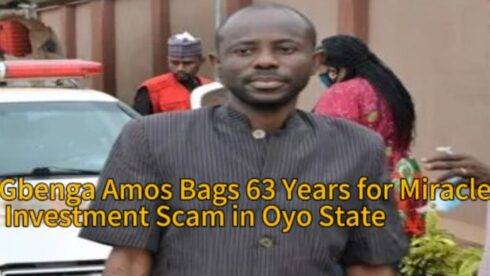
Gbenga Amos, once hailed as a rising star in Nigeria’s investment sector, watched his empire collapse as the Ibadan High Court handed him a 63-year jail sentence for orchestrating a string of sophisticated investment scams. Presiding Justice Adebayo Oyediran ruled that Amos was guilty of 21 counts of fraud, money laundering, and obtaining money under false pretenses, marking one of the most high-profile convictions of financial crime in Oyo State’s history.
Gbenga Amos, founder of now-defunct GreenBridge Capital Holdings, had lured unsuspecting investors with promises of mouth-watering returns from foreign exchange trading, agricultural schemes, and digital assets. Investigations revealed the ventures were mere fronts in a classic Ponzi operation. Over N2.7 billion was siphoned from over 500 victims across the southwest, many of whom had liquidated life savings or cooperative funds.
Fraudulent Empire Built on Religious Rhetoric and Tech Deception
Gbenga Amos built trust among investors by blending religious piety with technological jargon, creating a compelling persona that resonated with Nigeria’s faith-driven and tech-hungry youth. Appearing regularly at Christian business seminars and digital entrepreneurship workshops, he often claimed divine inspiration for his ventures, branding them as “Kingdom Wealth Accelerators.”
Using professionally designed mobile apps, social media promotions, and scripted testimonials, Amos orchestrated a web of deceit that was hard to penetrate. His digital platforms appeared credible, offering dashboards showing phantom profits and referral bonuses. Behind the scenes, however, funds were being funneled into offshore accounts, luxury purchases, and shell companies.
EFCC Unmasks Multi-State Network of Deception
The Economic and Financial Crimes Commission (EFCC) uncovered that Gbenga Amos operated through a sprawling network spanning five Nigerian states. His operations included dummy companies registered under multiple aliases, with shell directors used to evade financial monitoring regulations. Bank accounts were regularly changed to stay ahead of law enforcement.
During the trial, forensic auditors presented damning digital evidence—WhatsApp chats, fake investment statements, and flagged bank transactions—that linked Amos to a criminal enterprise far beyond initial suspicions. EFCC spokesperson, Wilson Uwujaren, stated, “This is one of the most intricately woven investment frauds we have tackled in recent times.”
Victims Share Heart-Wrenching Testimonies in Packed Courtroom
Many victims gave chilling accounts of financial ruin and psychological trauma caused by Gbenga Amos’ scams. A retired school principal recounted how she lost her pension and borrowed heavily to invest in what she believed was a God-blessed agricultural project. Another testified that her family was evicted after defaulting on rent when promised returns never materialized.
Some victims described being shamed by their communities after convincing others to join the scheme, believing it was a legitimate business. “He was a wolf in sheep’s clothing,” said Mr. Kayode Adeyemo, who introduced 13 people to the scheme and now lives with regret. The courtroom often fell silent as stories of ruined lives unfolded.
Gbenga Amos’ Defense Crumbles Under Pressure and Cross-Examination
Throughout the trial, Gbenga Amos maintained his innocence, claiming he was merely a failed entrepreneur caught in a volatile market. His legal team argued that global economic downturns and the naira’s devaluation were responsible for the business collapse. However, prosecutors quickly dismantled this defense with overwhelming evidence of intentional deceit.
Under cross-examination, Amos faltered when asked to explain the disappearance of investors’ funds and the use of ghost companies. Financial experts testified that no verifiable trades or business activities were ever conducted under the alleged ventures. Judge Oyediran called his excuses “an insult to the intelligence of the court.”
Aftermath and Implications for Nigeria’s Investment Landscape
The sentencing of Gbenga Amos to 63 years in prison marks a critical turning point in Nigeria’s crackdown on white-collar crime. Legal experts hailed the ruling as a stern warning to investment fraudsters who exploit trust, technology, and religion to fleece citizens. It also highlights gaps in financial education and regulatory oversight.
The case has sparked nationwide debate over the need for stricter vetting of investment platforms and the role of religious institutions in financial endorsement. Meanwhile, victims are still demanding restitution. The EFCC has assured the public that asset recovery is underway, with court orders already issued to seize properties and accounts linked to Amos’ schemes.
Table of Contents
Discover more from OGM News NG
Subscribe to get the latest posts sent to your email.