





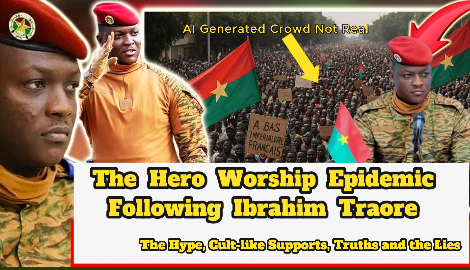
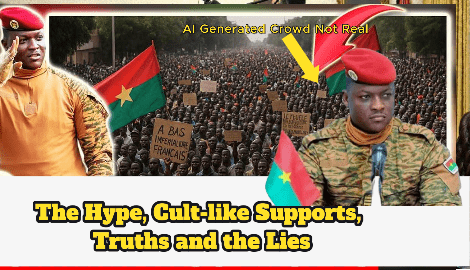
Captain Ibrahim Traore | Let’s get something out of the way: hero worship is not a form of patriotism; it’s a form of hypnosis. In Africa, especially in the social media jungle, there’s a growing trend—political leader worship. It’s like watching a reality show where facts don’t matter, but vibes do. And right now, the season finale is featuring none other than Captain Ibrahim Traore, the young military ruler of Burkina Faso, who’s been soaked in online praise like a sponge in holy water.
While it’s commendable that he’s taken a bold stand on several issues, we must remind ourselves: boldness is not always brilliance. The minute we start singing praises louder than reason permits, leaders start believing their own hype. They stop being accountable and start playing god—except without the omniscience. When the masses glorify a mortal, they create a monster. And trust me, African history is littered with these praise-mutated monsters—from Mobutu to Mugabe.
The key point? It’s perfectly fine to commend good governance, but once we slip into fanfare and delusion, we lose our grip on reality. What we need is civic maturity, not celebratory madness. If you’re wearing a t-shirt with your president’s face and calling it political expression, maybe it’s time to log off and read a book. Please.
While his reign so far has been noteworthy, the cult-like support and hype on social media are vastly misleading. Even worse is the idea that an interim government, ushered in through a military takeover led by Captain Ibrahim Traore, has now dramatically made significant moves to extend the transitional period until at least 2029, dissolving the government without an immediate replacement. These actions have sparked debates regarding democratic processes and governance both within Burkina Faso and internationally, ultimately raising fears of another lifetime ruler in Africa, potentially replicating the tyrants of the past.
Ibrahim Traore: Ditching France to Hugging Russia: One Puppet Master for Another?
Now here’s the viral narrative: Captain Ibrahim Traore is the African Che Guevara, the new Sankara, the man who gave the middle finger to the West—France, America, and all their imperial cousins. And that’s partially true. He did indeed tell France to pack up their bags, close shop, and stop meddling. But guess what? That’s not new. That’s practically chapter one in the “Military Coup Starter Pack” across Africa.
Sani Abacha did it. Idi Amin did it. Every military leader trying to sound revolutionary does it. But where things get murky—and comical—is when Traoré simply replaced one Western master with another. News flash: cozying up to Russia or flirting with Turkey doesn’t make one a pan-Africanist; it just makes you a client state with a different invoice. As the old folks say, if you jump out of the frying pan into a pot of jollof rice owned by Moscow, you’re still being cooked.
True pan-Africanism isn’t about musical chairs with foreign powers; it’s about building independent institutions, pan-continental partnerships, and homegrown solutions. Until then, whether it’s Paris or Putin, it’s still a matter of foreign influence—same soup, different spoon. So before you tattoo Ibrahim Traore’s face on your chest, maybe ask yourself if you’re cheering for liberation or just a rerun of history’s under evil military’s regime.
Reports of Human Right Abuse Under Ibrahim Traore Has Already Surfaced
In a deeply disturbing revelation, Human Rights Watch (HRW) has accused Burkina Faso’s military government under Captain Ibrahim Traoré of executing a massacre in the northern villages of Nondin and Soro, killing over 200 civilians—including 56 children—on February 25th. The HRW report, highlighted by OGM News NG, paints a harrowing picture of state-perpetrated violence in a nation already grappling with a deadly conflict between government forces and militant insurgents. This mass killing has not only shocked the international community but also raised alarms over the extent of human rights violations unfolding under the military regime.
HRW has urgently called upon the United Nations and the African Union to step in and initiate an independent investigation. Executive Director Tirana Hassan emphasized the critical need for international pressure to break the cycle of impunity. Survivors and families of victims demand justice and transparency, as many fear this may only be the beginning of escalating violence under the guise of counterterrorism. The tragedy also sheds light on the lack of accountability and the dangers of unchecked military power, especially when governments operate in near-secrecy.
Eyewitnesses to the February 25th events recount scenes of horror, describing how villagers were gunned down indiscriminately, including infants and the elderly, as the army accused them of harboring militants. The government’s silence and its attempts to blame jihadists disguised as soldiers only deepen the mistrust. With over two million people already displaced across the country, the massacre signals a dangerous new low in Burkina Faso’s fight for stability. The international community now faces a pivotal moment: demand accountability or risk further deterioration of human rights in the region.
The Real Story Behind Ibrahim Traore EV Revolution
Let’s switch gears—literally. One of the loudest trumpets blown by Ibrahim Traore supporters is that Burkina Faso is now producing Electric Vehicles (EVs). That’s true, and quite frankly, that’s awesome. The initiative, supported by the government under Traoré, aligns well with sustainable development goals and shows real technological ambition. EVs made with local expertise? That’s a headline worth clapping for. Even Nigeria is still battling with traffic lights, so Burkina Faso building electric rides is a vibe.
Now, here’s where things get both exciting and a little awkward. Yes, Burkina Faso is now proudly waving the flag for locally-produced electric vehicles (EVs). That’s a massive win in a region better known for exporting raw materials than finished tech products. And yes, Traoré’s administration provided significant backing to the project, boosting national pride and turning some heads globally. That’s the kind of energy we like to see.
But let’s pump the brakes before we rewrite the timeline like a Marvel multiverse flick. The EV project wasn’t born from Ibrahim Traore’s military fatigues. It was pioneered by a homegrown tech company, ITAOUA, before he took office. What Traoré did do—and deserves credit for—is amplifying and accelerating the vision. That’s commendable leadership, but not divine creation. It’s one thing to carry a baton; it’s another to build the track. He did the former.
Still, we can’t knock the hustle. Supporting local innovation, reducing dependency on imports, and pushing for sustainable development? That’s leadership worth acknowledging. Just don’t turn it into a Marvel origin story. If we want leaders who actually serve, we need to learn how to praise with discernment and criticize with facts.
In this age of algorithm-fueled propaganda, it’s easy to fall in love with the idea of a leader rather than the reality. Captain Ibrahim Traore is not a villain, nor is he a god. He’s a man in a military jacket navigating a minefield of geopolitics, public pressure, and propaganda. Let’s appreciate the good, question the shady, and above all—keep the worship for Sundays, not politics.
Ibrahim Traore EV Influence, The ITAOUA Dream: A Car, A Hope, or A Hype?
Ibrahim Traore and Burkina Faso’s announcement of its electric vehicle, the ITAOUA, had all the markings of a viral victory lap: solar-powered, domestically assembled, and rolled out with the bravado of a tech superpower awakening from its slumber. Cue the patriotic drumbeats, pro-Traoré memes, and grand declarations of African industrial independence. But let’s pump the regenerative brakes a little.
While ITAOUA represents a brave and commendable step for a landlocked country with limited industrial infrastructure, it’s far from being the first, the only, or even the most influential EV effort on the continent. Contrary to the celebratory noise on social media (and some suspiciously enthusiastic Telegram channels), Burkina Faso’s debut in the EV race is more tortoise than Tesla. It’s not even in the top ten EV producers in West Africa, let alone Africa. In fact, for now, ITAOUA is more symbolic than scalable — a prototype loaded with hope, not horsepower.
Don’t get us wrong — there’s nothing wrong with ambition. But when ambition gets packaged as historical precedence, or worse, geopolitical messaging, we have a problem. Especially when folks are being misled into thinking this is some kind of technological Davido-versus-Goliath showdown against other African innovators. Spoiler alert: it’s not.
Let’s Talk Scale: Africa’s Real EV Titans Are Already Here
If EV production were a concert, Burkina Faso even with the efforts of Ibrahim Traore is still tuning its guitar backstage while countries like Morocco, South Africa and Nigeria are already headlining festivals. South Africa, with its longstanding automotive backbone, exports multiple EV models and has global manufacturers on speed dial. Morocco? It’s practically Europe’s EV backroom — home to Renault and PSA factories, churning out vehicles like couscous at a Sunday bazaar.
Then there’s Egypt, investing strategically in EV assembly with serious government backing; Kenya, where Roam’s electric buses and bikes are replacing fossil-fueled matatus; and Nigeria, where Innoson has already put EVs on the streets without setting the internet on fire (or at least not without reason). These countries have infrastructure, policy, partnerships, and — importantly — production volumes.
Meanwhile, Burkina Faso has innovation but not the industrial oomph. ITAOUA’s solar concept and 330km range are great PR, but there are still questions about whether it’s locally manufactured or a stylishly repainted kit car from abroad. Without transparency and scalable rollout, it’s hard to separate what’s real from what’s just… rechargeable rhetoric.
As for countries like Rwanda, Ghana, Botswana, and Tunisia — all are already engaged in EV-related initiatives, assembly lines, or policy pilots. They’re just not tweeting about it with “Supreme Leader” hashtags. Maybe they’re too busy, you know, building.
Electric Dreams or Political Schemes? EV as the New Weapon of Image-Warfare
Now here’s the twist: why all the noise about Ibrahim Traore and Burkina Faso? A closer look suggests something beyond national pride — perhaps even a bit of strategic storytelling. Some media narratives, particularly those circulated by Russian-affiliated accounts and pan-Africanist echo chambers, seem eager to prop up Ibrahim Traore and Burkina Faso as a lone revolutionary outpost against neo-colonial tech dominance. It’s EV meets geopolitical cosplay — and frankly, it deserves a skeptical chuckle.
Framing Burkina Faso as the “only EV producer in Africa” is not just inaccurate — it’s intellectually dishonest. It erases the hard work of other African countries that have been grinding, investing, and innovating for years. It also turns a promising development into a propaganda tool, reducing serious industrial milestones into clickbait for ideological clout.
That said, Burkina Faso still deserves applause for trying. It’s a country that’s faced security crises, economic instability, and limited resources — yet it dares to dream of clean energy mobility. If ITAOUA gets proper investment, partnerships, and infrastructure, who knows? It might eventually compete. But until then, let’s resist the urge to crown it king of African EVs just because it showed up with a shiny chariot and a catchy name.
Let’s be clear: Burkina Faso’s ITAOUA EV project is a milestone worth acknowledging. It shows ingenuity, ambition, and the power of dreaming big under difficult circumstances. But dreaming isn’t the same as dominating. The EV space in Africa is already crowded with pioneers, and success will be defined by production, policy, exports, and longevity — not viral headlines.
Burkina Faso is not the first, not the only, and certainly not yet the biggest EV player in Africa. But it could be part of the story — if it focuses on scale, partnerships, and transparency rather than political hype. In the race toward electric futures, every spark counts — but only those with sustainable voltage will truly go the distance.
Burkina Faso under Ibrahim Traore Is Not Leading West Africa’s GDP, Let Alone in Africa?
Before anyone rushes off to print t-shirts saying “Burkina Faso: Africa’s GDP Champion,” let’s hit pause — and maybe crack open a spreadsheet. In 2023, Burkina Faso posted a decent 4.9% GDP growth, which sounds nice at dinner parties but unfortunately doesn’t get you a VIP seat in Africa’s top 10 economic leaderboard. For context, Libya was sprinting ahead at a whopping 17.5%, while Senegal jogged past with 8.3%. Even Gambia, the smallest country on the mainland, had a 5.6% growth rate and waved as it passed Burkina on the economic track.
Sure, 4.9% isn’t a disaster — it’s like getting a B- in class when the nerds are acing all their tests. It’s respectable, but it doesn’t earn bragging rights at the African Economic Union table. Burkina Faso is trying, and nobody’s laughing at the effort. But if this were a GDP Olympics, they’re more in the qualifying heats than on the podium.
2025 Projections: The Crystal Ball Doesn’t Say ‘Burkina’
Looking ahead to 2025, the economic astrologers have spoken — and Burkina Faso is still nowhere near the stars. It’s not even in the celestial neighborhood of the top 10. Senegal is expected to blast off with a 9.2% growth rate, followed by Libya with 7.6%. Rwanda, Mauritania, Côte d’Ivoire, and Ethiopia are also charting impressive climbs. Burkina Faso, meanwhile, is quietly hanging back like someone who forgot there was a group project due.
To be fair, Burkina Faso under Ibrahim Traore still faces a range of challenges, from political instability to security threats, and that kind of turbulence doesn’t exactly inspire a stock market rally. Economically, it’s like trying to cook a gourmet meal while your kitchen is on fire. So yes, they’re not topping any charts — but considering the circumstances, surviving with a nearly 5% growth rate is, ironically, kind of heroic.
So, Who Gets the Economic Crown in West Africa? Not Who You Think
If we zoom in to just West Africa, the real MVPs become clearer. Senegal and Côte d’Ivoire are crushing it with strong growth both in 2023 and in the 2024 projections. Benin and Niger are also showing muscle. These are the countries walking into the West African Economic Club with shades on and growth charts in hand.
Burkina Faso, though geographically central, remains economically peripheral in this GDP race. It’s like showing up to a Formula 1 race on a bicycle. You appreciate the effort, maybe even cheer it on, but nobody’s putting bets on a podium finish. The country has enormous potential, yes — but potential doesn’t pay the bills or win economic awards. Until we see sustained reforms, better security, and more investor confidence, Burkina Faso will remain a hopeful bystander in Africa’s economic arena.
The story of Captain Ibrahim Traore is as much about perception as it is about policy. At the heart of the growing infatuation lies a dangerous cultural reflex — mistaking charisma for competence and equating viral symbolism with visionary leadership. Hero worship, especially in politically fragile states, becomes a hall of mirrors where accountability fades and image management replaces nation-building. While Ibrahim Traore’s backing of initiatives like the ITAOUA EV project deserves measured praise, turning him into an icon beyond reproach only serves to stunt democratic maturity. Africa doesn’t need more messiahs; it needs mechanisms — institutions that outlive and outshine individual personalities.
True progress will not come from slogans, trending hashtags, or political cosplay. It will come from consistent, transparent governance, strategic investment, and empowered citizenry willing to both cheer and challenge their leaders. Ibrahim Traore may indeed be part of a new generation of African leadership, but the jury is still out. To avoid repeating history’s cautionary tales, we must learn to balance recognition with realism — and stop mistaking a loud narrative for a lasting legacy.
Table of Contents
Discover more from OGM News NG
Subscribe to get the latest posts sent to your email.