




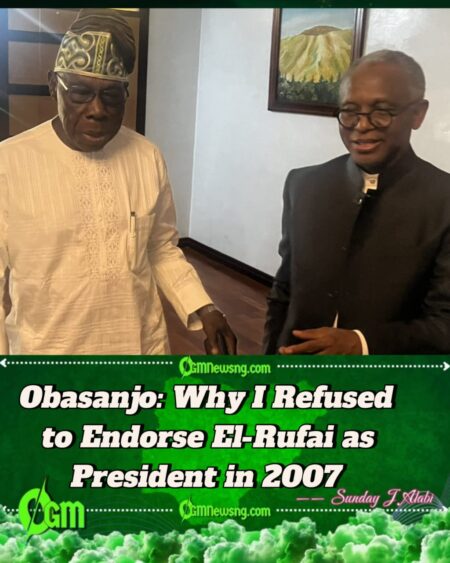
Former President Olusegun Obasanjo has disclosed that he once rejected a proposal to support former Kaduna State Governor, Mallam Nasir El-Rufai, as his successor at the end of his tenure in 2007.
Obasanjo, who made the revelation on Friday during the second edition of the Ajibosin Platform Annual Symposium in Abeokuta, Ogun State, said he believed El-Rufai lacked the political and personal maturity required at the time to lead the nation.
El-Rufai had served under Obasanjo’s administration between 1999 and 2007, first as Director-General of the Bureau of Public Enterprises and later as Minister of the Federal Capital Territory. During this period, he was widely regarded as one of the most energetic and reform-minded members of Obasanjo’s cabinet.
The Moment of Disclosure at Abeokuta Symposium by Obasanjo
The revelation came as a surprise to many attendees when Obasanjo interrupted the keynote address of former Minister of Aviation, Osita Chidoka, who had earlier narrated how El-Rufai introduced him to Obasanjo at age 34 — an encounter that eventually led to his appointment as Corps Marshal of the Federal Road Safety Corps (FRSC).
“Let him tell you,” Obasanjo interjected, referring to Chidoka. “He didn’t mention that he was pushing when I was leaving government that his friend, El-Rufai, should be brought in as my successor.”
Amid laughter from the audience, Obasanjo turned to Chidoka and asked in Pidgin English, “No be so?” to which Chidoka nodded in agreement. The former president then explained his decision: “I did not yield to the pressure. Later, he said, ‘I suggested this person, why didn’t you agree?’ I said El-Rufai needs to mature. You remember?”
Chidoka Calls for Institutional Reforms Over Strongmen Leadership
Delivering his keynote address, Chidoka used the platform to emphasize that Nigeria’s persistent governance challenges were not due to a lack of ideas but a failure to build strong, sustainable systems and institutions.
“Leadership finds its true measure not in speeches or charisma but in the systems it leaves behind,” Chidoka said. “Moral conviction must translate into the everyday machinery of governance—rules, routines, and institutions that make competence predictable and corruption difficult.”
He argued that accountability should be institutionalized, stressing the need for leadership to be judged by measurable outcomes rather than political rhetoric.
“We must therefore make leadership accountable not to rhetoric but to results: measure by building national dashboards and accountability systems that track every promise, every budget, every outcome,” Chidoka added. “Monitor by strengthening the institutions that evaluate government performance and expose complacency.”
Obasanjo’s remarks offer a rare glimpse into the internal deliberations surrounding Nigeria’s 2007 political transition. His comments also reopen long-standing debates about leadership readiness, mentorship, and the institutional weaknesses that continue to define Nigeria’s political landscape.
Table of Contents
Discover more from OGM News NG
Subscribe to get the latest posts sent to your email.