






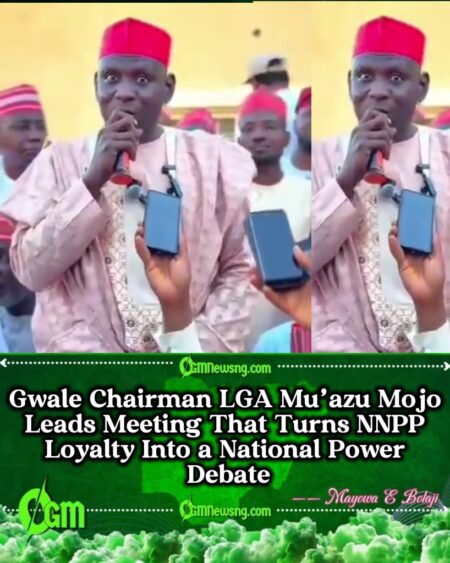
Mu’azu Mojo, the Chairman of Gwale Local Government Area, on Tuesday spearheaded a high-level political meeting involving key stakeholders of the New Nigeria People’s Party (NNPP), signaling what many observers describe as a major turning point in Kano State’s political landscape. The meeting, which brought together party elders, youth leaders, women representatives, and grassroots mobilizers, focused on the future political direction of the local government and the broader interests of Kano State.
Mu’azu Mojo emphasized during deliberations that the gathering was not merely routine but a strategic consultation aimed at reassessing political alliances in light of prevailing national realities. He noted that the discussions were driven by the need to ensure stability, accelerated development, and stronger federal-state collaboration that would benefit residents of Gwale and Kano State at large.
Mu’azu Mojo further explained that the consensus emerging from the meeting reflected widespread grassroots sentiments, particularly among party loyalists who believe that aligning with a stronger national platform could unlock greater opportunities for infrastructure, security, and economic growth within the local government and beyond.
Mu’azu Mojo and NNPP Stakeholders Urge Kwankwaso and Governor Yusuf to Join APC
Mu’azu Mojo disclosed that one of the key resolutions from the meeting was a formal call on NNPP national leader, Senator Rabiu Musa Kwankwaso, and Kano State Governor, Abba Kabir Yusuf, to consider joining the All Progressives Congress (APC). According to participants, the appeal was made in what they described as the collective interest of Kano State’s long-term political and economic advancement.
Mu’azu Mojo stated that stakeholders believe a move to the APC would position Kano more favorably within the national power structure, allowing the state to attract increased federal attention, funding, and policy influence. He stressed that the call was neither confrontational nor coercive, but rather a patriotic appeal rooted in pragmatic political calculations.
Mu’azu Mojo added that the stakeholders’ position was informed by ongoing consultations with constituents at the ward and polling-unit levels, many of whom reportedly support a political realignment that prioritizes results, governance efficiency, and stronger synergy with the federal government.
Mu’azu Mojo Highlights Implications for Kano Politics and Grassroots Development
Mu’azu Mojo described the outcome of the meeting as a reflection of evolving political consciousness among grassroots leaders in Gwale Local Government, noting that political loyalty must ultimately translate into tangible benefits for the people. He argued that party affiliation should serve as a vehicle for development rather than an obstacle to progress.
Mu’azu Mojo pointed out that Kano State, given its population size and political weight, cannot afford prolonged isolation from the center of national decision-making. He maintained that a strategic alliance with the ruling APC could strengthen Kano’s bargaining power on issues such as security, youth employment, education funding, and infrastructural expansion.
Mu’azu Mojo concluded by reaffirming his commitment to consulting widely and maintaining unity within Gwale Local Government, assuring residents that any political decisions or recommendations would always be guided by the principles of inclusiveness, development, and the overall prosperity of Kano State.
Table of Contents
Discover more from OGM News NG
Subscribe to get the latest posts sent to your email.