







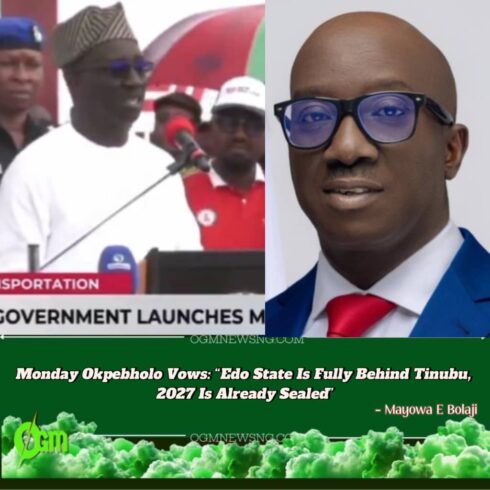
Edo State Governor, Monday Okpebholo, has stirred political controversy by declaring that coalitions and alliances are unnecessary ahead of the 2027 presidential elections, citing the sweeping impact of President Bola Ahmed Tinubu’s Renewed Hope Agenda. Speaking passionately at the unveiling of newly commissioned modern transit buses in Benin City, Okpebholo said, “His renewed hope agenda has transformed this country. What else do we need? We do not need all these coalitions.” The remarks, perceived as a direct jab at opposition blocs and internal party dissenters, have triggered sharp reactions from political observers and stakeholders.
Governor Okpebholo’s rejection of coalition politics has intensified the intra-party debate within the All Progressives Congress (APC) and beyond. Critics argue that such a unilateral stance risks alienating potential allies needed for broader national consensus, while supporters hail it as a bold affirmation of Tinubu’s performance and a clear commitment to loyalty. With rising economic concerns and growing civil discontent, the governor’s endorsement of a “go-it-alone” strategy could either solidify Tinubu’s base or fracture critical alliances.
2.5 Million Edo Votes Promised for Tinubu: “I’m Not Joking”
Governor Monday Okpebholo did not mince words when he emphatically claimed that 2.5 million votes from Edo State are already in the bag for Tinubu in 2027. “Come 2027, 2.5 million votes are guaranteed in Edo for President Tinubu. I’m not joking,” he declared, drawing applause from APC loyalists and eyebrows from opposition figures. The figure, however, has sparked skepticism, as Edo’s total registered voters hover around 2.3 million, raising questions about electoral credibility and political exaggeration.
Observers suggest that Okpebholo’s audacious claim might be aimed at demonstrating political strength and rallying the APC base in anticipation of a potentially turbulent 2027 electoral cycle. However, the governor’s confidence is seen by some as either prophetic or purely propagandist. Analysts warn that unless backed by solid grassroots mobilisation and performance metrics, such rhetoric could boomerang into political embarrassment.
Modern Buses, Modern Politics: The Launch That Sparked a Storm
The setting was meant to celebrate infrastructure, but it quickly morphed into a high-octane political rally. During the launch of a fleet of modern transit buses in Edo State, Governor Okpebholo pivoted from transportation upgrades to political declaration, seamlessly linking Tinubu’s national vision to local development. According to him, “This project is a child of Renewed Hope. Tinubu leads from the centre; we replicate in the states.”
The symbolic timing of the bus unveiling was not lost on many — it served as a stage to broadcast APC’s infrastructural footprint while indirectly campaigning for Tinubu’s 2027 re-election. By marrying governance deliverables with political endorsement, Okpebholo set a precedent for infrastructure-based campaigning, which may soon become a trend in APC strongholds.
Backlash from the Opposition: “Edo Is Not a Political ATM”
No sooner had Okpebholo made his bold assertions than a coalition of opposition voices—led by PDP chieftains and Labour Party surrogates—fired back, accusing the governor of treating the state as a political ATM for Tinubu. “Edo is not up for sale,” one PDP spokesperson declared, slamming the 2.5 million vote guarantee as a reckless and anti-democratic assertion that undermines voter autonomy.
Political analysts believe that Okpebholo’s comments may have reignited tribal and ideological fault lines, particularly in a state known for its oscillating loyalties. The narrative that Edo is automatically aligned with Tinubu’s re-election may backfire, potentially galvanizing a counter-movement focused on preserving Edo’s perceived political independence and defying federal imposition.
Inside APC: Strategic Move or Miscalculated Boast?
Within the ruling APC, reactions to Okpebholo’s speech remain mixed. While some insiders consider it a strategic masterstroke to bolster Tinubu’s dominance in the South-South region, others quietly worry it may over-promise and under-deliver. A party source who requested anonymity said, “It’s good to show strength, but you don’t tempt fate with unrealistic numbers.”
Political strategists argue that Okpebholo’s approach might have boxed APC into a tight corner, as failure to meet the projected votes could become ammunition for critics. Still, the governor’s fiery endorsement may serve as a signal to Tinubu’s inner circle that Edo is ready to play ball, provided federal incentives continue flowing into the state.
2027 Election: Early Campaign or Desperate Gamble?
Governor Monday Okpebholo’s declaration appears to be the unofficial launch of President Tinubu’s 2027 campaign in the South-South — over two years ahead of schedule. While the Independent National Electoral Commission (INEC) has warned against premature political campaigns, Okpebholo’s speech veered dangerously close to open canvassing, likely drawing scrutiny from watchdog groups and electoral monitors.
Ultimately, this could be a desperate gamble to remain relevant within the inner sanctum of Tinubu’s political dynasty or a calculated move to lead the South-South resurgence for APC. Either way, the governor’s words have lit a fire under Edo’s political terrain. Whether it burns bridges or forges new alliances remains to be seen, but one thing is clear — Okpebholo has made Edo State ground zero in the race to 2027.
Table of Contents
Discover more from OGM News NG
Subscribe to get the latest posts sent to your email.