




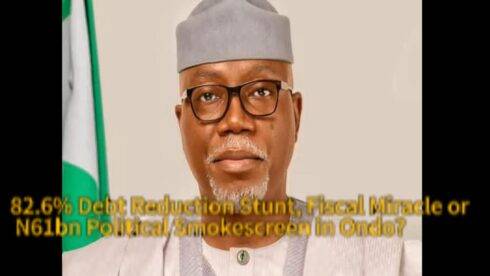
Governor Lucky Aiyedatiwa of Ondo State has declared an unprecedented 82.6% reduction in domestic debt within just one year—a development that has sparked both applause and suspicion among political analysts. According to the Debt Management Office (DMO), Ondo’s domestic debt dropped from N74 billion in 2023 to a mere N12 billion in 2024, signaling a dramatic shift in fiscal policy not commonly witnessed in sub-national governance.
Lucky Aiyedatiwa, through his Chief Press Secretary, Ebenezer Adeniyan, emphasized that this fiscal leap was achieved without sacrificing public services or the welfare of civil servants. This claim, however, has drawn mixed reactions, as some critics question the sustainability and transparency of the financial maneuvers used to reach this milestone.
Secrets Behind the Cut: Strategic Reforms or Political Optics?
Lucky Aiyedatiwa asserts that the debt reduction was driven by rigorous cost-control strategies and structural economic reforms. He credited a series of decisive financial policies—ranging from contract reviews to the elimination of bureaucratic waste—as key instruments that slashed domestic debt by N61 billion.
Yet, political observers are asking probing questions: What specific reforms were implemented? Were these strategies independently audited? Some analysts fear that this rapid decline may be a façade built on creative accounting rather than authentic economic transformation, demanding full disclosure of the state’s financial playbook.
Ondo’s Debt Miracle: Genuine Progress or a One-Time Windfall?
Lucky Aiyedatiwa’s administration proudly reported that in Q1 of 2024 alone, the domestic debt dropped by 77%, reducing the figure from N71.5 billion in December 2023 to N16.4 billion in March 2024. This puts Ondo just behind Jigawa State in national rankings for debt reduction—an achievement that seems almost miraculous amid national fiscal turbulence.
However, economic experts warn that such drastic cuts could stem from non-recurring inflows such as federal refunds, asset liquidations, or bailout funds rather than long-term revenue growth. If not properly substantiated, this “miracle” could collapse under scrutiny, especially with mounting demands for improved infrastructure and job creation.
Workers’ Welfare Untouched—Or Just Repackaged?
Governor Lucky Aiyedatiwa reassured Ondo State workers that the debt cutback has not compromised their entitlements. Backlogs of salaries, pensions, and gratuities are being cleared, he said, while public service operations continue seamlessly. This approach contrasts sharply with past administrations that often relied on austerity measures and workforce downsizing to reduce debt.
Nonetheless, insiders within the civil service allege delays in some salary adjustments and opaque distribution of gratuity payments. Critics argue that while public salaries may be flowing, capital expenditures in rural development and health infrastructure have slowed, suggesting a subtle shift in spending priorities masked under fiscal success headlines.
Investor Confidence or Political Theater?
Governor Lucky Aiyedatiwa claims that the fiscal rebound has rekindled investor confidence and restored public faith in government. According to him, the drastic debt reduction has made Ondo State a preferred destination for private sector engagement, with multiple firms reportedly eyeing partnerships in agriculture, tech, and energy.
Yet, as of now, no major Memorandum of Understanding (MoU) or foreign direct investment deal has been officially announced. Opposition voices argue that this investor narrative may be premature and politically motivated, intended to boost the governor’s image ahead of future electoral contests.
Lucky Aiyedatiwa’s Model of Fiscal Discipline: Blueprint or Bluff?
Lucky Aiyedatiwa touts his administration’s economic management as a model for other Nigerian states, stating that “Ondo stands out as a beacon of fiscal discipline and financial resilience.” His admirers have called for the replication of this governance style nationwide, praising the balance between fiscal responsibility and social obligations.
However, skeptics urge caution. Without independent audits and detailed budget performance reports, it remains unclear how deep or replicable this strategy truly is. The fear, some say, is that this may be less of a blueprint and more of a political bluff—clever in optics but thin on structural integrity.
Table of Contents
Discover more from OGM News NG
Subscribe to get the latest posts sent to your email.