









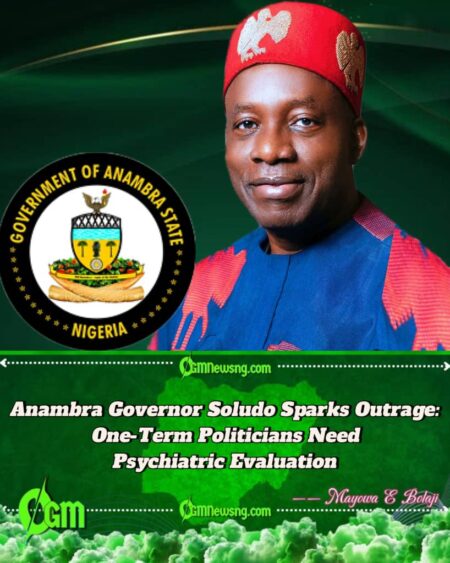
Chukwuma Soludo, Governor of Anambra State and a seasoned economist, has ignited a nationwide controversy after declaring that any politician who promises to serve only one term “must be sent to a psychiatric home.” He made the statement while addressing a gathering of political stakeholders, emphasizing that such a promise reveals a deeper “mental problem” and must not be entertained in serious democratic discourse.
Soludo’s assertion, laced with sarcasm and intellectual bravado, has stirred outrage across party lines. Critics argue that his language is demeaning, unbecoming of a public servant, and symptomatic of the growing arrogance in Nigeria’s political elite. However, Soludo maintains that the statement was a brutally honest commentary on the hypocrisy and self-deception in Nigeria’s political landscape.
The Governor’s Philosophical Take on Political Tenure
Chukwuma Soludo began his argument with what he described as a “reality check” on the dynamics of governance, arguing that any serious-minded reformer would understand that four years is barely enough to clean institutional rot, let alone deliver deep structural change. He insists that promising a single term is nothing more than “a deceitful strategy to curry public favour.”
Soludo further explained that nations in transition—especially fragile democracies like Nigeria—require leaders who are committed to long-term development blueprints. He argued that the one-term mantra has become a manipulative tool used by desperate aspirants who know they won’t be re-electable, branding them as “merchants of lies, not visionaries.”
Backlash from Civil Society and Opposition Parties
Soludo’s comments have drawn a sharp rebuke from several civil society organizations and opposition figures. Groups like SERAP and the Centre for Democratic Integrity issued statements condemning the governor’s choice of words and called for a public apology, citing it as an affront to democratic ideals and citizens’ intelligence.
Opposition politicians were even more scathing. A spokesperson for the Labour Party described Soludo’s remarks as “a symptom of a ruling-class syndrome—leaders who think their office gives them the right to insult the electorate.” They questioned whether Soludo himself would submit to psychiatric evaluation after his own tenure ends if he fails to deliver on his promises.
Defending the Indefensible or Speaking Unfiltered Truth?
Chukwuma Soludo defended his remarks during an interview on Arise TV, saying he wasn’t referring to anyone specifically but to the growing pattern of “performative humility” in Nigerian politics. He claimed that what the country needs is not populist gestures but bold, long-term governance untainted by political gimmicks.
Soludo argued that being honest about leadership intentions is not a flaw but a form of democratic integrity. “This country is too important to be handed over to experimental leaders,” he said, emphasizing that sustainable reforms demand continuity. Whether Nigerians buy into this justification, however, remains an open debate.
Ethical Questions: When Does Boldness Become Insult?
While some Nigerians applauded Soludo’s frankness, others are questioning the ethical boundaries of political rhetoric. Mental health advocates say the governor’s words could further stigmatize those living with psychiatric conditions, thereby reinforcing harmful stereotypes in a nation already struggling with mental health literacy.
Chukwuma Soludo, however, dismissed the criticism as “emotional blackmail,” stating that his analogy was rhetorical, not literal. Still, analysts warn that such utterances could contribute to a growing trend of dehumanizing political discourse—where opponents are not only debated but denigrated.
A Mirror to Nigeria’s Political Double Standards
Chukwuma Soludo’s statements have opened a Pandora’s box of political introspection. Many analysts believe his comments expose a deeper truth about the duplicity of political promises in Nigeria. Politicians often swear to serve for just one term to gain initial support, only to renege once in office—exposing a systemic culture of broken vows.
The controversy has now morphed into a litmus test for political transparency. While Soludo may have used explosive language, his underlying message resonates with voters tired of recycled pledges. Whether this will spark serious conversations on political accountability or fizzle out in media sensationalism remains to be seen.
Table of Contents
Discover more from OGM News NG
Subscribe to get the latest posts sent to your email.