









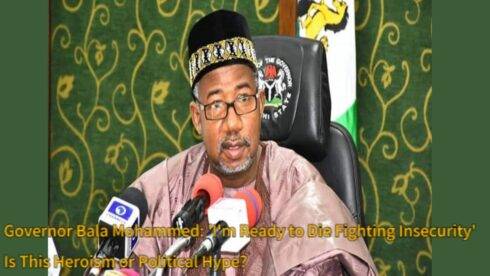
Governor Bala Mohammed of Bauchi State has made an emotionally charged declaration, pledging to lay down his life in the battle against deepening insecurity in Northern Nigeria. Speaking during a high-level stakeholders’ forum in Bauchi, the governor revealed that he is prepared to make the “ultimate sacrifice” to protect the lives and property of citizens under siege by armed bandits, kidnappers, and insurgents. This bold pronouncement has sparked fierce reactions across the political and civil spectrum.
Bala Mohammed stated that the bloodshed and impunity perpetrated by criminal elements had reached intolerable levels. “I am ready to die if it means restoring peace and protecting my people,” he said. While some hailed his courage, critics questioned whether such rhetoric is symbolic grandstanding or a genuine call to action. His statement is now a trending flashpoint in the national debate about the role of elected leaders in a failing security structure.
Controversy Erupts Over Symbolism vs. Strategic Governance
Bala Mohammed’s dramatic vow has drawn sharp criticism and concern from political analysts, civil society organizations, and opposition parties, who argue that emotion-laden pledges do not substitute for actionable policy. His opponents claim that the governor’s words, while passionate, lack the substance of a coherent security blueprint and may instead reflect desperation or an attempt to deflect from administrative shortcomings.
Others, however, defend the governor, suggesting that such declarations are necessary to inspire hope in a climate of despair. The controversy has reignited debate over the limits of performative leadership in a democratic setting. Does courage alone neutralize terrorists, or is this a distraction from failures in intelligence coordination, state policing, and community engagement?
Insecurity Deepens in Bauchi: The Data Paints a Grim Picture
Governor Bala Mohammed emphasized that the escalating insecurity is not just theoretical—it is deeply felt in rural communities where farming has become a life-threatening activity. According to recent statistics released by local authorities, there have been over 350 reported abductions in Bauchi in the first quarter of 2025 alone, a 63% spike compared to last year’s numbers.
Communities in Toro, Ningi, and Alkaleri LGAs continue to face daily threats from roving gangs and militant herders. Bala lamented the absence of federal reinforcements, stressing that state governors have been left to “fight lions with bare hands.” The data-driven narrative confirms that the crisis is not exaggerated, and stakeholders are now calling for immediate, decisive interventions.
Regional Implications: North-East Governors in Disarray
Bala Mohammed’s statement has also drawn attention to the fractured unity among governors in the North-East region. Although security challenges are shared across Adamawa, Gombe, Yobe, and Borno states, coordinated inter-state action remains elusive. Bala criticized the silence of some of his peers, whom he accused of prioritizing political survival over collective security.
Analysts point to a leadership vacuum among regional blocs, noting that the North-East Governors’ Forum has become “largely ceremonial.” Bala Mohammed’s impassioned vow may be an attempt to reignite regional solidarity, but the lack of institutional synergy continues to impede a unified front against the surging threats of terrorism and banditry.
Traditional Rulers and Vigilantes: The Rising People’s Army
Governor Bala Mohammed highlighted the invaluable role of local vigilante groups and traditional institutions in resisting criminal infiltration. According to him, local emirs, hunters, and vigilantes are now the “real frontline defenders” of the state, often risking their lives with minimal resources. This grassroots resistance is becoming a defining feature of Northern Nigeria’s evolving security architecture.
However, human rights observers warn that empowering informal armed groups without strict regulatory oversight could backfire. Bala defended his approach, asserting that when formal security forces are outnumbered or absent, communities have no choice but to defend themselves. The delicate balance between community empowerment and state control is now at the heart of the insecurity conversation.
Federal Government Response: Deafening Silence or Strategic Delay?
In his speech, Governor Bala Mohammed issued a thinly veiled rebuke of the federal government, accusing it of adopting a “wait-and-watch” attitude while states burn. He demanded that President Bola Tinubu initiate immediate high-level security deployments to critical zones in the North-East, as well as permit constitutional reforms to allow for state policing.
So far, there has been no official response from Aso Rock, sparking speculation that Abuja may be wary of endorsing Bala’s emotionally charged posture. Some believe the federal government is treading cautiously to avoid inflaming tensions or setting a precedent for other governors to make similar declarations. The absence of a firm reaction only deepens public unease and fuels growing calls for a nationwide state of emergency on security.
Table of Contents
Discover more from OGM News NG
Subscribe to get the latest posts sent to your email.