









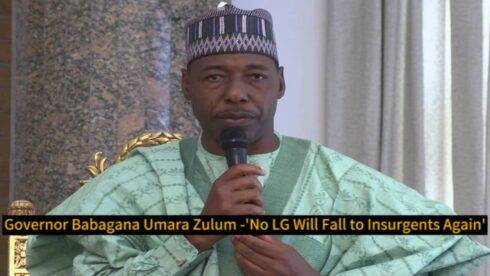
Governor Babagana Umara Zulum of Borno State vowed that not a single local government area will ever fall again to insurgents. Echoing the sentiments of a region scarred by over a decade of terrorism, Zulum declared, “With the support of the Nigerian Army and the armed forces, we will not allow a single local government to fall into the hands of the insurgents.”
This marks a bold turning point in the counterinsurgency strategy, as Borno’s governor, known for his courage and grassroots governance, positions himself not just as a political leader but as a wartime commander. His remarks come amid concerns of resurging terror cells in Sambisa Forest and Lake Chad fringes, pushing a narrative of unshakable resistance and military-backed stability.
Presidential Backing: Tinubu Endorses Umara Zulum’s Hardline Security Push
President Tinubu, according to insiders familiar with the closed-door conversation, expressed his full backing of Zulum’s intensified anti-insurgency campaign. Sources at the meeting confirmed that Tinubu promised increased logistical and intelligence support to the Borno State government, commending Zulum’s rare blend of pragmatic leadership and tactical resolve.
This presidential endorsement could serve as a crucial pivot for Nigeria’s North-East stabilization agenda. It sends a message to both international partners and terrorist factions alike: the federal government is not only alert but is now prepared to match resolve with reinforced action in Borno’s war-weary districts.
Military Collaboration Reinvigorated: Army Chiefs Rethink Theatre Strategy
Governor Umara Zulum’s renewed confidence rests on a reconfigured partnership with the Nigerian Army, Air Force, and allied security agencies. Following several collaborative operations in 2024 that reclaimed key outposts from Boko Haram and ISWAP fighters, the military is said to be redesigning its rules of engagement in Borno’s insurgency hotspots.
Top military officials hinted at a sweeping multi-phased operation set to launch across Marte, Kukawa, and parts of Gwoza, targeting sleeper cells and arms depots. Umara Zulum’s influence has extended beyond governance into strategic military diplomacy, helping to secure more boots on the ground and faster intelligence dissemination.
Civilian Resilience and Vigilante Groups as Security Frontliners
Umara Zulum emphasized the importance of integrating civilian joint task forces (CJTFs) and vigilante groups into the mainstream security blueprint. “These young men know the terrain better than satellite maps,” he stated. Their cooperation with federal troops has yielded substantial arrests and thwarted ambushes in rural wards.
These civilian allies, often overlooked in defense narratives, are emerging as the unsung heroes of Borno’s stabilizing landscape. Their bravery is rewriting the role of local actors in national security, making community-based intelligence the cornerstone of Zulum’s containment doctrine.
Insurgents Regrouping? Intelligence Points to Shifting Tactics
Despite the governor’s assurances, multiple intelligence briefings reveal that insurgents are morphing their tactics—shifting from territorial control to guerilla-style raids, soft-target attacks, and cyber-recruitment. Reports suggest an uptick in drone surveillance over Sambisa and Mandara Mountains, with encrypted communications traced to foreign terror financiers.
Umara Zulum’s camp admits the fight is far from over. However, they argue that Borno is better positioned than ever, both tactically and psychologically, to withstand and repel such evolution in extremist strategies. The new frontier isn’t just territorial—it’s digital, ideological, and decentralized.
Beyond Borno: Implications for Nigeria’s National Security Doctrine
Umara Zulum’s firm stance could catalyze a national shift in security policymaking, especially as governors across the North grapple with banditry, kidnapping, and rural terrorism. His call for constitutional reform that empowers governors with state-controlled security apparatuses has gained renewed attention.
As Nigeria edges closer to decentralizing its security framework, Borno’s blueprint may become the template for adaptive counterterrorism. With Zulum leading the charge and Abuja offering federal cover, the insurgents’ dream of reclaiming local governments may now face its final burial.
Table of Contents
Discover more from OGM News NG
Subscribe to get the latest posts sent to your email.